Best Educational Wooden Toys for Children: Safe, Fun Learning
This article highlights top educational wooden toys that support early learning in colors, shapes, numbers, and fine motor skills. Each pick combines durable craftsmanship with kid-friendly design, helping little learners explore and grow through hands-on play. Below you’ll find five well-rounded options, along with key features and practical buying considerations to guide your choice for a constructive learning environment at home or on the go.
| Product | Brand | Key Benefit |
|---|---|---|
| Toddlers Montessori Wooden Educational Toys for Baby Boys Girls | KMTJT | Shape sorting, color and fruit recognition, fine motor practice |
| CozyBomB Montessori Educational Wooden Toys | CozyBomB | Color sorting, counting, stacking for early math |
| PEBIRA Montessori Toys for 1 to 3-Year-Olds | PEBIRA | Color, shape, and number differentiation, travel-friendly |
| GeroCrew Wooden Montessori Toys | GeroCrew | Self-guided number matching and independent play |
| Magnetic Wooden Fishing Game | NASHRIO | Alphabet and number recognition through interactive fishing |
Toddlers Montessori Shape Sorting Toys

These Montessori-grade wooden toys are designed for 1- to 3-year-olds, featuring 12 fruit blocks, 8 carrots, 10 worms, and a five-sided cart with various shapes. The set uses large particle wood, polished edges, and non-toxic water-based paint to ensure safe play. The design supports imaginative and practical learning, encouraging children to recognize shapes and colors while engaging in hands-on exploration.
The toy offers varied play methods such as shape sorting, fruit recognition, and matching, promoting color awareness, problem-solving, and early cognitive development. With multiple play channels, caregivers can transition from simple matching tasks to more complex sorting activities as a child’s skills grow, maintaining engagement over time.
Fine motor skills receive focused attention through the shape-sort mechanics and the precise handling of blocks and pieces. The product’s robust construction also makes it suitable for repeated use in early learning environments, minimizing wear while maximizing educational value.
CozyBomB Montessori Educational Toys for Toddlers

This 3-in-1 wooden set blends counting, shape sorting, and color recognition into a single, engaging activity. Targets toddlers and preschoolers aged 3 to 5 years, helping develop hand-eye coordination, color differentiation, and early math concepts in a playful format. The wooden pieces encourage tactile learning and sustained focus away from screens.
Educators and parents alike can appreciate its versatility: sorting shapes, counting pieces, and stacking blocks all promote cognitive flexibility and creative thinking. The toy also serves as a practical gift choice for birthdays and holidays, with enduring appeal across multiple developmental stages as children grow and their learning goals evolve.
PEBIRA Montessori Sorting & Stacking Toy

The PEBIRA wooden puzzle focuses on color and shape differentiation with 20 pieces, including blocks of five colors and five geometric shapes. Children can sort by color, shape, or the number of holes for pegs, supporting early geometry, color recognition, and spatial awareness. Its toddler-friendly design and smooth edges make it a practical choice for daily use at home or during travel.
As a gift, the toy appeals to two- to four-year-olds, encouraging independent play and problem-solving while building fine motor control. The bright colors and varied shapes stimulate curiosity and sustained engagement, essential for early education in a home environment.
GeroCrew Wooden Montessori Puzzles

GeroCrew offers self-guided wooden puzzles designed to strengthen number sense and math readiness. The set emphasizes independent learning, with each piece fitting only one matching location, challenging children to think critically as they complete number-related tasks. The approach aims to foster problem-solving, early arithmetic, and confidence in self-directed play.
Parents can expect a blend of cognitive challenge and engaging playtime, supporting a move from guided to more autonomous learning. The absence of screens aligns with healthy screen-time guidelines while delivering meaningful educational content that reinforces classroom-ready math skills.
NASHRIO Magnetic Fishing Game
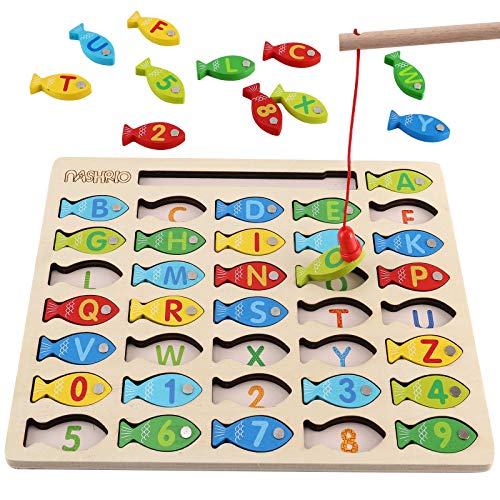
This magnetic fishing game combines alphabet and number recognition with a tactile fishing activity. The wooden board includes various fish pieces colored and labeled with letters and numbers, and a magnetic fishing pole encourages interactive play. It supports early literacy and numeracy in a compact, durable design suitable for travel and classroom use.
Crafted from polished wood with non-toxic, water-based paint, the toy emphasizes safety and durability. The open-ended nature of the game allows children to explore different fishing strategies, fostering focus, coordination, and a basic understanding of letters and quantities without relying on electronic devices.
Buying Guide
When selecting educational wooden toys for young children, consider the following factors to ensure quality, safety, and educational value:
- Age appropriateness: Choose sets designed for your child’s current developmental stage, with clear activity paths and scalable challenges as skills progress.
- Material and finish: Look for Beech, hardwood, or solid wood with non-toxic finishes. Smooth edges and rounded corners reduce injury risk for toddlers.
- Durability and size: Pieces should be large enough to avoid choking hazards and able to withstand frequent handling and dropping during early play.
- Educational focus: Decide which skills to emphasize—color recognition, shape sorting, number sense, or fine motor development—and select toys with clear, relevant activities.
- Storage and portability: For travel-friendly options, prioritize compact sets with easy-to-store containers or sturdy bins.
- Safety certifications: Check for child-safe labels, water-based paints, and adherence to safety standards to minimize exposure to toxins.
- Cleaning and maintenance: Choose surfaces that are easy to wipe down and sanitize after play sessions, especially for shared toys in classrooms or daycare.
- Value and longevity: Favor timeless designs that offer multiple play modes and extending learning opportunities as children grow.
Comparing sets on these dimensions helps balance immediate educational impact with long-term usability. For households seeking a versatile, calm learning environment, a mix of sorting, counting, and memory-based games can cover a broad range of early academic foundations. Consider pairing a few core puzzles with supplementary activities to sustain engagement across weeks and months.