Best Educational Robots for 5-Year-Olds: Inspiring STEM Play and Creativity
Discover top educational robots that fit a 5-year-old’s curious mind. These picks emphasize hands-on learning, motor skills, early coding concepts, and creative exploration. Each item below is evaluated for age appropriateness, safety, and how effectively it builds foundational STEM understanding through play.
| Product | Key Feature | Why It Matters |
|---|---|---|
| Ruko 6088 Programmable Robot | Gesture sensing, infrared remote control | Introduces simple programming and motion control |
| GWYUI Interactive Drawing Robot | Camera recognition, 150 drawing cards | Combines art with basic pattern recognition and guidance |
| 10 in 1 Electric STEM Toys | 10 models, 109 pieces, step-by-step guides | Broad hands-on engineering and problem solving |
| TEMI Magnet Robot Toy | Magnet monsters and stacking play | Encourages spatial reasoning and imagination |
| HOLIBIBE Drawing Robot | 150 cards, voice guidance, 12 color markers | Montessori-inspired learning with guided practice |
Ruko 6088 Programmable Robot

The Ruko 6088 is designed for younger children with gesture sensing and a simple infrared remote. It supports up to 50 motion combinations, enabling kids to experiment with movement and sequencing. A one-key demo showcases dance and music routines, offering an engaging entry point to basic programming concepts and cause-and-effect play. The remote control and gesture features foster interactive learning while keeping play intuitive and age-appropriate for ages 3-6.
GWYUI Interactive Drawing Robot

This drawing robot adds an educational twist with camera-based pattern recognition and voice-guided instructions. It offers Montessori-inspired activities that nurture independent thinking, hand-eye coordination, and logical reasoning. With 150 drawing cards spanning multiple themes, children explore shape recognition, vocabulary, and creative expression while following guided steps. It’s a solid choice for 3- to 8-year-olds who enjoy art-rich STEM play and guided discovery.
10 in 1 Electric STEM Toys

This versatile kit delivers 109 pieces that build into 10 different traditional and robotic models, including bulldozers, planes, and cars. An included step-by-step guide keeps kids on track, while the electric power feature adds excitement and enhances fine motor skills as children assemble and disassemble parts. Suitable for curious 5- to 9-year-olds, it supports collaborative play and guided exploration of engineering concepts.
TEMI Magnet Robot Toy

The TEMI magnet robot set focuses on magnetic play to form multiple monsters and shapes. Its kid-friendly size and simple, hands-on assembly help develop spatial awareness and fine motor skills. The open-ended nature encourages children to experiment with different configurations, supporting creativity and early engineering thinking without requiring advanced instructions.
HOLIBIBE Drawing Robot
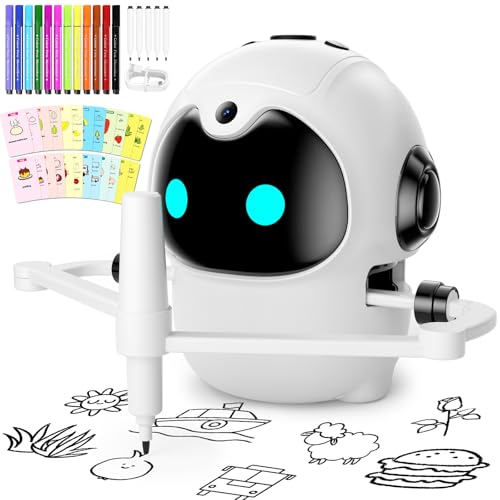
HOLIBIBE blends Montessori-inspired learning with guided art, offering 150 drawing cards and 12 color markers. A guiding voice and calming music support concentration and motivation, helping children build confidence, creativity, and hand-eye coordination. The thematic cards foster recognition skills and expand vocabulary while keeping activities structured and engaging for 3- to 8-year-olds.
Buying Guide: Key Purchase Considerations
- Age appropriateness: Check recommended age ranges to ensure the robot aligns with a child’s developmental stage and safety needs.
- Learning focus: Determine whether you want early coding and sequencing (Ruko), creative drawing and pattern recognition (GWYUI, HOLIBIBE), broad STEM exploration (10 in 1 STEM Toys), or magnet-based spatial play (TEMI).
- Hands-on vs. guided learning: Some kits emphasize open-ended building, while others provide step-by-step guidance or cards to structure activities.
- Motor skills development: Look for toys that improve fine motor control through snapping, turning screws, or manipulating components.
- Safety and materials: Prefer sturdy, non-toxic plastics or wood, with age-appropriate small parts and no sharp edges for younger users.
- Expandability: Consider whether the product can be augmented with additional sets or cards to extend learning over time.
- Power and maintenance: Note battery type, charging needs, and whether components require frequent replacement or simple upkeep.
- Value in learning outcomes: Balance creativity, problem solving, and foundational STEM concepts when choosing among options.