Best Dog Toys for Food: Interactive Puzzle Feeders for Smart Feeding
The right food-focused dog toys merge mental stimulation with slow, mindful eating. Below are five top picks that blend treat dispensing with problem-solving to keep dogs engaged, reduce boredom, and promote healthier eating habits. Each option comes from trusted brands and offers varying levels of challenge to suit puppies through adult dogs.
| Product | Brand | Key Benefit | Best For |
|---|---|---|---|
| DR CATCH Dog Puzzle (Blue) | DR CATCH | Interactive food discovery and slow feeding | Small to medium dogs |
| DR CATCH Dog Puzzles (Pink) | DR CATCH | Hands-on treat sliding for IQ and enrichment | Puppies to small dogs |
| BoYoYo Interactive Dog Puzzle | BoYoYo | Adjustable food distribution; quiet rolling | Medium to large dogs |
| Outward Hound Nina Ottosson Dog Brick | Outward Hound | Multi-level treat puzzle for problem solving | All skill levels |
| Potaroma Dog Puzzle Toy (2 Levels) | Potaroma | Two-stage puzzle with slow-feeder potential | All sizes |
DR CATCH Dog Puzzle (Blue)

The DR CATCH blue puzzle toy combines mental challenge with a slow-feeding mechanism. It is sized at about 9.44 by 9.44 inches with a shallow height, making it suitable for cats, puppies, and small dogs. The design prompts dogs to slide panels to uncover hidden treats, thereby encouraging problem-solving and gentle chewing. The slow-feed feature helps regulate eating pace, which supports digestion and prevents gulping. This toy can become a reliable daily activity for households seeking enrichment and better feeding routines.
- Size: L9.44″ × W9.44″ × H1.14″
- Interactive design encourages treat discovery
- Slow feeder to aid digestion and extend meal time
DR CATCH Dog Puzzles (Pink)

DR CATCH’s pink version mirrors the blue model with a similar size and sliding-part mechanism that reveals treats as dogs move pieces. It is described as an interactive toy that can become a beloved companion for puppies and small dogs, providing both enrichment and pressure relief. The pink variant emphasizes easy manipulation and consistent reward opportunities, making it a practical choice for households prioritizing IQ training alongside slow feeding.
- Size: L9.44″ × W9.44″ × H1.14″
- Interactive treat discovery promotes cognitive engagement
- Slow-feeding capability supports digestion
BoYoYo Interactive Dog Puzzle

BoYoYo offers a treat-dispensing puzzle designed to keep dogs engaged over extended play sessions. Built with ABS and nylon, it stands up to regular use while minimizing noise through a rubber-roller design. The toy includes two adjustable food-distribution switches to tailor the challenge and a spiral structure that increases difficulty as dogs learn. Ideal for dogs that enjoy problem-solving, this toy supports mental stimulation, reduces boredom, and can serve as a long-lasting enrichment tool under supervision.
- Two adjustable switches for portion control
- Spiral design adds challenge and engagement
- Durable materials with lower noise during play
Outward Hound Nina Ottosson Dog Brick

Dog Brick by Nina Ottosson is a versatile puzzle that challenges dogs at multiple levels. It features three types of openings and hidden compartments, enabling owners to raise difficulty as a dog becomes more proficient. This level-two to level-three style puzzle supports problem-solving, memory, and timing. It is suitable for dogs of various ages and breeds, providing a structured mental workout that pairs well with supervised treat dispensing to promote mindful eating.
- Level 2 Intermediate design with adjustable difficulty
- Three-in-one puzzle elements for varied challenges
- Encourages problem-solving and interactive play
Potaroma Dog Puzzle Toy (2 Levels)
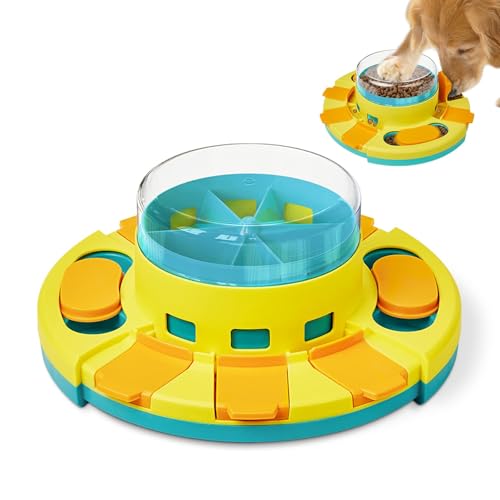
Potaroma’s two-level puzzle combines a base chamber and a top compartment, offering a progressive challenge. Level 1 introduces easy treat rewards, while Level 2 adds more complexity by requiring the dog to activate the top lid to dispense treats into the base. The large-capacity granary reduces frequent refills, and included non-slip mats and a weighted base help prevent tipping during play. This design suits a wide range of dog sizes and feeding habits, promoting slower eating and extended engagement.
- Two levels of puzzle complexity
- Slow-feeder features with a large capacity
- Non-slip base for stability during use
Buying Guide: Key Considerations For Choosing Food-Dispensing Toys
-
<liDog size and chew style: Select puzzles sized for your dog’s breed and strength. For aggressive chewers, prioritize durable materials and solid construction. For small dogs, look for smaller, simpler puzzles to prevent frustration.
<liDifficulty progression: Opt for toys that offer adjustable levels or tilts toward higher challenge as your dog learns. This sustains long-term engagement and prevents boredom.
<liFood compatibility: Check whether the toy accommodates different kibble sizes or treats. Some models include adjustable distribution to tailor feeding pace.
<liSupervision and safety: Always supervise initial use to ensure dogs don’t chew or dismantle parts. Choose designs with secure lids and non-toxic materials.
<liMaintenance: Consider ease of cleaning. Dishwasher-safe parts or simple hand-wash designs save time and improve hygiene.
<liMental vs. physical load: Some toys emphasize cognitive problem-solving, others rely on slow-feeding mechanics. A balanced setup can address both needs.
<liNoise and storage: If rolling or sliding mechanisms create noise, look for rubberized components or smoother gears to minimize disruption in a household setting.
<liDietary goals: For dogs needing slower eating, prioritize slow feeder functionality. For enrichment-focused play, prioritize puzzle difficulty and treat-dispensing features.
Across these options, the common thread is enrichment that ties mental challenge to food rewards. When introducing any new feeding toy, start with easy tasks and gradually increase difficulty to align with your dog’s cognitive pace. Regular rotation of toys can further extend interest and prevent routine fatigue, helping dogs stay engaged during meal times and treat sessions alike.