Best Counting Toys for 3 Year Olds: Top Educational Toys for Early Math
Choosing the right counting toys helps 3-year-olds build foundational math skills through play. The following five products combine manipulatives, color sorting, measurement, and imaginative play to support early numeracy, number recognition, and fine motor development. Each item emphasizes hands-on exploration, clear visual cues, and safe, durable design for preschool learners.
| Product | Brand | Key Benefit | Ideal For |
|---|---|---|---|
| MOTREE Preschool Learning Toys | MOTREE | Counting with 13 number blocks and 8 flash cards | 4-year-olds starting math basics |
| Kaodezhu Dinosaur Math Balance | Kaodezhu | Balance-based math practice and letter/number recognition | Kids developing measurement concepts |
| TOP BRIGHT Balance Math Game | TOP BRIGHT | Hands-on balance activities for counting and number sense | Kindergarten readiness |
| Magnetic Wooden Fishing Game | NASHRIO | Letter and number recognition through fishing play | Alphabet and early math foundations |
| Oomloid Counting Animals Montessori Toys | Oomloid | Counting, sorting bowls, and tweezers for fine motor skills | Color sorting and basic counting |
These five selections cover a spectrum of activities—from number blocks and balance scales to fishing games and animal sorting—ensuring varied, engaging experiences that support multiple facets of early math learning. Each product leverages Montessori-inspired or playful learning principles to encourage independent exploration and guided play.
MOTREE Preschool Learning Toys For Toddlers

MOTREE’s math manipulatives provide a tangible path to number sense. The set includes a wooden finger board, 13 colorful number blocks, 8 flash cards, and a convenient holder. Designed to support counting, addition, and subtraction within 10, these tools help children visualize numerical relationships. The Montessori-inspired approach encourages hands-on exploration, enabling toddlers to connect quantities with symbols while developing fine motor skills through precise block handling. This toy set is suitable for preschoolers and early-kindergarten learners seeking a tactile math introduction.
Kaodezhu Dinosaur Math Balance

Kaodezhu’s Dino balance toy combines color-coded weights and dinosaur-themed pieces to teach balance, weight comparison, and counting. Children place numbers and weights on each side to achieve balance, reinforcing concepts of equality, measurement, and basic arithmetic. The included cards and grooves help with visual recognition of numbers and letters, while the physical act of balancing supports fine motor development and hand-eye coordination. This is a multifaceted tool suited for interactive family learning or classroom activities for 3–7-year-olds.
TOP BRIGHT Balance Math Game

This TOP BRIGHT set centers on a cake-shop theme that uses color sorting and balanced counting. The model demonstrates how adding or subtracting pieces affects the balance, turning abstract equations into concrete actions. Kids can simulate purchases with pretend money, aiding early financial literacy alongside math skills. The design promotes independent play and problem-solving, aligning with Montessori-inspired methods that emphasize hands-on exploration and self-directed learning. A colorful, engaging option for early math practice.
Magnetic Wooden Fishing Game
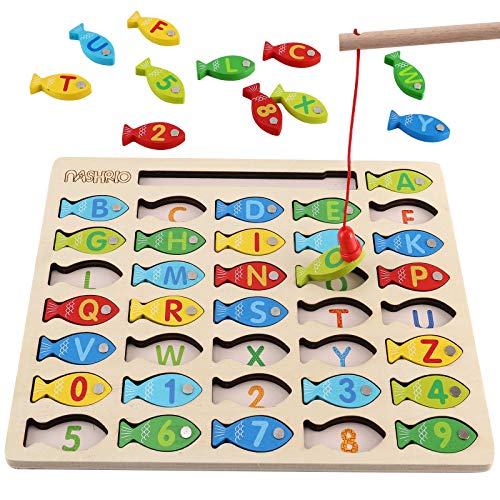
Magnetic fishing games introduce letters and numbers in an interactive fishing experience. Children use a magnetic rod to catch fish that bear letters or numbers, supporting early literacy and numeracy recognition. The wooden construction and non-toxic finishes ensure safety and durability for repeated play. As kids sort by color and identify symbols, they build memory, focus, and manual dexterity. This toy offers steady, guided learning opportunities suitable for home or preschool settings.
Oomloid Counting Animals Montessori

Oomloid Counting Animals brings together counting, sorting, and fine motor activities in a compact Montessori-style set. It includes 36 multi-colored animals, sorting bowls, and tweezers, enabling kids to practice counting, color matching, and categorization. The tactile experience of using tweezers to transfer pieces helps build hand strength and precision. This kit is well-suited for homeschooling, classroom centers, or family playtime focused on early math readiness and cognitive development.
Buying Guide
- Learning objectives: Look for toys that build number recognition, counting, and simple arithmetic (addition/subtraction) through hands-on manipulation and visual cues.
- Materials and safety: Favor wood or durable plastics with non-toxic finishes. Ensure edges are smooth and parts are age-appropriate to minimize choking hazards for 3-year-olds.
- Montessori alignment: Toys that encourage self-directed exploration, concentration, and problem-solving support independent learning and intrinsic motivation.
- Durability and age range: Choose items designed for preschoolers with pieces that withstand frequent play and potential rough handling.
- Versatility: Items that scale with skill level—from basic counting to introducing balance, sorting, and early algebra concepts—provide longer use.
- Play style balance: Include both solitary and cooperative play options to support different learning contexts, including parent-guided sessions and classroom activities.
- Storage and organization: Look for sets with organizers or trays to help children develop tidy habits and ease of clean-up.
When selecting counting toys for a 3-year-old, prioritize those that turn counting into a meaningful, visible activity. The best options combine visual counting blocks, balance mechanisms, and engaging themes (dinosaurs, animals, or fish) to sustain curiosity while reinforcing early math concepts. Each recommended product provides multiple pathways to learn: counting quantities, recognizing numerals, basic addition and subtraction, color sorting, and fine motor development. By balancing structured learning with imaginative play, children can build confidence in math-ready skills that prepare them for kindergarten and beyond.