Best Blocks for 18 Month Old: Top Safe, Educational Picks for Growing Minds
Choosing the right blocks for a toddler around 18 months helps build fine motor skills, spatial awareness, creativity, and early problem-solving. The right set should be large enough to handle safely, with soft textures or smooth wood and bright colors to engage a curious preschooler. Below, you’ll find five strong options that balance safety, open-ended play, and developmental value. Each product includes a quick look at key features to help caregivers compare at a glance.
| Product | Brand | Key Benefit |
|---|---|---|
| 78 Pcs Top STEM Soft Building Block Sets | chenxuanbro | Bright, large-particle blocks designed for early imagination and parent-child interaction |
| Large Particle Soft Building Block Toys (81P) | chenxuanbro | Soft, safe blocks with a pull-along handcart to encourage sharing and group play |
| PEBIRA Montessori Toys 20 Pcs | PEBIRA | Colorful shape sorter with wooden base for early geometry recognition |
| Hieoby Montessori 30Pcs | Hieoby | Colorful stacking blocks with guided designs for logic and creativity |
| QUOKKA 35 Alphabet Wooden Blocks | QUOKKA | Alphabet and peg-board style learning with big, grip-friendly pieces |
78 Pcs Top STEM Soft Building Block Sets

The 78-piece set targets early color recognition and sequencing while keeping safety at the forefront. Blocks are large, soft, and bendable for gentle play, reducing choking risks and enhancing tactile exploration. The materials and design support cooperative parent-child sessions, where caregivers guide sorting, stacking, and role-play scenarios. Aimed at ages 18 months and up, this option specifically appeals to households seeking interactive, educational building experiences that evolve with the child’s growing abilities.
Large Particle Soft Building Block Toys With Cart

This set emphasizes versatility with a handcart for movement and transport, supporting early motor planning and shared play experiences. The large, soft blocks are crafted to be safe for little hands and forgiving during construction, which helps sustain attention and encourages trial-and-error learning. The included storage options promote organization and reduce clutter, a helpful feature for busy households and preschool settings where kids frequently switch activities.
PEBIRA Montessori Shape Sorter Blocks

Designed with early Montessori principles in mind, this 20-piece wooden set blends color, shape, and number recognition into open-ended play. The blocks are finished with food-safe paint, ensuring a durable, non-toxic surface that resists fading. Rounded edges protect little hands, and the compact size makes the set easy to transport for travel or visits. The attention to detail supports toddlers as they explore categorization, matching, and basic geometry through hands-on manipulation.
Hieoby Montessori 30Pcs Stacking Blocks
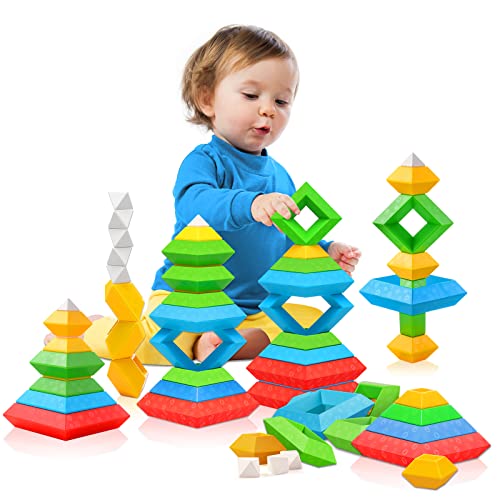
With 30 blocks in bright colors and multiple shapes, this set invites toddlers to explore more than 60 possible designs. The accompanying guideline promotes logical thinking while younger children enjoy simple stacking, and older toddlers can expand into more elaborate structures. The included non-woven storage bag helps travelers transport the set, reinforcing a habit of tidying up after play and encouraging consistent practice of fine motor coordination, color and shape recognition, and early problem-solving skills.
QUOKKA Alphabet Wooden Blocks

This set emphasizes literacy-oriented play with 35 wooden alphabet blocks featuring animals and words. The design fosters early letter recognition and simple word-building activities, which align well with foundational pre-reading goals. The large, easy-to-hold pieces suit toddlers in the 12-24 month range and older preschoolers who enjoy matching and memory challenges. The sturdy peg-board concept encourages fine motor development and persistent exploration of language concepts through tactile interaction.
KOIEMAY Magnetic Blocks 30 Pcs

This set uses large magnetic blocks designed for collaborative play and early STEM exposure. The magnetic connectors support quick, satisfying construction results that boost a child’s confidence and willingness to experiment with different shapes. The blocks are built from ABS plastic with smooth, rounded edges to minimize risk of injury. Strong magnets help stabilize structures, encouraging toddlers to reimagine configurations and practice turn-taking with peers or caregivers.
Buying Guide: Key Considerations For 18 Month Olds
- Safety and age suitability: Prioritize large, chunky pieces without small parts. Look for non-toxic finishes, rounded edges, and certifications (ASTM, CPSIA) when possible.
- Material and texture: Soft, bendable blocks reduce injury risk and are gentle on busy hands; wooden blocks support durable, long-term learning experiences but may require supervision for small shapes.
- Developmental focus: Choose sets that promote fine motor skills, hand-eye coordination, color and shape recognition, and early problem-solving. Open-ended play supports creativity and social skills.
- Maintenance and storage: Sets with easy-to-clean surfaces and included storage solutions help sustain a tidy play area and encourage consistent use.
- Portability and versatility: Consider travel-friendly options or storage bags to facilitate play in different environments, such as living rooms, daycares, or on-the-go.
- Future-proof value: For mixed-age households, select sets that expand in complexity as the child grows, enabling continued engagement beyond 18 months.
How To Use Blocks For Maximum Benefit
- Supervised exploration: Initially guide your child through simple stacking and matching tasks to model safe handling and turn-taking.
- Color and shape games: Use blocks to name colors and shapes, gradually introducing new concepts as the child becomes more proficient.
- Storytelling moments: Build simple houses, vehicles, or animals and narrate short stories to build language and imagination.
- Collaborative play: Encourage siblings or caregivers to join in; shared tasks improve social interaction and cooperative problem-solving.
- Progressive challenges: Introduce more complex builds or limited-time goals as skills advance, keeping play engaging without frustration.