Best Anatomy Toys for 5 Year Olds: Hands-on Human Body Play and Learning
Discover engaging, age-appropriate anatomy toys that help 5-year-olds explore the human body through hands-on activities. The following selections combine tactile learning, STEM concepts, and safe designs to support early science curiosity, fine motor skills, and language development during homeschool or classroom play.
Summary of chosen products:
| Product | Highlights |
|---|---|
| Melissa & Doug Magnetic Human Body Anatomy Play Set | Magnetic pieces, storage tray, educational guide |
| Kidzlane My Body Puzzle | Five-layer wooden anatomy puzzle, durable |
| June Garden Little Patient Lucas Plush Anatomy Doll | Removable organs, interactive learning |
| NUHICO This Is Me! Felt Anatomy Set | 30 detachable organs and bones, large scale |
| QUOKKA Fully Assembled Busy Book | Nearly 200 elements, 15 themes, engaging |
Melissa & Doug Magnetic Human Body Anatomy Play Set

This set provides a wooden magnetic figure and anatomically correct magnets that help kids visualize the body’s systems and organs. A wooden stand and 24 magnetic pieces enable hands-on exploration of the head, shoulders, knees, and toes. An accompanying guide highlights organs and body parts, supporting structured learning. The magnetic design allows easy assembly and reconfiguration as children test different anatomical connections, fostering memory and verbal description skills without screens.
Kidzlane Boy Wooden My Body Puzzle

This 29-piece wooden puzzle teaches multiple body systems across five layers: skeletal, muscular, respiratory, and digestive. The puzzle encourages problem-solving, fine motor skills, and holistic understanding of how the body works. Thick, rounded-edged pieces are designed for safe handling by small hands, and the layered approach lets children build knowledge progressively while staying engaged with tactile play.
June Garden Little Patient Lucas Plush Anatomy Doll
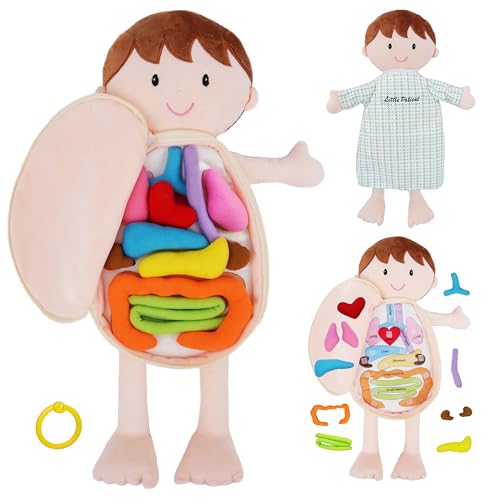
This plush anatomy doll offers an interactive learning experience with removable organs that Velcro into place. The nine soft organs—heart, lungs, liver, stomach, kidneys, trachea, esophagus, small intestine, and large intestine—provide a tactile way to identify organs and discuss basic anatomy. Zipping the doll’s belly and dressing mechanics support fine motor skills, sequencing, and language development as children describe functions and placement.
NUHICO This Is Me! Felt Anatomy Set

This extra-large felt anatomy set includes 30 detachable organs and bones, designed to be engaging and highly visible for learners ages 3–9. The oversized pieces provide a clear view of organ placement and relationships, while Velcro connections allow repeated assembly and disassembly. The size and soft materials make it suitable for group activities, classroom demonstrations, or focused individual play, encouraging exploration of human biology in a non-intimidating way.
QUOKKA Large Busy Book: Fully Assembled Anatomy Activities

QUOKKA’s ready-to-use busy book features nearly 200 pre-attached elements across 15 themes focused on the human body, brain, senses, skin, teeth, bones, and more. This fully assembled set reduces setup time and keeps kids engaged through interactive, story-like activities. The hook-and-loop closures support hands-on play that reinforces memory, observation, and language as children describe what they see and do. It’s designed for independent exploration or guided teacher-led sessions.
Buying Guide
Key considerations when selecting anatomy toys for five-year-olds include safety, age-appropriateness, and the balance between open-ended exploration and instructional content.
- Safety and durability: Look for non-toxic materials, rounded edges, and sturdy construction to withstand active play and rough handling common at this age.
- Hands-on learning vs. guided content: Toys with removable organs or layered puzzles encourage exploration, while magnetic sets and guides provide structured learning and vocabulary development.
- Motor skills development: Fine motor tasks like placing magnets, Velcro joints, zipping components, or assembling puzzle pieces support dexterity and coordination.
- Visual clarity and scale: Oversized organs and clearly labeled parts help children understand spatial relationships within the body.
- Ease of use in group settings: Larger pieces, simple assembly, and clear instructions help teachers and parents manage small groups effectively.
- Maintenance and longevity: Durable wooden or felt pieces endure frequent handling and multiple learning cycles, offering long-term value.
When comparing options, consider a mix of sensory engagement (soft dolls, felt parts) and cognitive depth (multi-layer puzzles, magnetic anatomy). For a well-rounded approach, combining a tactile plush with a larger, scaffolded activity set can accommodate diverse learning styles and attention spans within a classroom or home environment. Finally, align your choice with the child’s current interests—bones, organs, or how the body moves—to maximize engagement and educational impact.