Best Building Sets for 11 Year Olds: Top STEM Kits and Car Projects
Finding engaging building sets for curious 11-year-olds can boost problem-solving, creativity, and hands-on skills. The following five kits offer STEM-focused challenges, durable parts, and clear instructions to keep kids motivated. Each product below is chosen for its age-appropriate complexity, educational value, and ability to grow with a child’s developing interests in science, engineering, and technology.
| Product | Brand | Key Feature |
|---|---|---|
| Lucky Doug Solar Power Kits | Lucky Doug | 12-in-1 solar robot kits and renewable energy learning |
| LEGO Speed Champions Ferrari SF-24 F1 | LEGO | Authentic F1 details with play and display options |
| Opmind 5 in 1 STEM Building Kit | Opmind | Five models in one set with dual-motor power |
| LILCRUIBAO 258-Piece Airplane Model | LILCRUIBAO | Metal construction with detailed assembly |
| Lucky Doug STEM Building Projects Model Truck | Lucky Doug | Heavy-duty parts with a durable metal build |
Lucky Doug Solar Power Kits
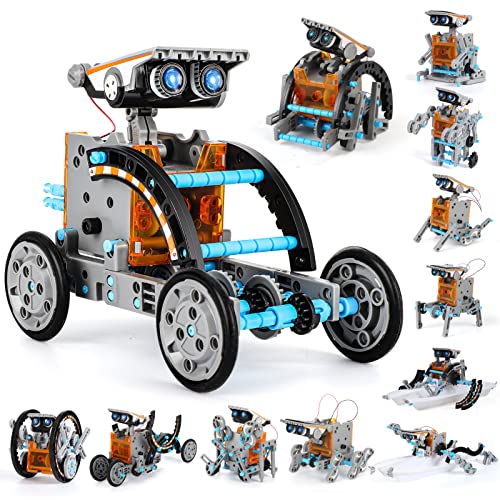
With 12-in-1 configurations, this solar-powered kit encourages experimentation and iterative learning. Children can build a variety of land, water, and moving robots using solar energy, which helps illustrate renewable technology concepts. The parts are designed for disassembly after each build, enabling multiple projects from a single set. Clear instructions guide independent assembly, while the solar focus emphasizes environmental awareness and practical science applications. The bundle includes compatible pieces and components to foster ongoing exploration in STEM disciplines.
LEGO Speed Champions Ferrari SF-24 F1 Race Car

LEGO’s Speed Champions set captures authentic Formula 1 styling with a minifigure driver and detailed design elements inspired by modern F1 racing. Although positioned for ages 10+, the complex build provides a satisfying challenge for 11-year-olds who enjoy vehicles and engineering. It offers both display-worthy aesthetics and imaginative play, letting youths reenact race scenarios or create showcase pieces. The kit’s modular parts enable customization and future LEGO adventures, extending its appeal beyond a single project.
LILCRUIBAO Airplane Model Kit

This 258-piece metal airplane model offers a robust building experience with durable parts designed to withstand careful assembly. The kit includes clear, step-by-step instructions to guide independent or collaborative builds. Children learn about aircraft mechanics as they align components, bend soft iron parts, and assemble a functioning model. The finished project serves as a detailed display piece that can inspire future aviation-focused STEM exploration and critical thinking skills.
Lucky Doug STEM Building Projects Model Truck

This model truck set features a hefty metal build with 391 parts, including nuts, bolts, a screwdriver, and a wrench. It emphasizes hands-on STEM learning, guiding children through a roughly five-hour assembly process that strengthens fine motor skills, sequence planning, and problem-solving. The larger dimensions make it a satisfying display piece once completed, appealing to young builders who enjoy realistic, mechanical models and durable construction toys that can endure repeated play and adjustments.
Opmind 5 in 1 STEM Building Kit

Opmind’s 5-in-1 kit delivers diverse, beginner-friendly builds that include a stunt off-road vehicle, a robot, a 360° tumbling car, and an all-terrain vehicle. With 392 pieces and dual-motor power, it provides substantial hands-on engineering practice and opportunities to explore mechanics, circuitry, and propulsion concepts. Compatible with many brick systems, it also offers expandability for continued experimentation and collaborative projects for siblings or classmates.
Buying Guide
Key purchase considerations for building sets aimed at 11-year-olds include complexity, durability, and educational value. Look for kits with clear, age-appropriate instructions that balance guidance with room for independent problem-solving. Consider the following perspectives:
- Age-appropriateness: Choose sets labeled for ages 9–12 or 10+, aligning with a child’s growing skills while avoiding overwhelming difficulty.
- STEM focus: Prioritize kits that emphasize science, technology, engineering, and mathematics concepts, such as solar energy, robotics, or mechanical design.
- Durability and materials: Metal components tend to be sturdier for longer-lasting projects, especially for inquisitive builders who like to adjust or rebuild parts.
- Build time and complexity: Some sets require several hours; consider whether your child prefers long, immersive projects or shorter, more frequent builds.
- Replay value: Kits with multiple configurations or expandability offer ongoing engagement and learning opportunities.
- Safety and age-appropriate design: Look for non-toxic materials, smooth edges, and well-fitting parts that minimize frustration and maximize safe play.
- Display versus play: Some builds are better for display, while others are crafted for dynamic play; choose based on your child’s preferences.
When evaluating options, compare not just the initial build but the learning trajectory: can the kit introduce new skills over time, or serve as a foundation for more advanced robotics or engineering sets? Consider pairing a solar or mechanical kit with supplementary learning resources to reinforce concepts in science and technology. Always supervise younger builders during early assemblies to model safe tool use and constructive problem-solving.