Best Activity Books for Preschoolers: Engaging Learning for 3- To 5-Year-Olds
Finding the right activity book for preschoolers can boost early literacy, fine motor skills, and problem-solving while keeping kids engaged. The following selections emphasize hands-on learning, tracing, color recognition, and creative play. Each title below is designed to be screen-free and suitable for home, classroom, or travel use, helping preschoolers build confidence through interactive activities.
Summary of Selected Products
| Product | Brand | Key Focus | Age Range |
|---|---|---|---|
| Busy Book for Toddlers 3-5 | URMYWO | Recognition, tracing, coloring, sensory play | 3-5 |
| Momo & Nashi Preschool Learning Activities | Momo & Nashi | Letter tracing, handwriting, motor skills | 3-5 |
| Huijing Montessori Busy Book | Huijing | 15 themes, drawing & writing pages, fine motor skills | 3-5 |
| School Zone Thinking Skills Workbook | School Zone | Logic, problem solving, early reasoning | 3-5 |
| School Zone Connect the Dots Workbook | School Zone | Dot-to-dots, counting, coloring | 3-5 |
Busy Book for Toddlers 3-5 — URMYWO

The Busy Book emphasizes comprehensive learning through 36 themes that cover recognition, reading, tracing, and coloring. It’s designed to support early development and target skills such as concentration, color perception, and basic letter recognition. Aimed at ages 3 to 5, the activities can be used in kindergarten settings or at home to reinforce core preschool concepts. The book also highlights sensory-friendly elements, making it suitable for children with autism or sensory needs. The included road-trip focus helps keep kids engaged during travel without screens.
Momo & Nashi Preschool Learning Activities

This complete preschool workbook focuses on letter tracing, handwriting practice, and foundational skills. It includes six dry-erase markers, an eraser, and an on-the-go box for portability. Activities are organized to build lines, shapes, numbers (1-10), and alphabet knowledge, with stroke patterns designed to improve motor memory and hand-eye coordination. Non-toxic markers and erasable content enable repeated practice, making it a reusable resource for home or classroom use. The set is positioned as a versatile tool for early literacy and pen control development.
Huijing Montessori Busy Book
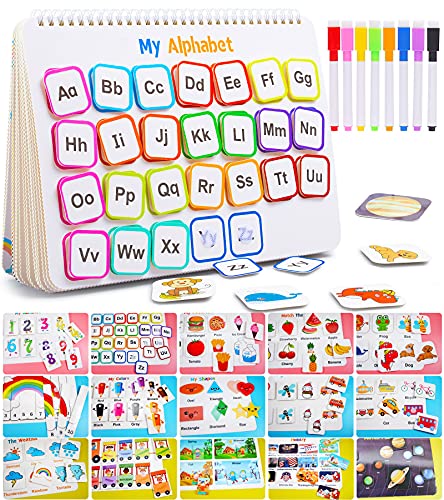
This Montessori-style busy book offers 15 themes plus 14 drawing and writing pages, supported by eight colored pens. It aims to enrich a child’s knowledge across numbers, alphabet, colors, shapes, and seasonal topics. The book is designed to enhance fine motor skills, memory, problem-solving, and verbal communication through diverse activities and writing practice. Geared toward ages 3 and up, it positions drawing and tracing as central to the learning experience, with a focus on multi-sensory engagement and imaginative play.
School Zone Thinking Skills Workbook

The Thinking Skills Workbook introduces preschoolers to critical thinking, logic puzzles, and problem-solving activities. While compact, the book covers essential early learning areas such as patterns, sequencing, and basic logic, supporting readiness for kindergarten. Its structured activities provide guided practice to help children approach problems methodically, building confidence in approaching new tasks and improving cognitive flexibility. Suitable for quiet work at home or in a classroom corner, it complements broader literacy and numeracy efforts.
School Zone Connect the Dots Workbook

The Connect the Dots workbook emphasizes visual tracing, number recognition, and early counting through dot-to-dot activities. With 32 pages of child-friendly puzzles, it combines coloring with counting exercises, helping preschoolers practice fine motor control and number sequencing. The workbook is designed for kids ages 3 to 5 and supports a gentle progression from simple to more complex tasks, making it a practical addition to a home or classroom learning shelf.
How to Choose the Right Preschool Activity Book
Key purchase considerations include age-appropriateness, alignment with core skills (lettering, handwriting, counting, logic), and the balance between workbook-style tasks and open-ended creative activities. Look for non-toxic materials, reusable elements (dry-erase markers, laminated pages), portability for travel, and clear instructions for adults guiding the activities. Assess whether the book supports screen-free learning, supports children with special needs, and provides a variety of activities to maintain engagement across weeks of use. Compare sets that offer complementary skills—letter tracing, number practice, and reasoning puzzles—to create a well-rounded learning toolkit for preschoolers.
Buying Guide: Key Purchase Considerations and Comparisons
When selecting activity books for preschoolers, consider the following perspectives to ensure a suitable and durable choice:
- Educational Goals: Prioritize books that balance literacy (letter tracing, handwriting) with numeracy (counting, basic math concepts) and cognitive skills (logic, pattern recognition).
- Age and Skill Level: Ensure the materials target ages 3–5 and offer progression from simple to more complex tasks to sustain interest and challenge.
- Material and Reusability: Look for laminated or dry-erase components, erasable markers, and sturdy binding for repeated use, especially for screen-free learning environments.
- Motor Skills Support: Favor activities that develop fine motor control (pencil grip, tracing, coloring) and hand-eye coordination, which are foundational for writing.
- Accessibility and Inclusivity: Consider books with sensory-friendly elements or themes that accommodate children with autism or sensory processing needs, and ensure clear, simple instructions for caregivers.
- Portability and Longevity: Travel-friendly options and durable pages can extend the life of the book across trips and seasons.
- Supplementary Tools: Some products include extra accessories (markers, erasers) that add value and convenience for setup and ongoing practice.
- Brand and Reliability: Reputable brands in early education often provide consistent quality, safe materials, and age-appropriate activities, making them safer long-term investments.
Overall, integrating a mix of tracing, drawing, dot-to-dot, and problem-solving activities can create a well-rounded learning routine for preschoolers. The selected titles above each offer distinct strengths, from Montessori-inspired structure to comprehensive skill-building workbooks, enabling caregivers to tailor a plan that supports foundational literacy, numeracy, and cognitive development.