Best Stem Robotics Kits for Adults: Hands-on Kits for Learning, Building, and Tinkering
Growing interest in STEM education has led many adults to explore robotics kits that blend programming, electronics, and mechanical build projects. This article highlights five Amazon-listed kits that suit adult learners seeking practical, educational, and challenging experiences. Each entry includes a quick overview of key features, what to expect during assembly, and how it supports ongoing learning in robotics and engineering.
| Product | Brand | Amazon Link | Key Focus |
|---|---|---|---|
| ELEGOO UNO R3 Smart Robot Car Kit V4 | ELEGOO | View Product | Arduino-based robotics, beginner to intermediate |
| ELEGOO Conqueror Robot Tank Kit with UNO R3 | ELEGOO | View Product | Tank-style chassis, graphical programming |
| ANNISOKA Robot Arm Kits | ANNISOKA | View Product | Robotics, circuits, 3D puzzle integration |
| Thames & Kosmos Mega Cyborg Hand | Thames & Kosmos | View Product | Hydraulic hand mechanism, pneumatic control |
| ACEBOTT Smart Robot Car Kit with 3MP Camera | ACEBOTT | View Product | Visual feedback, ESP32 controller, camera |
Note: The kits listed below are designed to accommodate adult learners and hobbyists who seek deeper engagement with robotics concepts, from mechanical design to programming and sensor integration. Each product section provides an objective overview of its capabilities and potential educational applications.
ELEGOO UNO R3 Smart Robot Car Kit V4

This Arduino-based kit delivers a compact, practical introduction to robotics for adults exploring hands-on electronics, programming, and vehicle control systems. It combines a robust UNO R3 foundation with a smart car platform designed for expandable learning, making it suitable for in-depth exploration of sensors, motor control, and microcontroller programming. The package includes multiple modules such as obstacle avoidance and line tracing, plus control options via Android and iOS devices, enabling experiments in wireless and remote operation.
Educational value centers on integrating hardware and software: constructing the car helps reinforce concepts in circuit design, port pin mappings, and motor control logic; software these kits teach use of Arduino IDE and basic coding patterns. As a long-term project, it supports iterative upgrades—adding new sensors or control schemes to investigate topics like feedback loops, PID tuning, and autonomous navigation. The kit’s standardized interfaces reduce assembly errors, helping learners progress with confidence.
ELEGOO Conqueror Robot Tank Kit with UNO R3
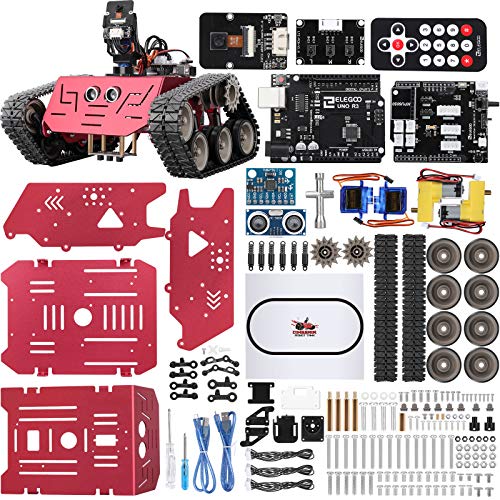
The Conqueror Tank Kit emphasizes robust chassis design and graphical programming features, offering a more arms-on exploration of robotics projects for adults. The Arduino-based system and diverse learning resources support learners who want to experiment with control algorithms, sensor integration, and modular expansion. The tank form factor enables experiments in maneuverability, track-based traction, and spatial reasoning, making it a good fit for projects that demand stable, multi-directional movement and creative problem solving.
Targeted skills include circuit assembly, debugging, and developing intuitive control interfaces. The open resources and modularity allow for deeper dives into topics such as motor drivers, sensor fusion, and simple AI-like behaviors. The kit can function as a springboard for larger, more complex builds as expertise grows, helping adults bridge classroom theory with practical hardware practice.
ANNISOKA Robot Arm Kit

This kit targets the practical mechanics of robotics and electronics by combining motors, a microcontroller, and wiring to assemble a functional robotic arm. It provides a hands-on path to understanding how electronic circuits drive mechanical motion, with a 3D puzzle element that adds a design and spatial planning challenge. The project appeals to adults who want a tangible, multi-step build that introduces servos, linkage mechanisms, and control logic while encouraging problem-solving and iterative testing.
Strengths include the opportunity to explore how power, control signals, and mechanical joints interact. It also emphasizes iterative design—tuning joint angles, testing grip strength, and refining control sequences. Note that some kits require multiple power sources or batteries, and designers should plan accordingly for extended sessions and safe handling of moving parts.
Thames & Kosmos Mega Cyborg Hand

Built as a wearable mechanical hand, this kit emphasizes pneumatic systems and hydraulic actuation rather than motors. It demonstrates how air pressure can power gripping actions, providing a clear view of fluid dynamics in robotics. Adults can explore precise finger articulation, customizable grip strength, and the relationship between human input and machine response. The absence of batteries stresses the purely passive and fluid-driven principles at work, suitable for experiments in soft robotics concepts and hydraulic control strategies.
Educational potential includes understanding pneumatically driven motion, material selection for leverage, and safe handling of pressurized systems. Learners can compare hydraulic versus electric actuation, investigate maintenance considerations for seals and pistons, and document how adjustments to finger joints alter grip and manipulation. This kit is well-suited for project-based learning, classroom demonstrations, or personal exploration of human-robot interaction models.
ACEBOTT Smart Robot Car Kit with 3MP Camera
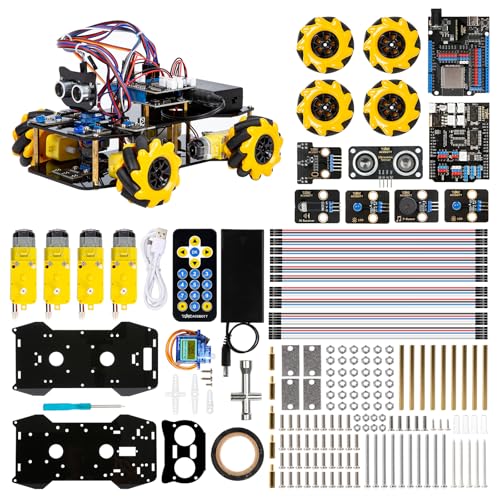
This kit centers on a camera-enabled robot car powered by an ESP32 controller, enabling real-time video streaming and image-based exploration. The ESP32 platform supports a variety of programming environments compatible with Arduino and Scratch, making it accessible to both learners and adults pursuing more advanced projects. The kit includes 16 storytelling-style tutorials that guide users through assembly and coding, reinforcing structured learning while allowing exploration through app and remote control features.
From a practical standpoint, the camera module introduces opportunities for computer vision basics, spatial awareness, and data streaming concepts. The expansion-ready design invites experimentation with modules such as robotic arms, tank tracks, and solar options, supporting long-term engagement and scalable challenges as skills progress. It is particularly suitable for adults who want a clear pathway from fundamentals to more complex, integrated robotics projects.
Buying Guide: key purchase considerations for adult learners
When selecting a stem robotics kit as an adult learner, consider the following criteria to ensure the purchase aligns with goals and skill level:
- Skill level and progression: Choose a kit with a clear learning path, tutorials, and expandable modules if you plan to grow from beginner to advanced projects.
- Programming environment: Look for compatibility with widely used ecosystems (Arduino IDE, Scratch, ESP32) to ease learning and future project reuse.
- Hardware architecture: Decide between motor-driven systems, hydraulic/pneumatic mechanisms, or camera-enabled platforms based on your interests (motion control vs. perception).
- Documentation and resources: Quality manuals, tutorials, and community support help reduce troubleshooting time and foster steady advancement.
- Component quality and safety: Ensure components (wheels, gears, sensors, actuators) are robust and safe for prolonged use, especially for complex builds.
- Expandable potential: Kits with add-ons (arms, sensors, solar panels) enable ongoing challenges and more sophisticated projects over time.
- Power requirements: Consider whether batteries are included or needed, and plan for safe charging and storage practices during extended sessions.
- Price-to-learning value: Compare total parts, complexity, and time-to-competence to determine which kit offers best ROI for your goals.
In summary, these kits provide adults with practical, hands-on avenues to explore robotics concepts—from mechanical design and control theory to data capture and AI-inspired experimentation. Selecting a kit with scalable complexity and rich educational resources can maximize long-term learning and engagement in STEM disciplines.