Best Counting Beads for Math: Top Abacus Sets for Early Number Skills
Counting beads are a practical, hands-on way to introduce children to early math concepts like counting, addition, and number sense. This article highlights five well-regarded abacus-style counting toys that use wooden beads, counting sticks, and number cards. Each option is designed to engage young learners, build fine motor skills, and support classroom or home practice. Below you’ll find quick product highlights, image links, and a buying guide to help parents choose the best tool for their child’s needs.
| Product | Brand |
|---|---|
| Melissa & Doug Abacus – Classic Wooden Educational Counting Toy With 100 Beads | Melissa & Doug |
| Cltoyvers Wooden Abacus for Kids | Cltoyvers |
| KIDWILL Preschool Math Learning Toy | KIDWILL |
| Ranqibo Wooden Abacus for Kids Math | Ranqibo |
| Vanplay Abacus for Kids Math | Vanplay |
Across these options, you’ll find classic wooden bead abacuses, multi-component sets with number cards, and kid-friendly safety features. Consider how your child learns best—through visual counting, hands-on deconstruction and construction of numbers, or color- and pattern-based activities—to pick the right fit. All selections are durable, age-appropriate, and suitable for independent practice or guided learning sessions.
Melissa & Doug Abacus — Classic Wooden Counting Toy

The Melissa & Doug Abacus is a traditional wooden counting frame featuring 100 brightly colored beads on 10 wires. Its solid hardwood construction provides durability for classroom or home use. This set emphasizes visual counting with 100 beads, enabling quick grouping and simple arithmetic demonstrations. The included beads and wires support early math exploration, from recognizing colors to basic addition and subtraction. Eight extension activities are included to extend learning beyond basic counting, helping children ages 3 to 5 build foundational math and logical thinking skills.
Cltoyvers Wooden Abacus for Kids

Cltoyvers offers a classic abacus with 100 wooden sticks and 110 math cards. The top card slot design displays equations below the beads, helping children visualize addition and subtraction. The sturdy wood frame holds 10 wires with 10 beads per wire, totaling 100 beads. Designed to engage kids in simple math problems, this abacus blends tactile counting with visual prompts to reinforce number construction and deconstruction in early math learning.
KIDWILL Preschool Math Learning Toy
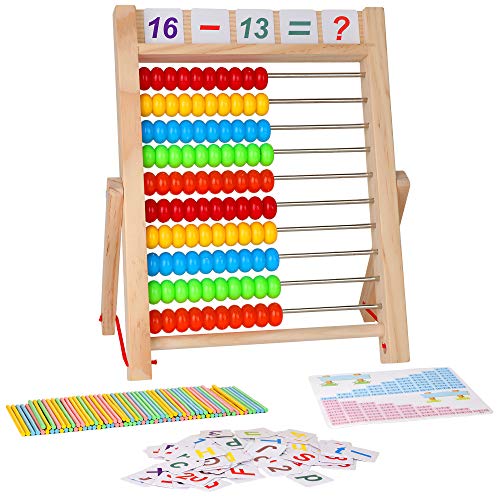
The KIDWILL abacus features a 10-row wooden frame with multi-color beads and counting sticks. It supports early color recognition with five distinct bead colors and is advertised as a tool to aid counting, simple calculations, and even alphabet learning. The wooden construction is designed with smooth edges for safety and durability, making it suitable for toddlers and preschoolers who are just beginning to explore numbers and basic arithmetic.
Ranqibo Wooden Abacus for Kids Math

Ranqibo’s wooden abacus provides a 10-row counting framework with 100 beads and a robust wooden frame. It includes counting sticks and number cards, making it a multi-functional learning tool. Aimed at ages 3 and up, this abacus supports counting, basic arithmetic, and color recognition. Its tactile beads and counting sticks promote hands-on exploration of the base-10 system and mathematical relationships, suitable for home or classroom use.
Vanplay Abacus for Kids Math

Vanplay’s abacus set combines 112 math cards with 100 counting sticks and a storage box, plus an included table for addition, subtraction, multiplication, and division. The design emphasizes pattern recognition, color naming, and numeracy concepts while offering a neutral color palette that fits a minimalist aesthetic. This kit provides a comprehensive framework for practicing basic arithmetic and building computational fluency through visual and tactile means.
Buying Guide: Key Purchase Considerations
- Age and Skill Level: Choose a setup aligned with the child’s age and math readiness. Early counters focus on counting and basic addition, while more advanced kits introduce multiplication and division tables.
- Construction and Safety: Look for solid wood frames, smooth edges, and non-toxic finishes. Durable designs withstand repeated handling in homes or classrooms.
- Number of Beads and Wires: More beads and longer frames enable larger groupings and more complex exercises, but smaller sets can be easier for beginners.
- Learning Aids: Some products include number cards, mapping cards, or extension activities that provide guided practice and progression.
- Versatility: Sets with counting sticks, boards, or magnetic components offer varied approaches to counting, addition, and pattern recognition.
- Storage and Portability: A storage box or compact design helps keep pieces organized and easy to transport for travel or classroom use.
How To Use These Counting Beads Effectively
For beginners, start with hands-on counting: move beads while counting aloud to reinforce one-to-one correspondence. Progress to simple addition by combining two groups of beads on different wires, then introduce subtraction by removing beads. Use number cards to practice counting forward and backward from a given number. Encourage pattern creation with counting sticks to illustrate place value and base-10 concepts. Consistent, short practice sessions help maintain engagement and support retention.
Educational Value Across Perspectives
From the classroom to home learning, abacus-based tools offer scalable math exposure. For visual learners, beads provide a tangible representation of numbers. For kinesthetic learners, the sliding motion supports engagement and fine motor development. For parents seeking calm, low-distraction learning, these sets deliver focused practice without screens. When selecting, consider whether you want a standalone counting frame, a card-based system, or a multi-tool kit that includes both counting sticks and number charts to maximize instructional options.