Best Toys for Cognitive Development in Children
Choosing toys that actively support cognitive development can help children build critical thinking, problem-solving, memory, and language skills. This article highlights five carefully selected Montessori-inspired and traditional toys that promote color and shape recognition, logic, counting, fine motor skills, and early literacy. Each pick offers durable design, age-appropriate challenges, and opportunities for independent or guided play.
| Product | Brand | Key Cognitive Benefit | Age Range |
|---|---|---|---|
| PEBIRA Montessori Toys for 1 to 3-Year-Olds | PEBIRA | Color and shape recognition; early geometry; hand-eye coordination | 12–36 months |
| GOPO TOYS Montessori Shape Sorter & Stacking | GOPO TOYS | Problem solving; independent play; dexterity | 12+ months |
| Melissa & Doug Shape Sorting Cube | Melissa & Doug | Color/shape matching; spatial reasoning; problem solving | 2–5 years |
| Skrtuan Counting Animals Color Sorting | Skrtuan | Early math concepts; color recognition; fine motor skills | 3–5 years |
| MUONE Montessori Busy Book Color Sorting Toys | MUONE | Color knowledge; fine motor control; vocabulary through labeling | 2–4 years |
PEBIRA Montessori Toys For Toddlers

PEBIRA presents a wooden sorting and stacking puzzle designed for toddlers aged 1 to 3, featuring 20 pieces across five colors and five geometric shapes. The activity supports basic differentiation of shapes, colors, and sizes as children match blocks to targets or create varied combinations. The toy emphasizes color recognition, shape identification, and early geometry, while encouraging hand-eye coordination as kids manipulate pegs and shapes. Its compact, travel-friendly size makes it suitable for on-the-go learning. Smooth wooden construction and rounded edges make it a safe option for young children exploring tactile learning experiences.
GOPO TOYS Montessori Shape Sorter & Stacking Puzzle
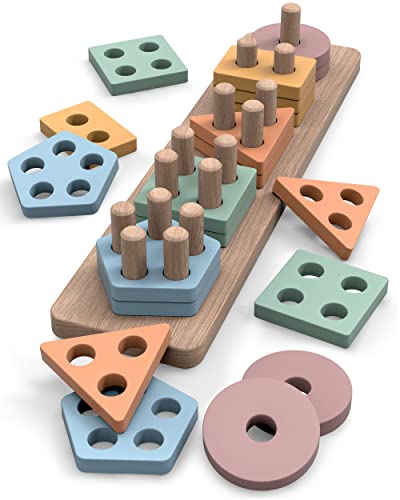
GOPO TOYS offers a Montessori-inspired wooden shape sorter and stacking puzzle that encourages problem solving through hands-on discovery. Children practice stacking, matching, and sorting to promote early cognitive development without screens. The toy supports fine motor skills by handling chunky wooden shapes and sturdy pegs, reinforcing hand strength and coordination through repeated, mindful tasks. It uses natural wood with smooth edges and water-based paint, meeting safety standards and minimizing potential distractions for focused play.
Melissa & Doug Shape Sorting Cube

The Melissa & Doug Shape Sorting Cube is a classic wooden toy featuring 12 bright shapes that fit into corresponding holes. Each match reinforces color and shape recognition while promoting problem-solving and spatial reasoning. The sturdy wooden construction supports durability for longer use, making it a staple in early learning environments. Its simple design focuses attention on essential cognitive skills as children explore which shapes fit where, fostering logical thinking through exploration.
Skrtuan Counting Animals Color Sorting
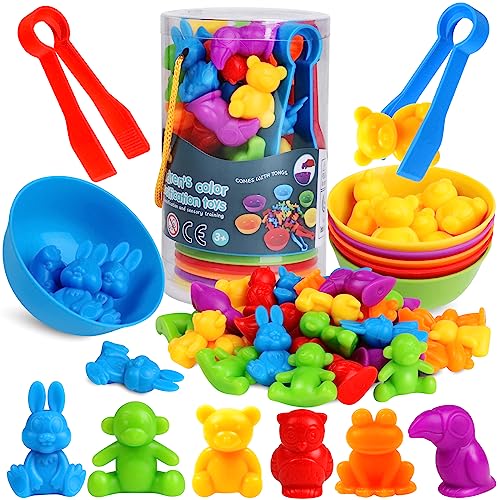
Skrtuan’s Counting Animals set combines color sorting with counting practice. The kit includes 36 differently colored forest animals, six sorting bowls, and two large tweezers, all designed to engage 3- to 5-year-olds. Beyond color recognition, children learn numerical concepts, sorting, and basic counting as they place animals into corresponding bowls. The rubbery construction is durable and washable, adapting well to classroom rotations or home play, while the included storage box helps maintain organization and ease of use.
MUONE Montessori Busy Book Color Sorting Toys

MUONE’s Busy Book focuses on color sorting through interactive activities that also introduce vocabulary. The busy book presents 12 colors and more than 48 cartoon stickers, each paired with a word to reinforce language learning alongside cognitive development. Children practice matching with hook-and-loop fasteners, supporting fine motor skills and concentration. This all-in-one tool emphasizes independent exploration and collaborative play, helping children build foundational cognitive and linguistic abilities as they sort, match, and label colors.
Buying Guide
Key considerations when selecting cognitive development toys for children include age alignment, safety, and the type of cognitive skills targeted. For very young children, choose toys with simple shapes and colors to promote basic recognition and hand-eye coordination. For older preschoolers, toys that encourage problem solving, planning, and counting help build executive function and math readiness.
- Age appropriateness: Ensure the toy’s complexity matches the child’s developmental stage to avoid frustration or disengagement.
- Material and safety: Prioritize smooth, non-toxic finishes and rounded edges. Wood-based toys often provide durable, long-lasting use.
- Open-ended play: Toys that support multiple solutions, like sorting and stacking, foster creativity and flexible thinking.
- Fine motor development: Look for pieces that require grasping, pinching, or precise placement to strengthen hand muscles.
- Language and vocabulary: Items that incorporate labeling or storytelling elements reinforce vocabulary alongside cognitive skills.
- Portability and storage: Compact designs with clear storage improve consistency of use and reduce clutter.
- Maintenance: Washable materials or easy cleanup help maintain hygiene and encourage frequent play.
- Non-screen engagement: Prioritize toys that minimize screens to support active exploration and real-world learning.
In practice, combining a color-and-shape sorter with a counting set offers a well-rounded cognitive challenge. A busy book adds language development and attention to detail, while a classic shape sorter reinforces durable problem-solving experiences. For caregivers, alternating between independent tasks and guided play can maximize learning outcomes without overstimulation.