Best Engineering Kits for 12 Year Olds to Explore Real-World STEM
Engineering kits designed for 12-year-olds offer hands-on exploration of mechanics, electronics, and problem solving. This guide highlights five engaging options that balance complexity with accessibility, helping young learners develop critical thinking, perseverance, and practical skills. Each kit encourages independent tinkering or collaborative projects, making them ideal for curious students, budding engineers, and science-curious families.
| Product | Brand | Key Focus | Age Range | Learnings |
|---|---|---|---|---|
| Henoda Robot Toys | Henoda | Remote/App controlled robot with 468+ pieces | 8–16 | STEM building, motor skills, programming modes |
| Discovery Model Engine Kit | Discovery | 4-cylinder combustion engine with moving parts | 8+ | Mechanical systems, physics basics |
| Smartivity Robotic Mechanical Hand | Smartivity | Hydraulic/mechanical arm with multiple axes | 8–14 | Structural design, hydraulics, manual dexterity |
| Thames & Kosmos Bridges & Skyscrapers | Thames & Kosmos | 20 buildable models teaching forces and structures | 8+ | Engineering principles, force, load, tension |
| ELEGOO UNO R3 Smart Robot Car Kit | ELEGOO | Arduino-based robot car with modules | 8–16 | Programming, electronics, robotics |
Henoda Robot Toys With App Or Remote Control
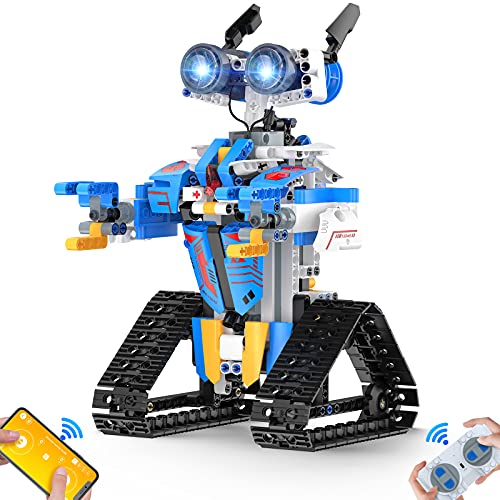
Henoda’s robot kit blends brick-building with interactive control to deliver a versatile STEM experience. The set includes 468+ pieces and engaging stickers to customize the model. Its design emphasizes hand-eye coordination and practical building skills, offering both smartphone app Bluetooth control and 2.4GHz remote operation. Movement supports multiple directions and a 360-degree rotating stunt mode, encouraging kids to experiment with motion, programming, and spatial reasoning. The kit is positioned as a gift for children ages 8 and up, suitable for birthdays or seasonal celebrations.
Discovery Model Engine Kit: 4-Cylinder Engine
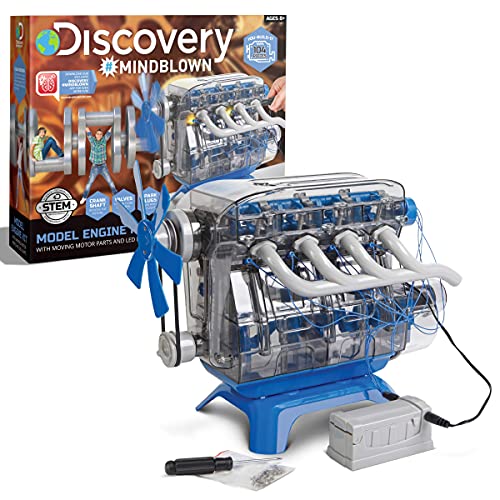
The Discovery engine model kit invites hands-on exploration of a miniature 4-cylinder engine. Students assemble cranks, pulleys, belts, and exhaust valves to bring the engine to life, fostering practical understanding of mechanical systems and how different components interact. The kit emphasizes troubleshooting and logical thinking as learners connect cables to a battery pack and observe the engine’s fans turning. Ideal for young makers who enjoy seeing cause-and-effect results and who want a tangible foundation in mechanical engineering concepts.
Smartivity Robotic Mechanical Hand

Smartivity’s mechanical hand kit is a popular option for developing fine motor skills and understanding hydraulics. The project guides builders through step-by-step assembly to construct a functional robotic hand with multiple movements. It emphasizes screen-free engagement, aligning with goals to reduce passive screen time while promoting critical thinking. The kit is designed for a broad age range (8–14) and includes replacement parts, ensuring ongoing play and experimentation as children master the principles of leverage, force, and motion in a hands-on, tactile format.
Thames & Kosmos Bridges & Skyscrapers

Thames & Kosmos structures kit challenges learners to build 20 different models, teaching the fundamentals of force, load, compression, and tension. With over 285 interchangeable building pieces and a detailed manual, students can explore how different configurations affect structural integrity. The kit blends theoretical concepts with practical construction, supporting cross-curricular connections to physics, mathematics, and engineering design. It’s well suited for classroom activities or family STEM nights, offering a tangible way to visualize complex ideas in a fun, iterative manner.
ELEGOO UNO R3 Smart Robot Car Kit

ELEGOO’s UNO R3 Smart Robot Car Kit provides an Arduino-based platform to learn programming, electronics assembly, and robotics integration. The kit comes with 24 module parts, including obstacle avoidance, line tracing, and infrared control, enabling kids to program and control the car via Android or iOS devices. Its modular design simplifies assembly with standardized ports, reducing setup errors and encouraging experimentation with sensors, motors, and control logic. This kit supports a progression from basic circuitry to more advanced coding projects as learners gain confidence.
Buying Guide
When selecting engineering kits for 12-year-olds, consider these factors to ensure a strong learning experience:
- Learning objectives: Align kits with goals such as mechanics, hydraulics, electronics, or coding to match a child’s interests and grade-level readiness.
- Difficulty curve: Look for sets that scale in complexity or include step-by-step guides, starter projects, and progressively challenging builds.
- Open-ended vs. guided play: Some kits emphasize structured instructions, while others invite creative experimentation. A mix can support both confidence and exploration.
- Time and space requirements: Consider the amount of time a project takes and whether it needs a dedicated workspace. Some kits are quick builds; others are longer-term projects.
- Safety and materials: Favor non-toxic components, sturdy parts, and clear safety guidelines, especially for younger end of the range.
- Expansion potential: Kits that integrate with microcontrollers or offer additional modules enable ongoing learning beyond the initial set.
- Pairing with other resources: Some kits include videos or online tutorials; others rely on printed manuals. Supplemental guidance can enhance understanding.
In summary, the selected kits provide diverse pathways into engineering—from hands-on construction and hydraulics to coding and circuit design. Whether a child loves building models, exploring renewable energy, or programming robots, these options offer structured learning with practical outcomes that align with middle school science standards and real-world engineering thinking.