Best Educational Toys for 11 Year Olds: Engage, Explore, and Learn
Finding the right educational toys for 11-year-olds means choosing activities that blend curiosity with hands-on problem solving. The following selections emphasize STEM concepts, critical thinking, creativity, and safe, screen-free play. Each option above offers engaging projects that build practical skills while sparking a lifelong interest in science and engineering.
| Product | Focus | Age Range | Why It Stands Out |
|---|---|---|---|
| STEM 13-in-1 Solar Power Robots | Robotics | 8-12 | Multiple builds using solar energy and modular parts |
| Smartivity DIY Robotic Mechanical Hand | Mechanics | 8-14 | Hands-on engineering with a creative, child-friendly manual |
| National Geographic Magic Chemistry Set | Chemistry | 8-12 | Magic-like tricks that teach core chemistry concepts |
| Henoda Robot Toys | Programmable Robotics | 8-16 | Multiple control modes and 468+ pieces for expansive builds |
| Croove Brain Teasers & Memory Game | Logic & Memory | 6-12 | Six games to boost memory, strategy, and cognitive skills |
13-In-1 Solar Robot Kit

The STEM 13-in-1 Solar Power Robots kit provides a versatile entry into robotics with 13 different builds. Children follow a step-by-step manual to assemble robots that can move on land or water using solar energy, encouraging soft engineering thinking and energy concepts. The set includes gears, plates, tires, and shafts designed for easy disassembly and reconfiguration, supporting iterative learning. All parts are manufactured from non-toxic ABS material with smooth edges for safe handling. This project-based kit helps children improve hand-eye coordination, spatial reasoning, and problem-solving as they explore how different configurations affect movement and performance.
Educational value: This kit foregrounds STEM learning through play, reinforcing basic physics ideas like leverage, gear ratios, and energy conversion. It is designed to scale in complexity, so older children can tackle more challenging builds with parental support or independent exploration. The kit also encourages teamwork when children collaborate on multi-robot challenges or parent-child build sessions.
Smartivity Robotic Mechanical Hand

Smartivity’s Robotic Mechanical Hand focuses on hands-on engineering with a guided, step-by-step manual. This project invites kids to construct a functional, articulated hand, then explore motion transfer, grip mechanics, and dexterity through a series of assembly tasks. Suitable for ages 8 through 14, the kit emphasizes screen-free engagement while building confidence in problem solving and spatial awareness. Replacement parts are included, ensuring extended play beyond the initial builds, and the activity fosters patience and attention to detail as kids test and refine each mechanism.
Educational value: By translating theoretical concepts into a tangible mechanism, the kit reinforces core STEM components such as levers, linkages, and motion. It also nurtures creativity, as builders reimagine the hand’s applications and experiment with alternative grips or tasks. The absence of screens makes it ideal for unplugged play sessions that still deliver measurable learning outcomes.
National Geographic Magic Chemistry Set

This National Geographic kit presents chemistry as an exciting magic show, with 10 distinct experiments designed as tricks. Each practice demonstrates chemical reactions, color changes, and physical changes in a way that feels like magic while teaching real science concepts. The included wand and gloves add to the performance aspect, making the learning experience memorable without compromising safety. An illustrated guide provides clear, kid-friendly instructions and context about the science behind each effect, helping children connect phenomena to foundational chemistry ideas.
Educational value: The set emphasizes inquiry-based learning, hypothesis testing, and observation skills. It introduces concepts such as chemical reactions, acids and bases, color changes, and states of matter, all framed within engaging demonstrations. The performance aspect can boost confidence and public speaking as kids explain their experiments to friends or family.
Henoda Robot Toys With APP Remote
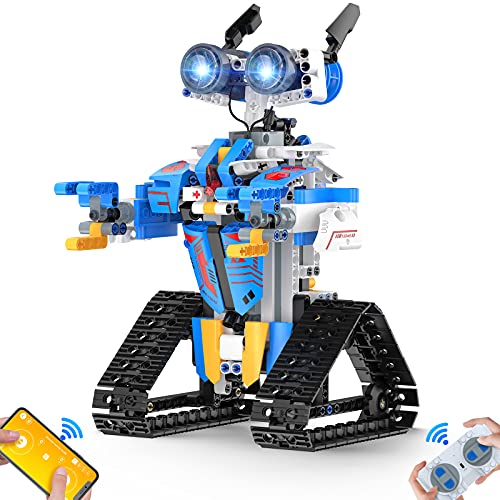
Henoda offers a programmable building kit with 468+ pieces and multiple control modes, including an app via Bluetooth, 2.4 GHz remote control, and several programming modes. The robot can move in multiple directions, rotate its arms, and perform stunts, providing a rich platform for exploration of robotics concepts, such as motor control, sensors, and programmable logic. The kit is suitable for age ranges 8 to 16, allowing it to grow with a child’s increasing skill set. The design emphasizes durability, extended play value, and engaging, dynamic play sequences.
Educational value: This kit integrates hands-on construction with digital control, bridging physical building and computational thinking. It supports experimentation with motion planning, pathfinding, and simple programming concepts, while offering opportunities for collaborative projects with friends or family members.
Croove Brain Teasers & Memory Game

Croove’s Brain Teasers & Memory Game pack features six distinct games designed to challenge memory, pattern recognition, and strategic thinking. The set includes activities such as color Sudoku, time-based challenges, memory matching, and more, offering diverse cognitive workouts in a single compact package. It can be used for solo play or as a social activity during family game night. The varied game modes keep sessions fresh and can scale with a child’s growing mental flexibility.
Educational value: The collection targets memory, attention, and cognitive flexibility, which are foundational for academic performance in math and science. It also enhances fine motor coordination through puzzle manipulation and encourages strategic planning and problem-solving across multiple game formats.
Buying Guide: Key Purchase Considerations For Educational Toys
- Age appropriateness: Confirm that the toy’s difficulty aligns with an 11-year-old’s cognitive and motor skills. Look for adjustable complexity or expandable kits to grow with the child.
- Core learning targets: Identify whether the toy strengthens specific STEM areas (robotics, chemistry, electronics, engineering) or broad cognitive skills (memory, problem-solving, critical thinking).
- Safety and materials: Choose kits made from durable, non-toxic components with smooth edges and clear safety guidelines. Ensure small parts are appropriate for the child’s handling and supervision requirements.
- Hands-on vs. screen-free balance: If screen time is a concern, prioritize kits that emphasize construction, measurement, and real-world experiments without digital interfaces.
- Learning progression: Favor sets that build on prior concepts, offering layered challenges or stepwise tutorials to prevent frustration and promote a sense of achievement.
- Project duration and play patterns: Consider how long a project takes and whether it supports short, repeated sessions or longer, focused builds. This helps fit into family routines and attention spans.
- Potential for creativity and collaboration: Look for open-ended kits that encourage experimentation, customization, and teamwork with peers or family members.
- Quality and support: Check for included replacement parts, comprehensive manuals, and access to customer support in case of misplacements or questions during assembly.
Overview comparisons reveal trade-offs between depth and breadth. For learners who enjoy hands-on building, Solar Power Robots and the Robotic Hand emphasize mechanical reasoning and energy concepts. Chemistry-based kits offer dramatic demonstrations that spark curiosity, while programmable robots provide a bridge to coding and logical thinking. Brain teaser games supplement STEM play by strengthening memory and strategic thinking. Selecting a mix that covers multiple domains can create a well-rounded learning toolkit for 11-year-olds.