Best Toys for Language Development and Speech Skills
Parents and educators can leverage interactive toys to reinforce vocabulary, pronunciation, and conversational confidence. The following picks are designed to support early language growth through engaging play, age-appropriate prompts, and clear audio cues. Each item focuses on word-building, memory, and sound discrimination to help children communicate more effectively.
| Product | Brand | Key Benefit |
|---|---|---|
| Airbition Talking Flash Cards | Airbition | 224-word vocabulary with animal sounds and Montessori-style interaction |
| LeapFrog Learning Friends 100 Words Book | LeapFrog | 100+ words with interactive pages and animal friends |
| Play-Act Learning Toy Farm Train | Play-Act | Sorting, colors, and numbers with interactive train play |
| Imitation Book: Learn To Talk | Twin Cities Speech Therapy Publishing | Speech-focused book for early talkers and late talkers |
| Zeoddler Alphabet Puzzles | Zeoddler | Wooden alphabet puzzles to build letter recognition |
Airbition Talking Flash Cards

Airbition’s talking flash cards are designed for toddlers and preschoolers, featuring 224 illustrated cards across topics like animals, vehicles, food, and fruits. The device reads content in American English and includes a repeat button for practice. A five-level volume control helps tailor the listening experience, supporting children as they expand vocabulary and cognitive skills. The product is described as suitable for autism-related speech therapy and sensory play, aligning with Montessori-style learning through sound-image associations.
Airbition Pink Talking Cards

This pink edition mirrors the original Airbition concept with 224-word content, clear American-accent narration, and independent use for toddlers. It emphasizes cognitive development, language recognition, and attention through interactive card insertion and auditory feedback. The Montessori-aligned setup supports self-directed learning, making it suitable for young language builders and early speech practice.
LeapFrog Learning Friends 100 Words Book
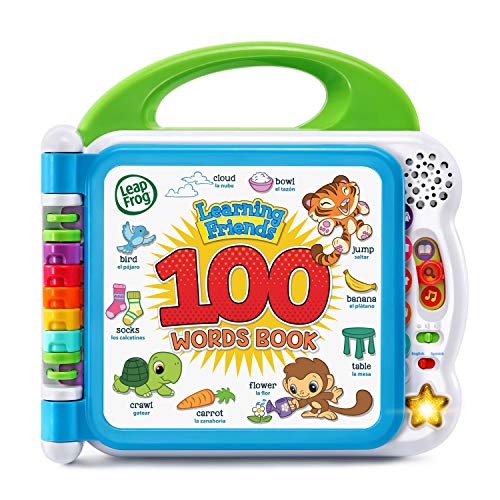
LeapFrog’s Learning Friends 100 Words Book features Turtle, Tiger, and Monkey as guides to more than 100 words across categories like pets, foods, colors, and activities. Pages respond to touch with word playback, sound effects, and a theme song. This interactive format supports vocabulary expansion, listening skills, and early reading readiness, with engaging characters that encourage repeated interaction and memory reinforcement.
Play-Act Learning Toy Farm Train

This Montessori-inspired train toy integrates colors, numbers, and sorting, with 10 numbered barns and 4 wagon cars. Children load, unload, and sort items as the train moves, promoting early math concepts and fine motor skills. The open train design allows for imaginative play, encouraging language through storytelling and role-play as kids describe actions and sequences.
Imitation Book: Learn To Talk

Imitation Book by Twin Cities Speech Therapy Publishing focuses on early talker development with speech-language therapy insights. The interactive format encourages toddlers to imitate sounds and words, supporting expressive language milestones. Its therapist-informed approach makes it a practical resource for parents and clinicians aiming to enhance daily language practice at home.
Zeoddler Alphabet Puzzles

Zeoddler Alphabet Puzzles present 26 uppercase letters in a wooden format designed for toddlers. The natural wood construction promotes durability and hands-on learning, supporting fine motor skills and letter recognition. As children manipulate pieces, they practice matching, spatial awareness, and vocabulary development through guided play and exploration.
Buying Guide: Key Considerations For Language Development Toys
- Age suitability and developmental stage: Choose toys aligned with your child’s current language level (nursery to preschool) to ensure appropriate challenge without frustration.
- Audio clarity and accent: Look for standard American pronunciation and clear enunciation to support accurate speech modeling and listening skills.
- Interactivity level: Consider whether the toy offers immediate feedback, repeating features, and prompts that encourage turn-taking and conversation.
- Multisensory engagement: Toys that combine visuals, sounds, and hands-on manipulation tend to reinforce memory and comprehension more effectively.
- Durability and safety: Wooden or sturdy plastic options with rounded edges reduce wear and risk during active play, an important factor for younger children.
- Montessori and therapeutic alignment: If supporting speech therapy or independent learning, prioritize tools designed for Montessori methods or clinician-informed approaches.
- Portability and setup: Portable devices or compact sets support use across home, car rides, and classrooms, enabling consistent practice.
- Variety and progression: A mix of vocabulary cards, alphabet activities, and storytelling aids helps cover nouns, verbs, sounds, and sentence structure.
- Parental involvement: Toys that offer guided activities or prompts for caregiver participation can maximize language practice and turn-taking opportunities.
- Safety and materials: Ensure non-toxic inks and child-safe materials, especially for items with chewed or mouthed components.