Best Balance Scales for Kids: Fun and Educational Toy Scales for Young Learners
Balance scales for kids blend hands-on math with interactive play, helping children grasp weight, volume, and comparison concepts. This guide highlights five child-friendly balance scales and related manipulatives, designed to support early math and science exploration in homes and classrooms. Each selection emphasizes safe design, clear measurement cues, and engaging activities that build counting, estimation, and logical reasoning.
Summary of chosen products
| Product | Brand | Key Benefit | Where It Shines |
|---|---|---|---|
| Blue Nestable Bucket Balance | hand2mind | Clear liquid and solid measurement with stackable base | Volume experiments, solid/liquid comparison |
| Primary Bucket Balance | Learning Resources | Calibrated buckets; removable lids for visibility | Mass measurement, estimation |
| Blue Nestable Pan Balance | hand2mind | Pan balance for liquids and solids in a compact base | Weight comparisons, volume exploration |
| Numberblocks Blockzee Balance | hand2mind | Math linking with Numberblocks theme | Numeracy concepts up to 10 |
| CozyBomB Frog Scale Cards | CozyBomB | 3-level balance challenges with illustrated cards | Progressive difficulty, STEM fun |
Blue Nestable Bucket Balance For Classrooms
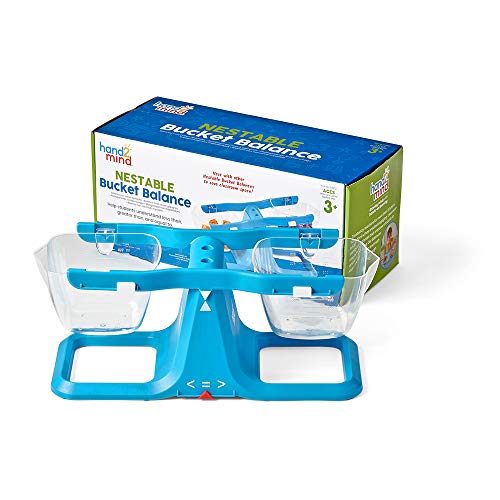
The Blue Nestable Bucket Balance from hand2mind provides a clear, double-bucket setup ideal for measuring liquids and solids. Teachers and curious learners can place manipulatives, counting bears, or math counters on the scale to observe weight differences. Its durable construction supports ongoing classroom use, while the nestable design saves storage space. This balance supports early concepts like mass, volume, and estimation, helping students connect hands-on experiments with math ideas such as inequality and arithmetic operations.
Primary Bucket Balance For Preschool Learners

The Learning Resources Primary Bucket Balance lets young students explore volume and solids/liquids using calibrated clear buckets with removable lids. Students develop observation and estimation skills as they compare mass and volume. The static demonstration of mass, coupled with hands-on measurement, supports foundational STEM literacy and helps children visualize how different materials occupy space and weigh differently.
Blue Nestable Pan Balance For Kids

This pan balance from hand2mind emphasizes weight comparison with clear, durable pans and a simple assembly. Learners place solids or liquids on either pan to discover differences in mass, fostering early algebraic thinking about inequalities and equality. The design supports classroom use with a compact, space-saving base, enabling multiple stations or small-group activities without crowding the room.
Numberblocks Blockzee Balance Activity Set

Officially licensed Numberblocks Blockzee Balance combines a balance scale with MathLink Cubes to explore numbers up to 10. This set includes 61 cubes and conveys concepts of greater than, less than, and equal to as students balance different quantities. The Blockzee theme engages young learners through recognizable characters while developing counting, one-to-one correspondence, and relational math understanding.
Penguin Themed Balance Scale

The BAKAM Penguin Balance Scale introduces a playful, penguin-themed balance system designed for early math practice. With four difficulty levels, the toy challenges children to think critically while balancing two plates. It’s suitable for preschool through early elementary environments, supporting counting, basic arithmetic, and problem-solving in a tactile, engaging format. The penguin motif keeps learners focused and excited about balancing concepts and number relationships.
Buying Guide: How To Choose The Right Kids’ Balance Scale
When selecting a balance scale for kids, consider age appropriateness, safety, and the learning goals you want to emphasize. Here are key purchase considerations from multiple perspectives:
- Educational focus: If the aim is basic measurement and estimation, bucket or pan balances with clear volume indicators work well. For number sense, look for sets that integrate numbers or counting cubes.
- Durability and materials: Look for shatter-resistant plastics and sturdy bases to handle frequent use in classrooms or homes with active learners. Clear buckets help visibility of contents during experiments.
- Storage and space: Nestable or compact bases minimize storage needs in small rooms. Consider whether the set includes lids or coverings to keep materials organized and clean.
- Engagement and theme: Themed sets (Numberblocks, penguins, frogs) can boost engagement, especially for preschool and early elementary learners, by linking play with math concepts.
- Progressive difficulty: A mix of simple and more challenging components supports growing math skills, from basic mass comparisons to relational thinking like greater than and less than.
- Compatibility: If using with standard classroom manipulatives (counters, bears, cubes), ensure the balance accommodates those items and allows clear viewing of weights and volumes.
- Safety features: Soft edges, rounded corners, and non-toxic materials are essential for younger children; ensure age recommendations align with your group.
- Teacher and caregiver resources: Some sets include activity cards or guided lesson ideas that help structure lessons and measure progress.
Across these options, buyers should align product choices with the learner’s current level and the intended classroom or home activities. Whether focusing on volume exploration, mass comparison, or number-building with blocks, the right balance scale creates meaningful, hands-on math experiences that build a strong mathematical foundation.