Best Science Kits for Toddlers and Early Learners
Exploring science early helps spark curiosity and foundational skills for young minds. The following kits are selected for safe, age-appropriate experiments that use common household items and colorful, illustrated guides. This guide highlights five options that align with toddler-friendly science, encouraging hands-on discovery while building basic concepts in chemistry, physics, and observation.
| Product | Brand | Age Range | Key Benefit |
|---|---|---|---|
| National Geographic Kids Junior Chemistry Set | Blue Marble | 4-6 | 50 experiments using household items to spark curiosity |
| Learning Resources Primary Science Deluxe Lab Set | Learning Resources | 3+ | Preschool science with activity cards and a write & wipe journal |
| Doctor Jupiter My First Science Kit | Doctor Jupiter | 4-8 | 100+ experiments to foster STEM thinking |
| UNGLINGA 150 Experiments Science Kit | UNGLINGA | 4+ | Varied topics across earth, chemistry, and physics |
| UNGLINGA 70 Lab Experiments Kit | UNGLINGA | 4+ | Multiple projects including volcanoes and circuits |
National Geographic Kids Junior Chemistry Set

A complete chemistry lab designed for young scientists aged four and up. This kit provides essentials to explore chemistry concepts with everyday items like baking soda and vinegar, promoting hands-on discovery in a safe, age-appropriate format.
Key features include 50 hands-on experiments and 20+ lab tools. Clear, illustrated instructions support independent exploration, helping children follow along and achieve successful results on their own. The setup emphasizes curiosity, observation, and basic scientific reasoning without requiring advanced supervision.
Learning Resources Primary Science Deluxe Lab Set
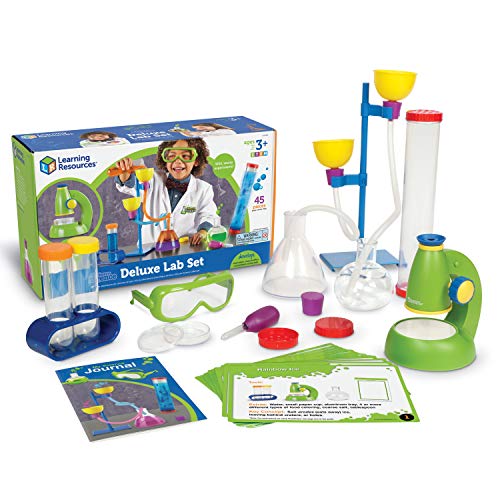
Designed for preschoolers, this 45-piece set introduces early science skills through engaging hands-on activities. It supports problem solving, fine motor development, and following multi-step directions, while offering age-appropriate lab gear and activity cards to guide exploration.
The included write & wipe journal supports recording observations and findings, reinforcing early literacy alongside science vocabulary. This kit emphasizes process skills, prediction, and focused exploration, aligning with foundational STEM learning for young children.
Doctor Jupiter My First Science Kit

This kit offers 100+ experiments designed to build early STEM thinking, curiosity, and problem-solving. It encourages kids to ask questions, observe results, and explore the world with safe, engaging activities that highlight fundamental science ideas.
Kids can experience phenomena such as Water Fireworks and Walking Water, among other projects. The set provides a balance of guided activities and open-ended play, making it suitable for collaborative learning and independent exploration from early elementary ages.
UNGLINGA 150 Experiments Science Kit

This kit includes a broad collection of experiments across earth science, chemistry, and physics. A well-illustrated step-by-step manual guides young scientists through each project, with kid-friendly tools and materials that support hands-on learning at home.
Materials are selected to be safe for children, and the activities emphasize observation, prediction, and basic scientific reasoning, helping children build confidence as they explore scientific concepts in a relaxed, exploratory setting.
UNGLINGA 70 Lab Experiments Kit

A varied science kit that invites kids to explore topics such as erupting volcanoes, fruit circuits, and other STEM activities. The included manual provides clear illustrations and step-by-step instructions, helping children progress from simple to more challenging experiments while developing critical thinking skills.
Buying Guide
Key purchase considerations for science kits for toddlers and early learners:
- Age appropriateness: Look for kits labeled for the child’s age range, with simplified instructions and safe, non-toxic materials.
- Safety and supervision: Prefer kits that emphasize safety gear (goggles, gloves) and provide clear guidance about adult supervision when needed.
- Hands-on balance: Choose sets that mix guided activities with open-ended exploration to support curiosity and independent problem-solving.
- Instruction quality: Favor clear, illustrated manuals and activity cards that help kids follow steps and understand underlying concepts.
- Materials and tools: Assess whether tools are child-friendly, durable, and easy to clean; ensure items are appropriate for small hands.
- Variety of topics: A broad range of experiments across chemistry, physics, and life science offers a well-rounded early science experience.
- Learning progression: Consider kits that gradually increase complexity, enabling skill-building without overwhelming the child.
- Parent involvement: Some kits are designed for shared exploration, which can enhance learning through guided discussion and questions.
When selecting a kit, weigh the child’s interests and attention span, the level of adult involvement required, and how well the experiments translate to foundational science concepts that will benefit early learning and future STEM curiosity.