Best Sorting Toys for Toddlers: Engaging Ways to Build Math and Fine Motor Skills
Sorting toys help toddlers develop early math concepts, color recognition, and fine motor skills through hands-on play. This guide highlights five highly-rated options that blend Montessori-style learning with durable, child-friendly design. Each choice supports independent exploration and guided learning, making them suitable for home, preschool, and classroom settings. Below, you’ll find quick product insights and a buying guide to help you pick the best fit for your child.
| Product | Brand | Key Benefit |
|---|---|---|
| Oomloid Counting Animals Montessori Toys | Oomloid | Counting, color sorting, fine motor with tweezers |
| Fisher-Price Stacking Toy | Fisher-Price | Shape sorting, early geometry basics |
| Learning Resources Farmer’s Market Color Sorting Set | Learning Resources | Color recognition, pretend play with food items |
| Skrtuan Counting Animals Color Sorting | Skrtuan | Counting, color sorting, fine motor skills |
| Coogam Sorting Toy for Toddlers | Coogam | Multi-theme sorting, problem-solving |
Oomloid Counting Animals Montessori Toys

The Oomloid Counting Animals set includes 36 colorful animal figures, six sorting bowls, and two tweezers. It supports early counting and color matching by having children sort animals by color into bowls, then use tweezers to transfer items. The Montessori-inspired design emphasizes hands-on manipulation to reinforce number sense and categorization. This helps children practice grouping and one-to-one correspondence while staying engaged through playful animal themes. The included materials are durable enough for repeated use in classrooms or at home.
Key features focus on math readiness and sensory learning. Counting animal toys help kids learn animal types, counting, and color matching. The activity also encourages children to sit, balance core muscles for precise hand movements, and coordinate tweezers with color bowls. With these prompts, learners build confidence in early math and improve fine motor control as they handle small pieces.
Ideal for ages 3–5 and adaptable for mixed-age groups (up to 8 in some settings), this set suits parents, teachers, and caregivers seeking practical, classroom-friendly tools. The activity blends cognitive challenges with a playful narrative that can sustain attention for longer play sessions. For best results, pair with guided counting games or color-name practice to extend learning beyond sorting.
Fisher-Price Stacking Toy: Baby’s First Blocks

This classic set includes 10 colorful blocks designed to be sorted, stacked, and dropped through a lid. The shape-sorter mechanism supports early geometry understanding as children learn about shapes and spatial relationships. The blocks also fit back into the storage bucket, promoting tidy cleanup habits and easy travel-ready play. The easy-carry handle adds portability, making it a reliable option for car trips or daycare centers.
Educational value centers on sensory engagement and fine motor development. By sorting shapes and stacking blocks, toddlers practice hand-eye coordination, grip strength, and problem-solving as they decide where each piece fits. The toy’s simple framework makes it suitable for very young learners who are just beginning to explore how objects fit together. It also introduces the concept of cause-and-effect as blocks tumble or slide into place.
Durable construction and bright, inviting colors help maintain interest over time. While some may outgrow it quickly, many families appreciate its enduring usefulness as a foundational play item. Use with guided play to introduce color and shape naming, and gradually increase complexity with timed building challenges or pattern copying activities.
Learning Resources Farmer’s Market Color Sorting Set
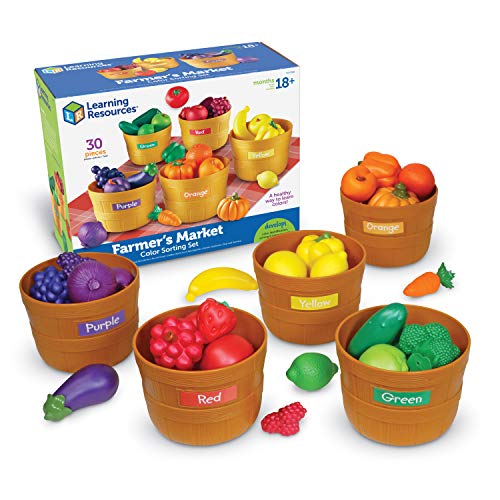
This color sorting collection uses pretend-play food items as the central learning prop. Each piece is color-coordinated to work with bushel baskets that visually demonstrate categorization. The design supports early color recognition, vocabulary expansion around familiar foods, and spatial sorting during pretend grocery or kitchen play. It’s well-suited for small-group activities as well as independent play.
Educational benefits come from pairing sort-and-match activities with language prompts, helping children articulate color names and food categories. The bushel baskets provide a contextualized framework for sorting that mirrors real-world activities, which can enhance memory retention. The set promotes social interaction when used in classroom centers, encouraging sharing and collaborative play while practicing color and categorical thinking.
Parents and teachers often use this set to align with early literacy goals by naming foods and colors aloud during play. The tactile nature of play food items supports sensory exploration, and the compact storage makes organization simple after playtime. For extended learning, integrate price or nutrition-themed discussions to deepen vocabulary and inquiry skills.
Skrtuan Counting Animals Color Sorting
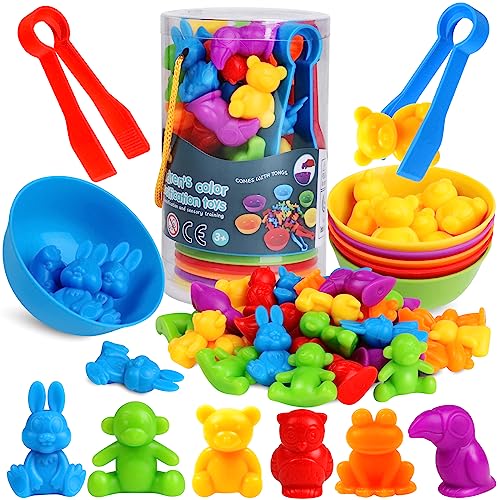
Skrtuan’s set features 36 forest animals, six sorting bowls, and two large tweezers, all in a colorful, child-friendly package. The soft rubber materials are designed for durability and safety, offering a tactile experience that supports fine motor development. The color-sorting activity encourages cognitive processing as children count, sort by color, and place pieces into matching bowls.
As a preschool learning toy, this set emphasizes counting and color identification while fostering hand strength through grasp-and-release actions. The included storage box makes organization straightforward, enabling efficient rotation of activities at daycare centers or in a home learning station. Because the pieces are non-plastic rubbery materials, they tend to be gentler on little hands and easier to clean than harder alternatives.
Educators can extend learning with simple math tasks such as counting the animals, comparing colors, or creating sorting patterns. The multi-piece approach introduces sequencing and pattern recognition, foundational math skills that support later school readiness. For caregivers, this toy provides a compact, versatile option for sensory-rich play sessions that blend education and fun.
Coogam Sorting Toy for Toddlers

Coogam presents a multi-theme sorting toy set that spans animals, dinosaurs, fruits, vehicles, foods, balls, and more, with 6 groups in various categories. The included activity cards guide kids to sort items by attributes, combining learning with play. This approach helps improve cognition, problem-solving, and fine motor skills as children distinguish differences and similarities between items.
The practical teaching aid design supports early cognitive development in classrooms or at home. The varied themes broaden a child’s exposure to different everyday objects, encouraging flexible thinking and categorization strategies. The kit serves as a versatile resource for both sorting and classification games, while the activity cards provide structured prompts for guided instruction or independent exploration.
Because the set spans many themes, it caters to a wide range of interests, keeping children engaged for longer play sessions. It’s a strong option for families seeking a comprehensive, all-in-one sorting experience that can be used across multiple play contexts, from quiet time to guided learning stations.
Buying Guide: Key Purchase Considerations
- Age and developmental stage: Look for sets designed for toddlers through early preschool to match motor and cognitive milestones.
- Materials and safety: Prioritize non-toxic materials, rounded edges, and pieces sized to prevent choking hazards. Rubber or wood options may offer different textures and durability.
- Theme variety: Multi-theme sets support broader learning by exposing children to animals, fruits, vehicles, and more, which helps sustain interest.
- Motor skills focus: Consider whether tweezers, sorting bowls, and graspable pieces will help strengthen pincer grip and hand-eye coordination.
- Storage and organization: Look for sets with a storage solution to support independent cleanup and classroom readiness.
- Learning approach: Montessori-inspired tools emphasize self-guided exploration, while card-guided activities provide structured instruction for younger or less experienced learners.
- Durability and care: Washable materials and sturdy construction ensure longevity in busy home or classroom environments.
- Progression potential: Some sets offer simple counting and color matching with opportunities to introduce more advanced sorting or patterning over time.
- Curriculum alignment: If you’re using these in a classroom, consider how the activities align with early math and language goals your program emphasizes.
- Budget and value: Compare sets based on the number of pieces, variety of themes, and included learning resources to determine long-term value.