Best Educational Toys for Kids: Top Picks for Engaging Learning and Fun
Discover a curated set of educational toys designed to spark curiosity, build skills, and keep kids engaged. From hands-on electronics to creative drawing and memory games, these picks encourage STEM thinking, early literacy, and problem-solving in playful ways. Below you’ll find five standout options with quick-reference highlights to help you compare features at a glance.
| Product | Age Range | Key Benefit | Format |
|---|---|---|---|
| Snap Circuits Jr. SC-100 | 8+ | Hands-on electronics exploration | Circuit kit |
| 3Doodler Start+ Essentials | 6+ | Creative 3D drawing without screens | 3D drawing pen set |
| Educational Insights Kanoodle | 7+ | Portable brain-teasing puzzles | Travel-sized puzzle game |
| Electronic Alphabet Wall Chart (GaHoo) | 1-5 | Interactive literacy and number basics | Wall chart poster |
| Speak & Spell Electronic Game (Basic Fun) | 7+ | Spelling and phonics practice | Retro-style electronic game |
Snap Circuits Jr. SC-100 Electronics Exploration Kit

Introduce young learners (ages 8 and up) to the fundamentals of electrical engineering with a safe, modular electronics kit. The Snap Circuits system uses colored, snap-together parts to create over 100 projects, from a simple buzzer to a flying saucer. The kit includes a full-color instruction manual and 29 parts that enable hands-on experimentation, reinforcing concepts such as circuits, voltage, and systems thinking. This tool is ideal for independent play or guided classroom style exploration, encouraging curiosity and practical problem-solving.
3Doodler Start+ Essentials 3D Pen Set
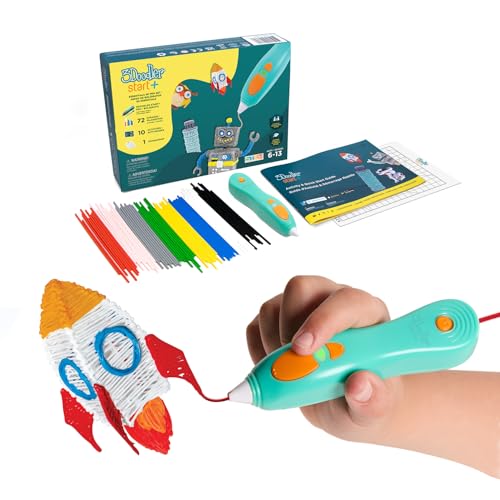
The Start+ line offers a child-safe 3D drawing experience that emphasizes hands-on creativity without hot parts. The pen is designed for younger users with safer plastic, a lighter grip, and faster filament loading. The package includes additional filaments and stencils, expanding opportunities for STEM-based art projects and spatial reasoning. This tool helps kids connect design thinking with tangible outcomes, encouraging experimentation and iterative learning in a no-screen setting.
Educational Insights Kanoodle

Kanoodle challenges spatial reasoning through hundreds of 2D and 3D puzzles, suitable for solo play or shared problem-solving sessions. The compact case makes it ideal for travel, restaurants, or quick brain-teaser breaks. With puzzles ranging from beginner to expert, it supports progressive skill development and helps improve visualization, pattern recognition, and logical thinking—important cognitive skills for school-age learners.
Electronic Alphabet Wall Chart (GaHoo)

This interactive wall chart blends letters and numbers with catchy songs to support early literacy and numeracy. The device encourages hands-on engagement through touch-activated content and a selection of learning cards for counting, matching, and word-building. It’s a lightweight, portable option that can fit into a child’s bedroom or learning corner, making literacy development an accessible, daily activity.
Speak & Spell Electronic Game (Basic Fun)

Relive a classic spelling-focused experience with a kid-friendly version of Speak & Spell. The toy features multiple play modes—Spell, Mystery, Say It, Secret Code, and Letter—providing varied challenges that promote phonics, spelling, and verbal skills. Its retro design offers a nostalgic learning tool that still supports foundational literacy in a structured, engaging format.
Buying Guide
- Learning goals: Choose toys aligned with targeted skills such as STEM fundamentals, early literacy, or spatial reasoning.
- Age appropriateness: Check recommended age ranges to ensure safety and suitable challenge levels.
- Hands-on vs. screen time: Balance tactile, screen-free activities with interactive experiences to support diverse learning styles.
- Portability and storage: For travel or small spaces, compact games like Kanoodle or pocket electronics provide flexible use.
- Safety and materials: Prioritize non-toxic materials, safety features for younger kids, and durable construction for long-term use.
- Expansion potential: Some kits integrate with other sets, offering extended learning and greater value over time.
- Maintenance: Look for components that are easy to assemble, replace, or clean as needed.
- Learning outcomes: Consider whether the toy emphasizes problem-solving, creativity, memory, or foundational knowledge.
These five selections cover a spectrum of educational goals, from practical electronics and creative prototyping to logic puzzles and foundational literacy. When selecting for a child, consider their interests, the learning objectives you want to support, and how each toy complements existing activities to build a well-rounded learning routine.