Best Mechanical Toys for 8 Year Olds: Hands-on STEM Fun
Discover engaging, screen-free mechanical toys that inspire curiosity and practical problem-solving for eight-year-olds. The following selections blend engineering challenges with age-appropriate instruction, helping kids build confidence and motor skills while exploring basic physics, gears, and circuitry. Below is a quick summary of five standout options, followed by deeper insights to help you choose.
| Product | Brand | Typical Focus |
|---|---|---|
| Smartivity DIY Robotic Mechanical Hand | Smartivity | Gears, levers, simple robotics |
| Smartivity DIY Pinball Machine | Smartivity | Arcade mechanics, interactive play |
| ELEGOO UNO R3 Smart Robot Car Kit | ELEGOO | Arduino-based robotics, coding basics |
| Henoda Robot Toys | Henoda | Remote/app control, multi-direction motion |
| BeAndge 11 Set STEM Science Kit | BeAndge | Multiple experiments, physics and engineering |
Smartivity Robotic Mechanical Hand

The Smartivity mechanical hand offers action-packed, screen-free construction that guides kids through a detailed manual to assemble a functioning hand mechanism. This kit emphasizes hand-eye coordination and engineering concepts as children manipulate gears, levers, and linkages to simulate grasping actions. Suitable for ages eight and up, the project supports independent or guided play and develops problem-solving patience while encouraging a basic understanding of mechanical systems. Replacement parts are available to extend playtime and learning.
Smartivity Pinball Machine Build Kit

This DIY pinball machine invites kids to assemble a mini arcade-style game that moves with gears and levers, delivering a hands-on lesson in physical principles and cause-and-effect. The step-by-step instructions keep construction accessible, making the activity enjoyable for both boys and girls aged 8–14. With lifetime replacement parts, children can rebuild or expand the experience as they grow more confident in mechanical thinking. The kit reduces screen time while fostering creativity and perseverance.
ELEGOO UNO R3 Smart Robot Car Kit

The ELEGOO UNO R3 kit provides an entry point into robotics and coding for kids 8–14. It includes multiple modules for obstacle avoidance, line tracing, infrared remote control, and smartphone control. This kit emphasizes hands-on electronics and programming fundamentals, teaching sequencing, sensor use, and basic robotics concepts. Easy-to-assemble modules with standardized ports support smooth learning progress, making it a practical choice for curious learners who want a tangible introduction to Arduino-style projects.
Henoda Remote-Controlled Robot Toys
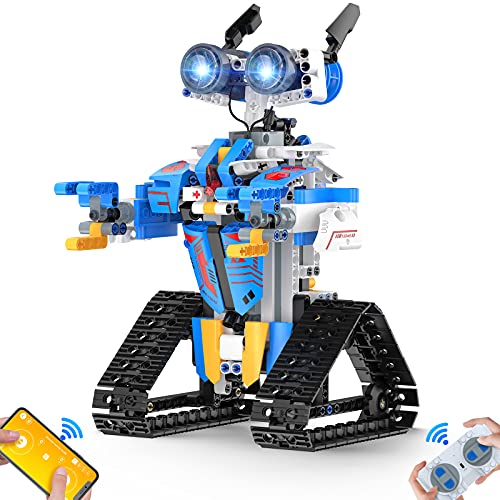
Henoda’s robot kit combines a 468+ piece build with app-based or remote control operation. Kids can command movement in multiple directions and enjoy features like glowing eyes and flexible joints. The product supports purposeful play that enhances motor skills, spatial awareness, and imaginative exploration, with modes spanning remote control, path planning, voice control, and STEM programming. It works well for group play and family involvement, and it is designed to captivate8–14-year-olds with varied play modes.
BeAndge 11 Set STEM Science Kit

BeAndge’s 11-kit collection provides a broad range of physics and engineering experiments, including multiple build projects and challenges that scale in difficulty. This set supports a progressive learning curve, helping children expand from simpler mechanisms to more complex assemblies. The kit is packaged as a gift-ready set, making it a versatile option for birthdays or holidays. It emphasizes hands-on experimentation, problem-solving, and creativity, aligning with essential STEM competencies for 8–14-year-olds.
Buying Guide: Key Considerations For Selecting Mechanical Toys
- Age-appropriateness: Look for kits clearly labeled for ages 8–14 to ensure appropriate complexity and safety.
- Learning focus: Choose toys that emphasize gears, levers, sensors, or coding to build foundational STEM skills.
- Hands-on engagement: Favor projects with step-by-step instructions and tangible outcomes to maintain sustained interest.
- Expandability and replacement parts: Consider kits offering replacement parts or additional modules to extend playtime and learning.
- Hardware vs. software balance: Decide between purely mechanical kits and those incorporating programmable elements for broader skill development.
- Durability and safety: Check for robust construction and non-toxic materials, with clear age-related safety guidance.
- Value and longevity: Evaluate whether a kit offers multiple projects or activities, providing long-term educational value beyond a single build.
- Parental involvement: Some kits benefit from adult supervision or collaboration, which can enhance learning and safety.
These options cover a spectrum from purely mechanical builds to coding-enabled systems, offering varied pathways to learn by doing. When selecting, balance the child’s current interests with the desired skill areas—mechanical reasoning, spatial thinking, problem solving, and basic programming—to maximize engagement and educational impact.