Best STEM Kits for 10-Year-Olds: Hands-on Kits That Spark Creativity
For parents and educators seeking engaging, screen-free STEM activities, these kits offer practical, hands-on learning for 8–14-year-olds. Each kit emphasizes building, experimentation, and real-world science concepts, helping kids develop problem-solving skills and confidence. Below is a quick overview of five highly relevant options that suit a 10-year-old’s curiosity and skill level.
| Product | Brand |
|---|---|
| Smartivity DIY Robotic Mechanical Hand | Smartivity |
| Thames & Kosmos Mega Cyborg Hand | Thames & Kosmos |
| Sillbird 12-in-1 Solar Robot Kit | Sillbird |
| ELEGOO UNO R3 Smart Robot Car Kit | ELEGOO |
| 11 Set STEM Science Kit (BeAndge) | BeAndge |
Smartivity Robotic Mechanical Hand Kit

The Smartivity DIY Robotic Mechanical Hand invites kids to assemble a fully functional hydraulic-like hand using simple levers and linkages. The step-by-step manual guides a deeply engaging, screen-free build experience suitable for ages 8–14. By following the instructions, children explore mechanical advantage, motion transfer, and basic engineering principles while constructing a working model that mimics real-hand movements. The kit emphasizes hands-on learning, persistence, and creative problem solving as part of a broader STEM education.
Key features include action-packed playtime and a focus on developing key skills without digital screens. This kit helps young builders understand the science behind mechanical systems and encourages curiosity about engineering concepts. Parts are designed for straightforward assembly, and replacement parts are available, reducing downtime and supporting ongoing exploration.
Thames & Kosmos Mega Cyborg Hand

The Mega Cyborg Hand kit provides a large, hands-on pneumatic system for building an operable hydraulic gripper. Users operate the fingers via air pressure—no motors or batteries required—promoting understanding of pneumatics and fluid power. Adjustable finger joints enable precise movement, teaching control, force, and leverage. The kit offers a tangible demonstration of how hydraulic systems translate user input into gripping action, supporting literacy in engineering concepts and practical design thinking.
Sillbird 12-in-1 Solar Robot Kit
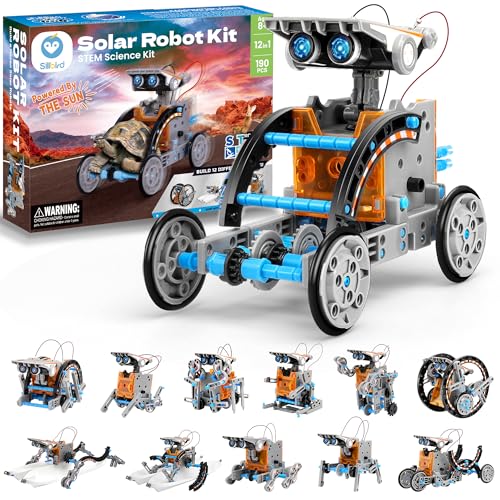
The Sillbird solar robot kit invites outdoor exploration with solar-powered operation and multiple build options. Kids can assemble 12 different models, each teaching core STEM principles like energy conversion, propulsion, and mechanical design. The solar-to-mobility concept reinforces renewable energy awareness and environmental science, while the hands-on builds support motor skills, planning, and iterative testing. A broad range of configurations helps maintain interest as kids grow more confident in engineering tasks.
ELEGOO UNO R3 Robot Car Kit

The ELEGOO UNO R3 Smart Robot Car Kit centers on Arduino-based robotics education. It provides 24 modular components, including obstacle avoidance and line-tracing modules, with smartphone control options via Android and iOS. The kit is designed for approachable entry into programming, electronics assembly, and robotics. Clear module interfaces and standardized ports reduce assembly errors, helping 10-year-olds develop debugging strategies, logical sequencing, and hands-on coding experience in a structured, scalable way.
11 Set STEM Science Kit (BeAndge)

The 11 Set STEM Science Kit from BeAndge offers a broad collection of projects focused on physics and engineering fundamentals. With age-appropriate difficulty levels, younger builders can tackle simpler tasks while older kids advance to more challenging experiments. This variety supports differentiation in a single purchase, allowing kids to explore concepts such as forces, motion, and basic circuitry, while providing a foundation for science fairs or classroom demonstrations.
Buying Guide
Key considerations
- Age appropriateness: Choose kits that match a 10-year-old’s motor skills, reading level, and interest in building and experimentation.
- Hands-on engagement: Look for kits with clear, illustrated instructions and components that encourage active construction and testing.
- Educational scope: Consider whether the kit covers physics, engineering, energy, or programming to align with learning goals.
- Longevity and expansion: Kits with multiple build options or replaceable parts extend value and keep kids engaged over time.
- Safety and complexity: Balance complexity with safety guidelines; ensure parts are age-appropriate and non-toxic.
What to compare
- Mechanics vs. electronics: Some kits emphasize mechanical design (pneumatic or hydraulic systems), while others focus on electronics and programming.
- Power source: Solar-powered kits teach renewable energy concepts, while battery-powered kits may be easier in indoor environments.
- Learning outcomes: Identify whether the kit prioritizes critical thinking, problem solving, coding, or hands-on construction.
- Support materials: Look for comprehensive manuals, online tutorials, and replacement parts availability for uninterrupted play.
- Price and value: Compare the number of builds, included parts, and potential for future projects to determine overall value.