Best Scooters for Young Children: Safe, Fun Options for Little Riders
Finding the right scooter for a young child involves balancing safety, ease of use, growth potential, and durability. Below is a curated selection of five kid-friendly scooters designed for beginners and early walkers, with features like LED wheels, lean-to-steer mechanics, adjustable heights, and wide decks for stability. The list focuses on models suitable for ages around 2-8 and up to varying weight limits, helping parents choose a ride-on option that grows with their child.
Product Overview
| Product | Brand | Max Load | Key Feature |
|---|---|---|---|
| KS1 Kids Kick Scooter (110 Lbs) | Gotrax | 110 lbs | LED-lit three-wheel design with Lean-to-Steer and 3-height handlebars |
| KS1 Kids Kick Scooter (100 Lbs, Blue) | Gotrax | 100 lbs | LED wheels, Lean-to-Steer, adjustable height, lightweight |
| 3 Wheels Sit/Stand Scooter | Hurtle | 132 lbs | 2-in-1 sit/stand with flip-out seat and colorful LED lights |
| Kick Scooter B02 | Allek | Various (adult-friendly design) | 4 adjustable heights, luminous wheels powered by rolling |
| Lifemaster 3-Wheel Scooter | Lifemaster | ≥ | Lean-to-Steer with adjustable handlebar and LED lights |
Note: The table provides quick compatibility checks. For detailed specs, refer to each product section below.
KS1 Gotrax Kids Kick Scooter (110 Lbs)

The KS1 scooter from Gotrax uses Lean-to-Steer technology to help children turn by leaning, supporting balance and coordination development. It features three height options for the handlebars (33.7/31.9/29.9 inches) so the scooter grows with your child. The three-wheel design includes eye-catching glowing LEDs in the wheels, offering extra visibility during dusk or after dark. Assembly is straightforward; the stem can be disassembled easily for storage or transport. The unit weighs 5.1 pounds, making it simple for kids to manage and parents to carry.
KS1 Gotrax Kids Kick Scooter (Blue, 100 Lbs)

This blue variant mirrors the KS1’s Lean-to-Steer design and adjustable handlebars, enabling a custom fit as a child grows. LED illuminated wheels captivate young riders and enhance safety by improving visibility. Its lightweight build supports easy lifting and portability. Like the other KS1 version, it emphasizes simple assembly—pull out the stem to disassemble, then reinsert to assemble. Suitable for active kids who want a playful, energetic first riding experience while maintaining a focus on stability and safety.
Hurtle 3-Wheeled Scooter With Seat

The Hurtle Sit/Stand scooter offers a versatile 2-in-1 experience with a flip-out seat for younger riders who are still mastering balance. The seat is detachable to allow standing as confidence grows. The vehicle uses multi-color LED wheel lights for additional fun and visibility. With a 45-pound seat-capable design, it accommodates a range of ages. The adjustable handlebar features four height settings (25.5/27.5/31/34 inches), helping the scooter to adapt as a child grows. The design emphasizes stability, making it a compelling option for beginners and parents seeking long-term use.
Allek Kick Scooter B02 With Light-Up Wheels
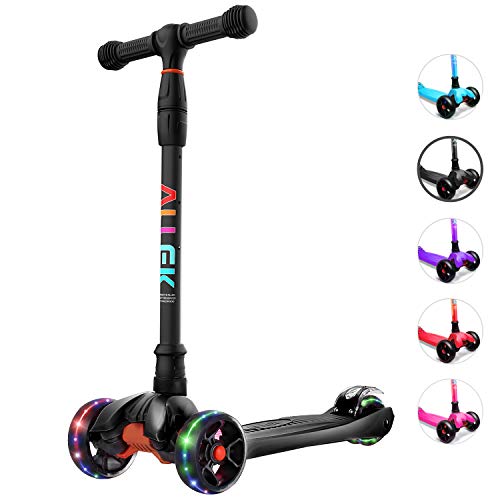
The Allek B02 pairs a reinforced fiberglass deck with durable PU wheels that offer solid grip and shock absorption for a smoother ride. It features four adjustable handlebar heights, making it suitable for children aged roughly 3 to 12 and beyond as needed. The wheels glow due to embedded LEDs activated by rolling motion. This model emphasizes durability and safety with a sturdy locking mechanism and a rust-proof aluminum frame, providing a reliable option for growing riders who demand stability and longer-term use.
Lifemaster 3-Wheel Scooter With LED Lights

The Lifemaster scooter features a luminous LED lighting system on its multi-color wheels to boost visibility and add excitement for riders. It uses Lean-To-Steer technology to help children master steering by leaning, supporting the development of balance and coordination. The adjustable handlebar accommodates growth with several height options. This model emphasizes a secure, three-wheel design combined with safety-focused features like a stable deck and bright wheel lights for enhanced after-dark riding confidence.
Buying Guide: Key Purchase Considerations And Comparisons
- Age and weight suitability: Look for scooters with weight limits and seat/handlebar heights that match your child’s current size and anticipated growth. Three-wheel designs tend to be more stable for younger beginners.
- Safety features: Prioritize non-slip decks, reliable brakes (foot brake or hand brake on some models), and a sturdy frame. LED wheels improve visibility in low light, increasing safety for after-school rides or dusk play.
- Growth potential: Adjustable handlebars and, if possible, convertible sit/stand configurations help the scooter “grow with” your child, extending usable life before a replacement is needed.
- Portability and storage: Lightweight scooters that disassemble easily or fold compactly are ideal for small cars or apartment storage. Weighing around 5–7 pounds is typical for kid-sized models.
- Durability and materials: Look for aluminum frames, reinforced decks, and wear-resistant PU wheels. A robust build reduces the need for frequent replacements as kids learn new skills.
- Wheel size and deck width: Wider decks offer more stability; 6–8 inch wheels are common for kids’ models. Consider larger wheels if your child will ride on rough sidewalks.
- Maintenance: Choose models with straightforward maintenance needs (e.g., simple tightening of clamps, periodic wheel checks) to minimize upkeep for parents.
- Learning curve: Lean-to-Steer designs encourage balance and controlled turning for beginners, and some models add a seat for transitional use as kids gain confidence.
These considerations help compare models beyond visuals, ensuring the chosen scooter matches safety standards, durability expectations, and your child’s development stage. When evaluating, balance immediate usability with long-term growth to maximize value and enjoyment for your young rider.