Best Science Kits for 2 Year Olds: Safe, Engaging Ways to Spark Early Curiosity
Parents looking for early science fun should focus on brightly colored, age-appropriate activities that encourage exploration, fine motor skills, and simple cause-and-effect understanding. The following picks are among the most relevant science toys and kits suitable for toddlers and preschoolers around age 2. They emphasize hands-on play, safety, and screen-free learning while laying the groundwork for future STEM curiosity. A quick summary table is provided to compare key options at a glance.
| Product | ||||
|---|---|---|---|---|
| Now I Am 2 | Doctor Jupiter | Early learning, fine motor, routines | 2+ years | Amazon |
| My First Microscope Kit | Boley | Intro to observation, basic magnification | 3-5 years | Amazon |
| My First Science Kit | Doctor Jupiter | Hands-on experiments, basic STEM | 4+ years | Amazon |
| Fizzy Volcano | Learning Resources | Chemical reactions, fizzing experiments | 4+ years | Amazon |
| 150 Experiments Kit | UNGLINGA | Earth science basics, multiple projects | 6+ years | Amazon |
Note: While many science kits are designed for older children, the selections above include options that support toddlers’ curiosity and provide safe, simple activities that can be enjoyed under adult supervision. Each entry features age-appropriate components, clear instructions, and a focus on exploration rather than memorization.
Now I Am 2: Toddler Learning Kit

Doctor Jupiter Now I Am 2 is a toddler-focused educational set designed to engage curious two-year-olds with playful learning tools. It includes two board books, a sticker activity, a reward chart, and a fine motor skills game. The kit centers on building hand-eye coordination, problem-solving, and routine recognition through interactive play. The materials are crafted to be age-appropriate and safe for small hands, making it a practical entry point for early STEM exploration under caregiver supervision.
My First Microscope Kit
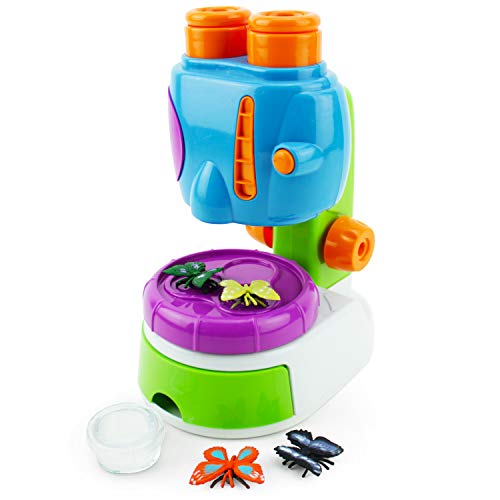
The Boley My First Microscope Kit introduces early scientific observation with a kid-friendly microscope, a rotating tray, and included pretend specimens like toy butterflies. Designed to spark curiosity about the natural world, this starter set emphasizes safe, hands-on exploration. It’s suitable for preschoolers with adult guidance and helps build foundational skills in observation, focus, and classification using simple magnification and kid-safe materials.
Doctor Jupiter My First Science Kit (4-8)

This Doctor Jupiter kit is crafted for early learners with 100+ experiments designed to teach basic scientific principles in a playful way. While geared toward children aged 4 and up, the kit can be used with adult supervision for younger toddlers, offering age-appropriate activities that introduce observation, prediction, and basic problem solving through hands-on projects like water experiments and simple chemistry concepts.
National Geographic Junior Chemistry Set

The National Geographic Junior Chemistry Set introduces kids to safe chemistry experiments with illustrated instructions. While listed for ages 4-6, parental guidance is recommended for younger participants. The kit focuses on simple chemical reactions, illustrating cause-and-effect and foundational lab safety. It’s a solid step toward structured STEM exploration for preschoolers who show interest in liquids, mixing, and harmless reactions.
National Geographic Earth Science Kit

This Earth Science Kit offers over 15 experiments that cover topics like volcanoes, crystal growth, and rock collection. It includes a full color learning guide to explain the science behind each activity. Although marketed to a broader age range, younger children can participate in guided experiments with an adult’s help, reinforcing early concepts about the earth and natural processes through tangible, visual demonstrations.
Fizzy Volcano by Learning Resources

The Fizzy Volcano kit from Learning Resources focuses on eruptions and chemical reactions with kid-friendly tools. It helps young children observe gas production, color changes, and mixing effects. The included guide outlines simple experiments that support early scientific reasoning, while the compact kit design makes it easy to manage during play sessions and classroom-style activities.
UNGLINGA 150 Experiments Kit

The UNGLINGA 150 Experiments Kit offers a wide range of science topics, from earth science to basic physics and chemistry. While many projects are better suited for older children, parents can curate a subset of beginner activities suitable for toddlers. The kit includes many tools and materials, enabling hands-on learning and encouraging kids to explore scientific thinking in a playful, age-appropriate way.
Buying Guide: Key Purchase Considerations For Early Science Kits
When selecting science kits for a 2-year-old, consider safety, age-appropriateness, and learning goals. Look for large, sturdy parts, non-toxic materials, and simple, clearly illustrated instructions. Favor open-ended kits that encourage exploration rather than step-by-step procedures. Parental involvement is essential at this stage to facilitate language development, turn-taking, and safe handling of small tools. Additionally, choose kits that can grow with the child, offering more complex activities as their skills advance.
- Safety first: Always check age recommendations and include adult supervision. Prefer kits with larger pieces and non-toxic components.
- Learning goals: Focus on sensory exploration, fine motor skills, and basic cause-and-effect concepts rather than complex experiments.
- Scalability: Look for kits that can be used in multiple ways or with increasing complexity to extend their usefulness as the child grows.
- Storage: Ensure the kit includes organizers or easy storage to keep parts sorted and accessible for quick play sessions.
- Caregiver involvement: Choose products with simple setup and instructions that caregivers can follow to maximize learning outcomes.
In evaluating these options, parents should balance the child’s current developmental stage with the potential to expand into more advanced science play later. The selections above aim to provide safe, engaging activities that nurture curiosity while remaining appropriate for a 2-year-old’s capabilities when guided by an adult.