Best Toys for 8- And 9-Year-Olds: Engaging STEM and Creative Options
Finding toys that are both fun and educational for eight- and nine-year-olds can boost problem solving, creativity, and hands-on learning. The following selections emphasize STEM learning, artistic expression, and engaging challenges suited for this age group. Each option supports critical thinking, fine motor skills, and collaboration, while keeping play exciting and accessible.
The table below highlights five top picks, with quick notes to help compare how each product supports growth, creativity, and learning at home or in the classroom.
| Product | Brand | Focus | Key Benefit |
|---|---|---|---|
| ThinkFun Gravity Maze | ThinkFun | STEM logic and planning | Brain-building marble maze challenges |
| Blue Marble Magic Chemistry Set | Blue Marble | Magic science tricks | Impressive, kid-friendly experiments |
| National Geographic Kids Magic Set | Blue Marble | Classic magic with instructions | Performance skills and showmanship |
| Smartivity Robotic Hand | Smartivity | Mechanical engineering | Hands-on construction and STEM thinking |
| Memory Game for Kids | Imagineers | Memory, focus, solo or group play | Portable brain training and fun |
Across these picks, you’ll find options that range from science and engineering challenges to creative arts and memory games. Each product supports active learning, encourages exploration, and provides clear opportunities for interaction, whether at home, in school, or during travel.
ThinkFun Gravity Maze: Marble Logic Challenge

ThinkFun Gravity Maze blends marble-based puzzle solving with engineering-style planning, offering a hybrid of play and learning for ages 8 to 12. The set includes multiple towers, marbles, and a game grid to create varied challenges that require critical thinking and spatial reasoning. As children test different marble routes, they practice sequencing, strategy, and persistence—core skills for academic success in science and math. The design supports both independent exploration and collaborative problem solving with family or classmates.
Features include nine distinct towers, three marbles, a grid, and a target piece, enabling endless construction possibilities. The tactile play helps develop fine motor control while introducing foundational STEM concepts, such as cause and effect, gravity, and structural stability. This toy is well-suited for counter activities, classroom centers, or quiet-time brain games at home.
Pretty Me Friendship Bracelet Kit: Creative Crafting

Crafting meets creative expression with the Pretty Me Friendship Bracelet Making Kit, a comprehensive kit designed for girls ages 8 to 12. The set includes 10 spools of colorful string, assorted rubber bands, pegs, heart clasps, and a sturdy storage case that doubles as a crafting board. A step-by-step illustrated guide makes the process accessible for beginners while offering room for creativity as skills improve. The case’s integrated kickstand transforms into an angled workspace, making bracelet weaving comfortable and engaging for longer crafting sessions.
This kit supports fine motor development, color theory, and simple design principles. It’s ideal for gifting, classroom crafts, birthday activities, and group projects where children can share supplies and ideas. The combination of tools and guided instructions helps younger crafters develop patience, planning, and floral or geometric design sensibilities that translate well to broader arts-and-crafts activities.
Blue Marble Magic Chemistry Set: Magical Experiments
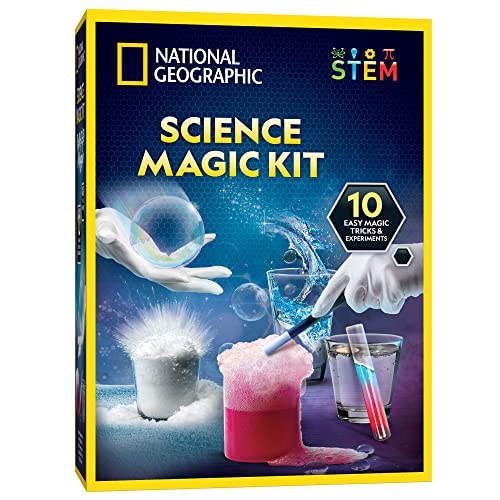
Blue Marble’s Magic Chemistry Set brings 10 science experiments to life with a magical twist. Kids can perform tricks that appear to defy everyday physics, such as making a coin float and transforming water colors. The included magic wand and white gloves invite children to perform as a scientist-magician, combining scientific exploration with performance skills. The illustrated guide is designed to be kid-friendly, explaining the science behind each trick and introducing foundational concepts in a memorable, engaging way.
Key benefits include hands-on experimentation, improved curiosity about physical science, and enhanced explanation skills as kids describe what they observe. The kit’s tricks are designed to impress peers and family, which can boost confidence and presentation abilities. While focusing on safe, age-appropriate experiments, it also emphasizes the importance of careful observation and methodical thinking essential for scientific inquiry.
National Geographic Kids Magic Set: Tricks & Video Guidance

The National Geographic Kids Magic Set blends classic magic tricks with modern instructional support. It includes props for cups-and-balls, a false thumb tip, clues for the ball-and-vase routine, a coin case, and a magic wand. A dedicated magician’s deck offers a practical tool for learning sleight of hand, while step-by-step video instructions provide professional demonstrations to help young performers master each trick. This kit supports performance skills, confidence, and sequencing, which are valuable for both school presentations and social activities.
With an emphasis on showmanship and concept development, children learn to plan routines, practice consistency, and engage an audience. The combination of hands-on practice and visual guidance helps solidify memory, focus, and fine motor coordination as tricks become more complex and polished over time.
Smartivity Robotic Mechanical Hand: Hands-On Engineering

Smartivity’s DIY Robotic Mechanical Hand invites kids aged 8 to 14 to construct and operate a working mechanical hand. The kit emphasizes STEM learning through a guided, step-by-step manual that keeps the build engaging and educational. Participants gain experience with mechanics, levers, links, and timing gears, while also cultivating patience and problem-solving persistence. The product offers a “free parts lifetime” promise, ensuring long-term play and learning as parts are replaced when needed. This hands-on experience reinforces engineering concepts and spatial reasoning in a tangible way.
As children assemble the hand, they learn how motion is translated into action, a foundation for more advanced robotics concepts later on. The clear instructions help keep the experience accessible yet challenging, making it suitable for both independent projects and collaborative, family-building activities that foster teamwork and communication.
Memory Game for Kids: Portable Brain Training

The Memory Game for Kids offers a compelling challenge for eight- and nine-year-olds, combining lights, sounds, and sequence repetition to test memory and focus. The game supports solo play or multiplayer competition, making it versatile for family game nights, classroom activities, or road trips. Each round increases in difficulty, encouraging players to observe patterns, plan ahead, and adjust strategies. Its compact design makes it easy to bring along for travel or quick brain workouts during breaks in the day.
By providing both mental stimulation and social interaction, Memory Game enhances cognitive flexibility and concentration. The portable format supports spontaneous play and structured practice, helping children develop a growth mindset through incremental challenge and feedback.
Buying Guide: Key Considerations For 8- and 9-Year-Olds
- Learning style and balance: Choose toys that blend hands-on activity with clear instructional guidance. Some kids prefer building and puzzles; others enjoy crafts or performances. A mix can support diverse skills, from problem-solving to communication.
- Skill progression: Look for options that scale in difficulty, so children stay engaged as they master concepts. Toys with multiple levels, such as modular builds or expanding trick sets, are ideal for ongoing growth.
- STEM and creative integration: A healthy mix of science, technology, engineering, and math themes alongside arts and crafts helps maintain curiosity across domains. Consider kits that teach scientific thinking, logic, and design.
- Safety and age suitability: Confirm that toys are age-appropriate with non-toxic materials, small parts supervision guidance, and clear safety warnings. Parent involvement may be helpful for more intricate builds.
- Durability and value: Durable components and replacement parts help extend play. Reusable storage solutions, such as cases and organizers, add value by keeping components organized after playtime.
- Portability and family use: Portable games support travel and shared activities. Group-friendly options promote cooperation, communication, and social learning, enhancing the overall experience.
- Budget and accessibility: Consider a mix of mid-range kits and specialty sets. Some items offer more long-term value through repeatable projects and varied activities.
Across these selections, the emphasis is on curiosity-driven learning, hands-on practice, and the development of fundamental skills that support school success. Parents and caregivers can rotate between STEM challenges, creative crafts, and memory-based games to maintain engagement and broaden a child’s learning horizon.