Best Electric Toys for 8 Year Olds That Spark Learning and Fun
Finding engaging, educational, and age-appropriate electric toys for 8-year-olds can boost critical thinking, problem-solving, and creativity. The following selections emphasize hands-on STEM play, programmable robotics, and interactive challenges that suit curious kids. Each product below is designed to captivate, teach core skills, and provide safe, entertaining experiences for children in the 8–12 range.
| Product | Age Range | Category | Key Benefit |
|---|---|---|---|
| 10 in 1 Electric STEM Toys for 5-8 | 5-8 | STEM Building Kit | Multiple models to explore engineering fundamentals |
| ELEGOO UNO R3 Smart Robot Car Kit | 8-12 | Robotics / Coding | Hands-on programming and electronics |
| Henoda Robot Toys | 8-16 | Remote-Control Robots | Motion, app control, and STEM programming |
| Dr. STEM Toys Circuit Science Kit | 8+ | Electrical Experiments | Over 100 experiments with lights and sound |
| Gesture Sensing RC Stunt Car | 6-12 | Remote Control Car | Gesture control and 4WD stunts |
Note: All product summaries reference features listed by the sellers. The items below are selected for relevance to learning, play value, and suitability for an 8-year-old’s developing skills.
10 in 1 Electric STEM Toys for 5 6 7 8 9+ Year Old

The Tsomtto 10-in-1 STEM building set provides a broad entry into mechanical design and basic engineering concepts. With 109 pieces, kids can assemble up to ten different models, including a bulldozer, plane, robot, and racing car. The kit emphasizes hands-on construction and family collaboration as children follow step-by-step instructions to complete one model at a time. It targets ages 5 and up, making it a flexible choice for a household with varying skill levels. An upgraded electric power feature adds excitement while encouraging exploration of circuitry and motion.
Educational value centers on spatial reasoning, follow-through with instructions, and teamwork as family members read the guide together and discuss how different mechanisms translate into motion. Batteries are required (not included), so plan for common AA power needs. This toy blends creative play with STEM practice, supporting early engineering literacy in a tangible, repeatable format.
ELEGOO UNO R3 Smart Robot Car Kit

The ELEGOO UNO R3 kit is a comprehensive robotics and coding platform designed for beginners and expanding learners. It includes 24 modules, such as obstacle avoidance and line tracing, enabling a progression from simple circuits to more complex autonomous behavior. The package supports Android and iOS control through mobile devices, and it is easy to assemble thanks to standardized interfaces. This kit can serve as a long-term learning tool, offering evolving challenges as the child grows their programming and electronics skills.
Strengths include hands-on experimentation with sensors, remote control options, and a clear bridge from electronics to software. The project-oriented nature helps 8–12-year-olds develop logical thinking, problem-solving, and persistence. Some setup may require adult supervision for younger builders to ensure safe and effective assembly, especially when handling multiple modules.
Henoda Robot Toys for 8-16 Year Olds
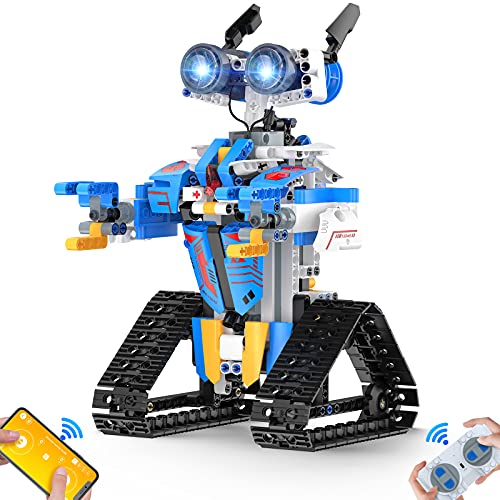
The Henoda robot kit features 468+ pieces for building transforming robots with glowing eyes, flexible joints, and 360-degree rotation capabilities. It supports multiple control modes, including smartphone app via Bluetooth, 2.4GHz remote control, and several programmable modes such as path, voice, and STEM programming. This breadth allows children to explore robotics, programming logic, and motor control while enjoying expressive animations and interactive play.
Educational focus centers on spatial awareness, sequencing, and cause-and-effect relationships as kids plan routes, adjust joints, and test responses. The kit is well suited for older children who can manage more complex construction and prefer interactive, tech-forward play. It can also support group projects and family demos to reinforce collaborative skills.
Dr. STEM Toys Circuit Science Kit

The Dr. STEM Circuit Science Kit offers over 100 electrical experiments designed to illuminate how circuits, lights, sounds, and motors interact. This kit emphasizes hands-on experimentation and observation, helping kids understand circuitry concepts through practical activity. It supports steady progression from basic circuits to more intricate projects, fostering persistence and curiosity while demystifying electronics.
As an educational tool, it provides measurable outcomes like identifying series vs. parallel circuits, understanding current flow, and evaluating how components affect performance. It is well-suited for homeschool use, classroom demonstrations, and curious kids who enjoy tinkering and testing hypotheses in a structured setting.
Gesture Sensing RC Stunt Car

The Gesture Sensing RC Stunt Car combines 4WD performance with advanced gesture control, allowing kids to steer and perform stunts with simple hand movements. It features dynamic lighting and music to enhance the driving experience, providing immediate feedback and a satisfying sense of control. Two high-capacity batteries help minimize downtime during play sessions, keeping the action moving as kids practice timing and precision during stunts and turns.
From an educational viewpoint, the car supports kinesthetic learning by translating motion into robotic response, reinforcing ideas about cause and effect, control systems, and troubleshooting. The accessible gesture controls make it appealing to younger and older kids alike, with a focus on active engagement and repeatable trial-and-error learning.
Buying Guide: Key Purchase Considerations And Comparisons
- Age appropriateness and safety: Verify the recommended age range and any small parts. Look for durable materials and age-appropriate complexity to sustain interest without frustration.
- Learning goals: Decide whether you want hands-on building (engineering), programming (coding and robotics), or science experiments (electric circuits). A mix can provide a broader skill set over time.
- Expansion potential: Some kits offer modular or upgradeable components, enabling continued learning as a child grows. Check for compatibility with additional modules or software.
- Control method and engagement: Gesture-based, app-controlled, or remote-control options each shape the user experience. Consider the child’s comfort with technology and the importance of screen time.
- Supplies and setup: Note requirements such as batteries, charging needs, or accessory pieces. Some kits come with everything needed, while others require extra purchases.
- Learning trajectory: For families seeking gradual progression, start with simpler kits and advance to more complex systems as skills develop. Docs, tutorials, and guided projects can support this path.
- Value and durability: Assess piece counts, included accessories, and build quality. Higher piece counts often reward deeper exploration but may require more time to complete.
- Educational balance: Favor products that emphasize problem-solving, experimentation, and critical thinking over pure play to maximize long-term benefits.
Overall, the selections emphasize hands-on learning, programming basics, and interactive play appropriate for eight-year-olds. Each option supports cognitive development through structural design, logical sequencing, and creative problem solving, while maintaining engaging, age-appropriate play.