Best Flash Cards for Autistic Children: Educational Sensory Tools
Choosing effective flash cards for autistic children involves focusing on visuals, sounds, and ease of use to support speech, language, and cognitive development. The following selections emphasize sensory engagement, clear cues, and practical portability for therapy at home or in school settings.
| Product | Brand | Key Benefit |
|---|---|---|
| Aullsaty Talking Flash Cards (248 Sight Words) | Aullsaty | Montessori-inspired word learning with sounds and 14 subject areas |
| Plastic Communication Cards (Nonverbal) | Hidaya Prints | Portable visual aids for daily needs and feelings |
| My Communication Cards (27 Cards) | Amonev | Simple pictorial cues to promote language development |
| CHEFAN 120 PCS Autism Cards | CHEFAN | Large set of visual cue cards for daily use and therapy |
| ZONSTVYS Talking Flash Cards (510 Words) | ZONSTVYS | 2-in-1 learning with an LCD writing tablet and cards |
Aullsaty Talking Flash Cards With 248 Sight Words

The Aullsaty talking flash cards offer a cat-themed reader that delivers 248 sight words across 14 subjects, including animals, vehicles, letters, numbers, foods, and daily necessities. Designed for Montessori-inspired learning, this toy uses sounds from animals and vehicles to engage children and support early language skills. It is positioned as a speech therapy aid and sensory toy, with adjustable volume and a repeat function to reinforce pronunciation. The product is intended for autistic children and families participating in therapy sessions at home and in care settings.
Aullsaty 248 Sight Words Flash Cards (Second Listing)

This version mirrors the 248-sight-words learning approach with a cat reader design, offering a broad vocabulary across 14 categories. The included animal and vehicle sounds, plus a user-controlled repeat and volume, support both independent play and guided sessions. The cards are intended to aid speech therapy and language recognition for autistic children, while also providing family-friendly engagement for home use.
Plastic Communication Cards For Non-Verbal Children

Hidaya Prints offers a ring-bound set of 30 double-sided picture cards, totaling 60 illustrated words. Sized at 75 x 75 mm, these quick-reference visuals support nonverbal communication and daily needs in autism support, speech delays, and early language development. The compact format is ideal for on-the-go use and easy organization for therapists, teachers, and families working with toddlers and individuals who benefit from clear pictorial cues.
My Communication Cards For Visual Aid In Special Education
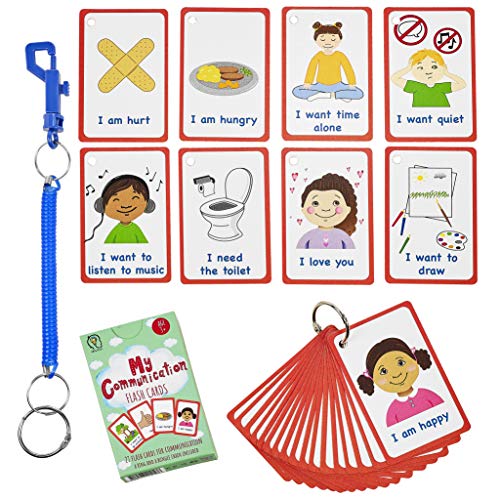
Amonev’s My Communication Cards focus on developing language through simple, illustrated cues. The pack emphasizes reducing anxiety by providing clear pictorial prompts that encourage responses and recognition. It is presented as a straightforward, practical tool for nonverbal individuals and those with speech delays, supporting both clinical therapy and home routines with easily accessible visuals.
CHEFAN 120 Autism Communication Cards

CHEFAN’s 120-card set covers three themes with robust visuals and a practical carry system, including plastic flip rings for easy organization. These cards serve as visual aids for autism therapy and daily routines, enabling nonverbal or speech-delayed individuals to express needs, emotions, and activities. The kit’s portability and clear imagery support independent use, social interaction, and routine-building in various settings, from classrooms to family environments.
ZONSTVYS Talking Flash Cards With LCD Writing Tablet

ZONSTVYS blends traditional flash cards with a 7-inch LCD writing tablet, providing a 2-in-1 learning experience. The kit includes 255 double-sided cards, totaling 510 sight words across topics like animals, vehicles, and food. The tablet function supports drawing and doodling, fostering fine motor skills alongside language development. Built for durability and child safety, this option suits early learners, speech therapy, and families seeking versatile educational tools.
Buying Guide
Key considerations when selecting flash cards for autistic children include:
- Learning modality: Visual cues, audio prompts, or a combination (multisensory approaches) tend to support different communication needs.
- Vocabulary scope: Check the number of words and the subject range to ensure coverage of common daily needs and interests.
- Ease of use: Look for simple operation, durable design, and portability for therapy sessions at home, school, or on the go.
- Engagement and motivation: Cards with familiar themes and appealing visuals can increase attention and participation.
- Therapy alignment: Consider whether the set supports speech therapy goals, including imitation, labeling, and functional communication.
- Expandability: Some sets offer add-on cards or digital features (like an LCD tablet) that grow with the child’s skills.
- Care and safety: Non-toxic materials, rounded corners, and child-safe construction are important for frequent handling.