Best Montessori Language Objects for Early Vocabulary Building
This guide highlights top Montessori language objects designed to strengthen vocabulary, letter sounds, and word comprehension through hands-on play. Crafted to support independent learning, these sets emphasize concrete objects, matching activities, and visual cards that align with Montessori principles. The selections below focus on language development using miniature items and card-based activities that engage young learners while building foundational literacy skills.
Summary of Chosen Products
| Product | Brand | Type | Link |
|---|---|---|---|
| MEROCO Montessori Language Miniatures Objects | MEROCO | Amazon | |
| Kiddison Montessori Language Materials: 12pcs Mini Kitchen Replicas | Kiddison | Matching Cards / Miniature Kitchen Objects | Amazon |
| Kiddison Montessori Language Materials: 12pcs Mini Clothing Replicas | Kiddison | Matching Cards / Miniature Clothing Objects | Amazon |
| Kiddison Montessori Language Materials: 12pcs Mini Living Room Replicas | Kiddison | Matching Cards / Mini Living Room Objects | Amazon |
| MEROCO Montessori Animal Match Game Cards Marine Animals | MEROCO | Matching Cards / Marine Animal Toys | Amazon |
MEROCO Language Miniatures Objects

The MEROCO Language Miniatures set presents 38 Montessori-inspired objects designed to support early language development. The collection balances beautiful, tangible items with practical, affordable options to encourage everyday language practice. Children can explore object names, sounds, and descriptive language as they engage in concrete-to-abstract activities—moving from real-world objects to spoken and later written language. The inclusion of various everyday items helps learners label categories, expand vocabulary, and build confidence in naming and describing what they see.
Key features include a structured mix of familiar items and mood-appropriate visuals that align with Montessori practice: concrete sensory input, clear object contrasts, and opportunities for guided storytelling or labeling tasks. The set is well-suited for language shelves, language centers, or independent exploration, enabling children to practice pronunciation, categorization, and word retrieval in a hands-on way. With careful handling and routine use, this collection can support foundational literacy alongside phonemic awareness activities.
Montessori Language Materials: Mini Kitchen Replicas
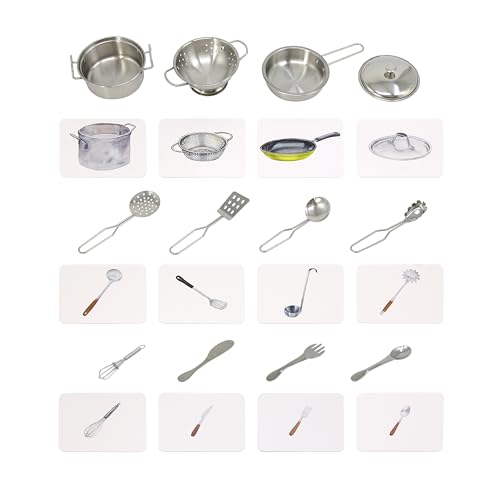
This 12-piece set focuses on language development through category-based matching. The kitchen-themed objects provide familiar vocabulary (e.g., utensils, cookware) paired with picture cards to support word recognition, description, and matching tasks. The material encourages children to classify objects by function or type, reinforcing vocabulary breadth and semantic connections. The combination of tangible items and quick-reference cards makes it ideal for small-group activities, guided language lessons, or independent practice that aligns with Montessori principles of self-directed, hands-on learning.
Features emphasize Montessori-friendly learning: concrete objects aid in naming, cards reinforce memory and recognition, and the materials lend themselves to category-based activities. Presenting items by category helps learners build linguistic schemas and supports early expressive language as children narrate what they observe. The durable design suits classroom and home environments, and the compact nature makes it easy to integrate into daily language routines, storytelling prompts, and language games.
Montessori Language Materials: Mini Clothing Replicas

The 12-piece clothing set combines practical life relevance with language learning. بچوں can name and describe wardrobe items, describe textures, colors, and uses, and match cards to real-life objects. This supports a concrete-to-abstract progression, as children first recognize 3D items and then connect those items to 2D images and vocabulary labels. The cards are large and high-contrast, making matching intuitive for early learners and helping with visual discriminability and vocabulary expansion across clothing categories such as tops, bottoms, and accessories.
From a Montessori perspective, this material supports independent exploration, precise language use, and descriptive speech. Teachers and caregivers can design activities around sorting by category (e.g., season, color), function (e.g., wear for warmth), or sensory attributes (soft, rough). The set’s compact size facilitates easy rotation among language shelves and makes it simple to reuse in different storytelling or role-play scenarios, reinforcing language-rich play without overwhelming young children.
Montessori Language Materials: Mini Living Room Replicas

This 12-piece set focuses on home-life items that children commonly encounter, helping to expand language around everyday activities and household objects. Matching cards accompany small-scale living room pieces, enabling children to name items, describe functions, and discuss where each object belongs. The set reinforces careful observation, vocabulary recall, and narrative skills as learners describe scenes, compare items, and create stories around a living room scenario. The material lends itself to both structured language lessons and open-ended storytelling during language centers.
Designed to be Montessori-friendly, the kit supports sensory-rich exploration and concrete-to-abstract reasoning. Children can sort items by room function, practice describing features (size, color, usage), and gradually move to more complex language tasks such as creating short sentences or captions for the cards. The combination of tactile objects and photographs provides a robust scaffold for building sentence structure and descriptive lexicon in a playful classroom or home setting.
MEROCO Animal Match Game Cards Marine Animals

The MEROCO marine animal match game combines matching cards with real-world imagery to support vocabulary development and pronunciation practice. This set is well-suited for Montessori environments, offering clear, realistic photos that help children identify and label marine animals. Cards are designed for little hands and include 12 items, making it feasible to create small-group activities, individual practice, or paired language games. Practitioners can use the cards to introduce new animal names, discuss habitats, and prompt descriptive language about size, shape, and color.
With a focus on concrete learning, the Marine Animals set supports the progression from concrete experiences to more abstract language use. It encourages learners to verbalize what they see, describe attributes, and compare different animals. The inclusion of tactile play with matching activities reinforces listening and speaking skills, making it a strong addition to a Montessori language shelf for early learners who benefit from multi-sensory engagement.
Buying Guide: Key Considerations for Montessori Language Objects
Selection goals: Choose language objects that provide clear, manipulable items and corresponding cards. Look for sets that balance concrete (3D objects) with 2D images to support a smooth progression from naming to description and basic sentence construction.
Age appropriateness: Pick materials designed for preschool to early elementary learners. Materials should be large enough for small hands, with high-contrast visuals to support recognition and avoid visual fatigue.
Language scope: Ensure the collection covers a range of vocabulary categories (objects, clothing, household items, animals) and offers opportunities for label pronunciation, categorization, and storytelling. A mix of nouns, verbs, and descriptive terms supports broader language development.
Montessori alignment: Look for hands-on, self-correcting activities that encourage independent exploration. Materials should promote sensory engagement, category-based organization, and gradual stepping from concrete to abstract language tasks.
Durability and maintenance: Select sturdy, easy-to-clean materials suitable for classroom and home use. Card stock should withstand frequent handling, and objects should be safe for young learners to examine closely.
Integration potential: Consider how the sets can be incorporated into daily routines, language centers, circle time, or small-group tasks. Portable sets ease rotation between shelves and classrooms, maximizing exposure to new vocabulary.
Assessment support: Choose materials that allow educators to observe pronunciation, word recall, descriptive language, and categorization skills. Simple checklists or rubrics can help track progress over time.
Cost and availability: Compare sets based on the number of items, variety of categories, and whether a given item complements existing language shelves. Bundles that mix common categories may offer more versatile usage without overwhelming learners.
Accessibility: Ensure images and cards are clear and legible for diverse learners, including those who rely on visual supports. Descriptive prompts and labels in the cards can aid comprehension and language production.
Summary: For language-focused Montessori practice, prioritize sets that combine tangible objects with intuitive matching cards, emphasize category-based organization, and provide multiple entry points for speaking, listening, and early writing activities. The five selections presented here offer a balanced mix of language-rich miniatures and image-based matching tasks designed to support progressive language development in young learners.