Best Engineering Toys for Boys: Top STEM Kits for Hands-on Learning
Parents and educators seeking engaging, hands-on toys that cultivate engineering thinking can turn to well-crafted STEM kits. This guide highlights five highly regarded options that cover bridges and structures, robotic hands, Arduino-compatible robotics, solar-powered builds, and arcade-style mechanical play. Each choice builds critical skills like problem solving, spatial reasoning, and basic physics while offering screens-free fun.
| Product | Brand | Highlights |
|---|---|---|
| Thames & Kosmos Structural Engineering: Bridges & Skyscrapers | Thames & Kosmos | 20 models, 285+ pieces, experiment manual |
| Smartivity DIY Robotic Mechanical Hand | Smartivity | Hands-on DIY robotics, screen-free, lifetime parts |
| ELEGOO UNO R3 Smart Robot Car Kit V4 | ELEGOO | Arduino robotics for beginners, 24 modules, smartphone control |
| Sillbird 12-in-1 Solar Robot Building Kit | Sillbird | Solar-powered, 190 pieces, outdoors and indoors |
| Smartivity Pinball Machine | Smartivity | Full-function mechanical arcade build, lifetime parts |
Thames & Kosmos Structural Engineering: Bridges & Skyscrapers

The Structural Engineering kit by Thames & Kosmos introduces foundational concepts in force, load, compression, and tension through model building. Its 285+ interchangeable pieces enable a wide range of designs, from bridges to skyscrapers. An illustrated 36-page manual guides experimentation and assembly, helping learners understand how structures respond to different stresses. The kit supports inquiry-based play, encouraging kids to predict outcomes, test hypotheses, and iterate designs for stronger builds.
Smartivity DIY Robotic Mechanical Hand

This kit provides action-packed, screen-free STEM fun as kids assemble a mechanical hand. The step-by-step manual supports independent building and troubleshooting, reinforcing principles of simple machines and robotics. It’s designed for ages 8–14 and emphasizes creative problem solving, spatial reasoning, and mechanical intuition. A lifetime replacement parts offer ongoing playability, making it a durable option for repeated projects and classroom use.
ELEGOO UNO R3 Smart Robot Car Kit V4

The ELEGOO UNO R3 kit is an entry-point to Arduino-based robotics. It includes 24 module parts, such as obstacle avoidance and line tracing modules, with control possible via Android and iOS devices. The kit emphasizes hands-on programming, electronics assembly, and robotics concepts, making it suitable for beginners who want to explore coding alongside hardware. Interfaces and ports are designed to minimize setup errors and streamline the learning curve for young makers.
Sillbird 12-in-1 Solar Robot Building Kit
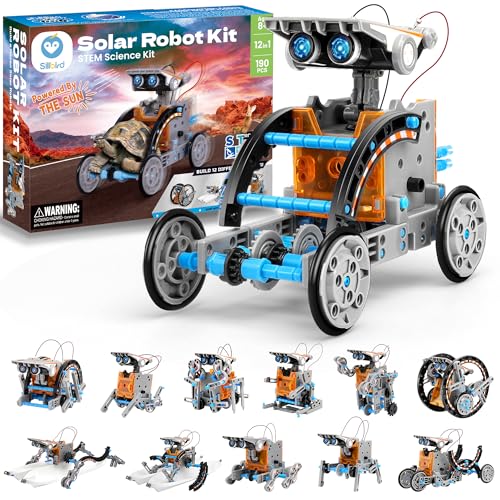
This solar-powered kit introduces renewable energy concepts through outdoor, sun-driven robotics. With 190 pieces and 12 different models, learners can experiment with propulsion, gears, and energy transfer. The solar aspect fosters understanding of sustainability and real-world physics while reducing reliance on batteries, making it a strong choice for hands-on experiments outdoors or in well-lit indoor spaces.
Smartivity Pinball Machine

The Smartivity pinball machine offers a compact, fully mechanical arcade experience. Builders follow a guided manual to construct a working pinball setup, then experiment with levers, ramps, and flippers. The activity fosters understanding of motion, leverage, timing, and cause-and-effect, while providing a tangible, screen-free play option that appeals to boys and girls aged 8–14.
Buying Guide
- Age appropriateness: Most kits target children aged 8–14, with some starting younger. Check recommended age and difficulty to match a learner’s current skills.
- Learning goals: Choose kits aligned with goals such as mechanical engineering, robotics, programming, or renewable energy to complement curricula or personal interests.
- Hands-on vs. digital: Some sets emphasize mechanical assembly and physical models; others introduce coding or microcontroller work. A mix can provide breadth.
- Parts availability: Look for kits with modular or upgrade-friendly designs and options for replacement parts, especially for growing skill levels.
- Materials and safety: Non-toxic components, sturdy construction, and clear instructions support safe, durable play. Check for small parts if younger siblings are present.
- Future-proofing: Kits that can be expanded with extra modules or compatible with other platforms (e.g., Arduino) offer long-term value as expertise grows.
- Storage and organization: Sets with organized containers or trays help keep parts sorted, encouraging independent planning and cleanups.
- Cross-disciplinary benefits: Look for projects that integrate science concepts with math, problem solving, and design thinking for a well-rounded learning experience.
- Budget and scale: Larger builds with 20+ models offer variety, while compact kits are ideal for travel or small spaces. Consider available workspace and time for assembly.
These selections provide a spectrum of engineering-oriented play—from structural analysis to robotics and renewable energy. When choosing, consider the child’s interests, the level of challenge desired, and the value of ongoing playability through expansion or replacement parts.