Best Science Kits for 9 Year Olds: Exciting Hands-on Learning Projects
Discover science kits that spark curiosity and provide hands-on experiments for nine-year-olds. This guide highlights engaging options that balance fun with foundational STEM concepts, helping kids explore chemistry, physics, earth science, and electronics through safe, age-appropriate activities.
| Product | Brand | Highlights |
|---|---|---|
| National Geographic Gross Science Kit | Blue Marble | Gross-out experiments, 15 base + 30 extra using household items |
| National Geographic Stunning Chemistry Set | National Geographic | 45 experiments including volcano and rocket |
| National Geographic Mega Science Lab | Blue Marble | Three kits in one; Earth science, chemistry, and magic projects |
| National Geographic Circuit Maker Kit | Blue Marble | Over 120 electrical circuit projects |
| Doctor Jupiter Ultimate Science Kit | Doctor Jupiter | 135+ experiments; comprehensive STEM kit |
National Geographic Gross Science Kit

Features emphasize high-interest, gross-themed experiments to engage kids while teaching core scientific concepts. The kit includes activities for 15 gross experiments with an added 30 experiments using common household items. Instructional guides are kid-friendly with illustrations to help guide each step, and provide insights into the science behind the gross effects. The set aims to sustain curiosity with a larger exploration scope beyond the initial experiments.
National Geographic Stunning Chemistry Set

This chemistry-focused kit offers a curated set of 45 experiments designed to reveal chemical reactions in a kid-friendly format. Projects include volcanoes, geysers, and rocket launches, with easy-to-follow, illustrated instructions. The emphasis is on hands-on investigation and observation, helping young learners connect everyday phenomena to chemical concepts while maintaining safe, guided activities.
National Geographic Mega Science Lab

Three science kits in one provide a broad exploration across Earth science, chemistry, and magic-inspired STEM projects. The kit includes activities like volcano building, fossil digging, glow-in-the-dark crystal growth, and more. A bonus guide and real rock, mineral, and crystal specimens enhance the investigative experience, offering both practical experiments and collection-oriented learning opportunities for curious minds.
National Geographic Circuit Maker Kit

Designed to introduce basic electronics, this kit features over 120 projects that explore circuit concepts through interactive activities. Kids can experiment with sound, light, motion, and other electrical phenomena. Video-assisted instructions via QR code provide additional context, helping learners understand circuit design while staying safe and engaged with hands-on building.
Doctor Jupiter Ultimate Science Kit
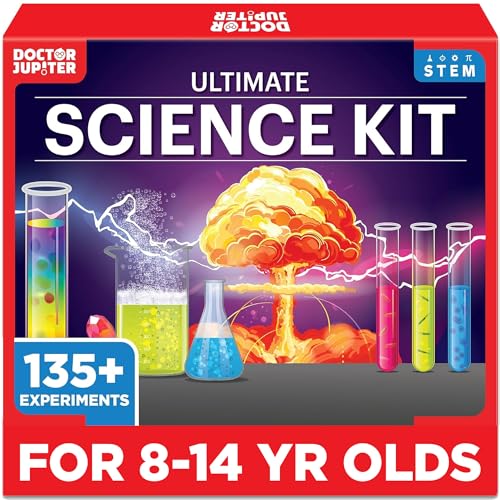
With 135+ experiments, this kit spans a wide range of scientific topics—from color changes and glowing liquids to volcanoes and crystal growing. It emphasizes STEM learning through guided, kid-friendly instructions and offers a broad, curiosity-driven learning path. The kit is positioned as a comprehensive gift option for ongoing exploration and skill development across multiple science domains.
Buying Guide
- Age appropriateness: Look for kits labeled for 8–12 years to match a nine-year-old’s capabilities and curiosity.
- Learning goals: Identify whether the child is more drawn to chemistry, physics, earth science, or electronics to align with interests.
- Safety and supervision: Choose kits that include clear safety guidance and non-toxic materials; plan for adult supervision during experiments involving heat, chemicals, or small parts.
- Instruction clarity: Prefer kits with illustrated, kid-friendly manuals and optional video instructions to support independent learning.
- Expansion potential: Kits that offer additional experiments or compatible accessories can extend learning over time.
- Value and variety: Consider sets that provide a breadth of topics (three-in-one kits or multi-topic kits) to keep engagement high.
- Hands-on vs. guided: Some kits encourage open-ended exploration; others provide structured experiments. Both have educational value depending on the child’s learning style.
- Maintenance and storage: Look for kits with organized components and included storage solutions to minimize setup time.