Best Chemistry Sets for 9 Year Olds: Fun & Safe STEM Kits
Choosing a chemistry kit for curious 9-year-olds blends hands-on learning with safety and engagement. This guide highlights five highly-rated options that balance experiments, clear instructions, and age-appropriate challenges. Each kit fosters practical science skills, from measurements to observation, while keeping complexity suitable for early middle-grade learners. Read on to compare activities, educational value, and what to consider when selecting the right kit for a budding young scientist.
| Product | Brand |
|---|---|
| Playz Edible Candy Making Science Kit | Playz |
| Doctor Jupiter Girls’ Science Kit | Doctor Jupiter |
| BenBen Science Kits for Kids | BenBen |
| Doctor Jupiter Girls’ Super Science Kit | Doctor Jupiter |
| UNGLINGA 150 Experiments Science Kit | UNGLINGA |
Playz Edible Candy Making Science Kit

The Playz candy-making kit invites kids to explore food science and chemistry through tasty experiments. Activities include making jelly candies, crystal rock candy, chocolates, and lollipops, with tests for sugar solubility and dissolution. The kit emphasizes edible outcomes, linking science to everyday experiences while encouraging careful measurement and observation.
The included lab guide uses colorful visuals and kid-friendly explanations. It acts as an easy-entry chemistry resource, helping children connect concepts like mixtures, solids, and solutions with hands-on steps. This kit suits children who enjoy food science, baking-like activities, and exploring chemical processes through tasty results.
Features highlight a blend of practical activities and safety-conscious design, making it a versatile option for classroom-style learning at home. It supports early engineering thinking and planning, as kids decide how to modify recipes and observe outcomes. Best suited for learners who enjoy gooey, edible experiments.
Doctor Jupiter Girls’ Science Kit for Ages 8-12

This kit from Doctor Jupiter offers a broad suite of over 135 experiments, spanning volcano and crystal-growing activities to water science and more. It is designed especially for girls aged 8-12, focusing on development of critical thinking, problem-solving, and curiosity through varied STEM challenges.
Users follow an instruction manual crafted for easy execution with included equipment and basic household items. The kit emphasizes safe, structured experimentation and gradual skill-building, making it a solid option for independent learning or guided family projects.
The variety of experiments supports different interests, from chemistry basics to environmental science, and fosters confidence as kids complete projects and reflect on results.
BenBen Science Kits for Kids
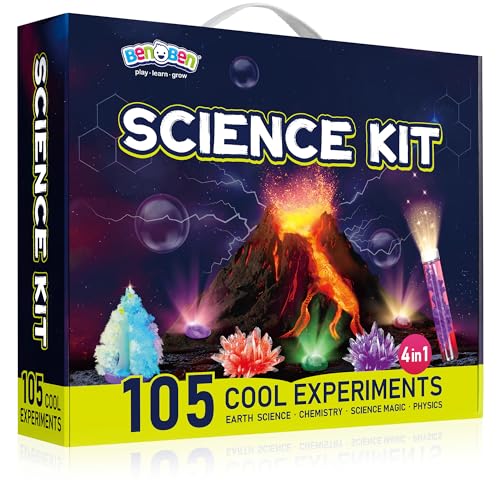
BenBen’s kit lineup covers 105 experiments across earth science, chemistry, physics, and more, including slime, crystal growing, volcano, and potion-style projects. It emphasizes hands-on learning, critical thinking, and problem-solving skills in an engaging, multi-topic approach.
Safety and accessibility are addressed with age-appropriate tools and materials. The kit is designed to sustain interest over time, supporting sequential discovery as kids advance from simpler to more complex experiments. It is well-suited for homeschoolers or families seeking diverse science activities in one package.
Educational goals align with NGSS-style inquiry, encouraging kids to hypothesize, test, and interpret outcomes while developing a practical understanding of scientific processes.
Doctor Jupiter Girls’ Super Science Kit

This more expansive Doctor Jupiter kit features over 100 experiments, including unique activities like unicorn soap, strawberry body mist, and lemon body scrub. It emphasizes engaging, kid-friendly science that blends chemistry with personal care and fragrance projects.
Structured to foster curiosity and sustained exploration, the kit supports a progressive learning arc—children gain confidence as they complete hands-on tasks, document observations, and discuss results with guidance from the manual.
Child–adult collaboration is encouraged, offering opportunities for bonding while modeling scientific thinking and safe experimentation practices.
UNGLINGA 150 Experiments Science Kit

UNGLINGA’s kit stacks a long list of 150 experiments across multiple STEM topics, from chemistry to physics. It includes a well-illustrated, step-by-step manual and a selection of tools and materials designed for home use, with safety at the forefront.
The kit’s breadth supports varied interests and longer-term engagement, helping children build a solid foundation in experimental design, measurement, and observation. It is particularly appealing for families seeking a wide-range science experience in one package.
Buying Guide: Key Considerations for Choosing a Chemistry Kit
When selecting a chemistry kit for a 9-year-old, consider learning goals, safety, and long-term engagement. Starter kits should include clear instructions, age-appropriate experiments, and essential protective gear such as goggles. Look for activities that integrate core concepts like states of matter, solutions, reactions, and measurement to build a strong scientific foundation.
Safety and quality are critical. Check for CE markings, CPC or ASTM certifications where applicable, and materials that are non-toxic and easy to clean. Parental involvement may be beneficial for younger kids, especially when handling heat, glassware, or strong reagents, even if they are child-safe.
Learning style matters. Some kits emphasize edible experiments or craft-like projects that connect chemistry with everyday life (food science, personal care products), while others focus on observation and theory-driven experiments. Consider your child’s interests—culinary science, environmental science, or general chemistry—and choose accordingly.
Skill progression and future learning are also important. A kit should offer a clear path from basic to more complex experiments, with a thorough manual and optional online resources or supplemental guides. NGSS-aligned options can help support school standards, especially for homeschoolers or supplementary education.
Durability and storage influence value. A sturdy case or organized tray helps keep tools and supplies accessible and reduces setup time for each session. Reusability and component quality contribute to long-term use and ongoing curiosity.
Budget and scope should be weighed. Larger kits with many experiments provide ongoing activity but may include many small parts. If time or space is limited, opt for a focused kit with a handful of activities that offer high engagement and repeatable results.