Best Wooden Busy Boards for 1-Year-Olds: Sensory and Motor Skills Toys
The best wooden busy boards for toddlers aged 1 and up combine safe materials, engaging textures, and hands-on activities that promote fine motor skills, problem-solving, and sensory development. The following selections focus on natural wood, kid-friendly switches and lights, and travel-friendly designs that keep little hands busy without screens. Below you’ll find a quick comparison of five top options, followed by in-depth product sections and a practical buying guide to help you choose the right board for your child.
| Product | Brand | Key Benefit | Approx. Age Range |
|---|---|---|---|
| WakeInsa Busy Board | wakeInsa | 8 switches, 14 LED lights for varied exploration | 1-3 years |
| Neikko Busy Board | Neikko | Realistic driving scene with lights and sounds | 1-3 years |
| Potatomato Large Busy Board | Potatomato | 18-in-1 activities for broad skill growth | 1-4 years |
| Potatomato Busy Board | Potatomato | 12 interactive elements for varied play | 1-3+ years |
| Sabdrau Busy Board | Sabdrau | 10 switches with LED lights, travel-friendly |
WakeInsa Busy Board With LED Light

The WakeInsa Busy Board is designed for toddlers aged 1 to 3 years, featuring eight distinct switches and 14 LED light bulbs. The sensory board offers a variety of tactile and visual stimuli to engage young minds and promote fine motor skills. The board is built with child-safe wood and small parts sized for little hands. Requires two AAA batteries (not included) to power the lights. It makes an appealing gift for birthdays and holidays, helping children recognize colors, sizes, and cause-and-effect relationships while keeping them engaged for extended periods.
Neikko Busy Board With LED Lights And Car Theme

The Neikko Busy Board recreates a driving dashboard as a focal point for learning. It includes an on/off start switch, gear shift, dashboard elements, a steering wheel, and a horn, plus seven LED indicators that light in response to actions. The board also features 26 letters in colorful print on the back, blending literacy exposure with motor entry points. A new-style main switch allows turning off all lights at once, and the design emphasizes safe, kid-friendly interaction without excessive electronics, making it suitable for travel and daily play.
Potatomato Montessori Large Busy Board
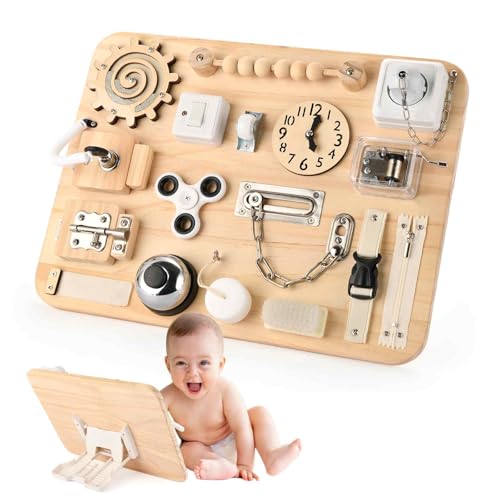
The Large Busy Board from Potatomato emphasizes a broad range of activities to foster imagination and developmental skills. With 18 different activities, the board supports hands-on exploration that evolves with a child’s growing abilities. Crafted from natural wood with non-toxic finishes, the board is hand-polished for safety and comfort, ensuring a secure play surface for curious toddlers. The assortment of latches, switches, and textures helps cultivate fine motor control, hand-eye coordination, and cognitive growth as children manipulate each feature.
Potatomato Busy Board — Travel Ready

This Potatomato Busy Board focuses on 12 interactive elements designed to suit a toddler’s varied skill levels. It features latches, bells, switches, and other tactile components, all constructed from natural wood with smooth finishes to minimize splinters. The vibrant color palette enhances visual attention while mirroring real-world tasks to help kids practice everyday life skills. The design emphasizes durability and safety, making it suitable for home use and travel alike.
Sabdrau Montessori Busy Board

The Sabdrau Busy Board blends ten switches with LED lights designed to capture a child’s interest. The compact, travel-friendly design makes it easy to take on car rides, plane trips, or family outings. It supports color and size differentiation while developing tactile and cognitive abilities. The LED lighting is calibrated for young eyes, providing engaging visual feedback without overwhelming brightness. This board serves as a practical, screen-free activity option for toddlers aged 1 to 3 years.
Buying Guide: Key Considerations And Choices
- Age appropriateness: Look for boards labeled for ages 1-3 or 1-4 to ensure the complexity aligns with your child’s motor and cognitive development.
- Materials and safety: Prioritize natural wood, non-toxic finishes, and smooth edges. Ensure there are no small detachable parts that could pose choking hazards.
- Motor skills and sensory targets: Choose boards with a mix of latches, switches, gears, and LED lights to promote fine motor precision, hand-eye coordination, color recognition, and cause-and-effect understanding.
- Portability and travel readiness: For travel, consider compact dimensions, lightweight builds, and simple battery requirements (generally AA/AAA).
- Power requirements: Note whether batteries are included. Some models require batteries to power LED lights or sounds, which can be a consideration for travel or gift giving.
- Durability and maintenance: Solid wood builds with secure fastenings tend to last longer. Check for easy cleaning and minimal parts that could loosen over time.
- Learning vs. play balance: A mix of educational features (letters, colors, shapes) and open-ended play (fidget elements) supports well-rounded development without over-reliance on screens.
- Travel-friendly features: For families on the go, boards with compact size, built-in handles, or lightweight construction offer practical portability.
- Gifting suitability: Consider boards that work as thoughtful gifts for birthdays or holidays, offering durable design and engaging activities that sustain interest over months.
Overall, wooden busy boards provide a structured, hands-on learning experience that supports early childhood development while offering a safe, screen-free option for busy toddlers. The selections listed above cover a range of styles—from driving-themed and educational to large multi-activity boards—allowing caregivers to match a board to their child’s interests and developmental stage.