Best Animal Toys for Toddlers Aged 1 Year Olds
Discover engaging, safe, and educational animal-themed toys perfect for one-year-olds. From pretend farms to interactive pop-up figures, these picks support early language development, fine motor skills, and imaginative play. Below are five well-suited options with age-appropriate features and durability for curious toddlers.
| Product | Brand | Notes |
|---|---|---|
| Aigybobo Farm Animals Big Barn Toys for 1 2 3 Year Old | Aigybobo | Big barn, 9 animals, stickers, hands-on play |
| Learning Toys for 1,2,3 Year Old Toddlers Farm Animals | Aigybobo | 20-piece farm set, finger puppets, numbers |
| Learning Toy for Toddlers Farm Train | Play-Act | Detachable roof, numbered barns, locomotive |
| Interactive Pop up Animal Toys with Music & Light | Hieoby | Cause-and-effect, 5 animals, lights and sounds |
| Fisher-Price Little People See ’n Say | Fisher-Price | Animal identification, quiz modes |
Aigybobo Farm Animals Big Barn Toys

Aigybobo’s Farm Animals Big Barn Toy includes a large red barn, a farmer, nine animals, and DIY stickers. The design emphasizes bright colors and finger puppets to encourage imaginative farm play and storytelling. The barn and animals use child-friendly materials with smooth edges for safe handling. The set supports fine motor practice through opening doors, placing animals, and decorating activities. Suitable for toddlers aged around 12-18 months and up, the kit focuses on exploring farm life in a tactile, open-ended format.
Learning Toys For Toddlers Farm Animals
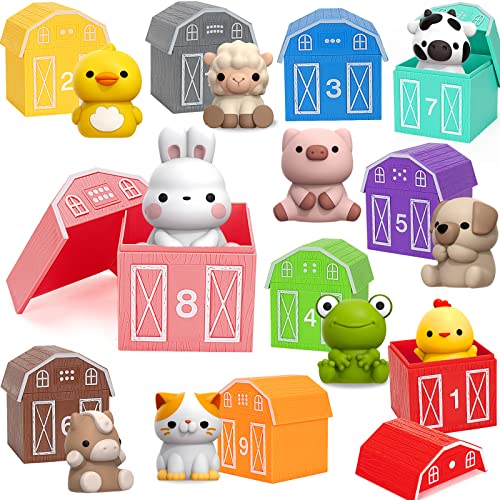
This 20-piece farm animal toy set from Aigybobo includes 10 animals and 10 barns designed for early counting, color recognition, and simple matching. Each animal doubles as a finger puppet, encouraging hands-on play and language development as kids pretend to feed, care for, and identify different creatures. The barns’ numbered lids and dot patterns support basic math and color sorting activities, making it a practical educational toy for 12- to 18-month-olds and beyond.
Learning Toy For Toddlers Farm Train

This Montessori-inspired farm train set features 9 animals and a farmer with a playful, interactive design. The train includes 10 numbered barns and four wagon carriages pulled by a locomotive, encouraging counting, sorting, and pretend play. Detachable roof and open-access design promote exploration and fine motor skills, while bright colors capture attention and spark early arithmetic and storytelling activities in toddlers aged 12-18 months.
Interactive Pop Up Animal Toys With Music & Light

This Hieoby pop-up toy includes five animals and five brightly colored action buttons. Kids press, twist, flip, or slide to trigger animals popping up, which supports cause-and-effect understanding and fine motor skills. The toy offers three play modes—quiet, learning, and game with music and lights—providing varied stimulation and safe, battery-free operation in the quiet mode. Aims to promote animal recognition, color awareness, and hand-eye coordination for infants 9-12 months and older toddlers.
Fisher-Price Little People See ’n Say

The Fisher-Price See ’n Say farm toy introduces kids to animals, sounds, and early vocabulary. By turning the arrow and pulling the lever, children can switch between animal identification and quiz modes. The familiar Little People branding offers durable construction and approachable play for toddlers. The toy supports language development and listening skills while reinforcing cause-and-effect concepts in a safe, age-appropriate format for 18 months and up, though older toddlers can still enjoy it.
Kiddiworld Animal Cars For Toddlers

This Kiddiworld set includes a collection of animal-themed mini trucks, a city mat, and a storage box. The friction-powered cars move forward and backward, with parts that move while in motion. The accompanying play mat creates an instant pretend city for kids to explore. The compact storage box aids organization, making it suitable for indoor play and travel. The assortment promotes imaginative play and basic spatial awareness in toddlers around 12-18 months.
Buying Guide: Key Purchase Considerations
- Age appropriateness: Look for toys labeled for 12-18 months or 9-12 months to ensure small parts are minimized and safety is prioritized.
- Material and safety: Choose BPA-free plastics or wood with smoothed edges. Verify that paint and finishes are non-toxic and durable for rough handling.
- Motor and cognitive development: Toys that encourage grasping, pushing, pulling, stacking, and opening/closing doors help fine motor and hand-eye coordination, while cause-and-effect and sorting activities support early problem-solving.
- Educational value: Pick toys that promote animal recognition, vocabulary, numbers, colors, and basic counting to align with early-learning goals.
- Durability and cleaning: Washable surfaces and sturdy construction reduce wear from drooling, spit-up, and rough play common with this age.
- Hands-on vs. screen-free: For one-year-olds, prioritize tactile, interactive play over electronic screens to support sensory development and safe exploration.
- Portability and storage: Consider sets with inclusive storage solutions or play mats to facilitate easy cleanup and travel.
- Multi-sensory elements: Toys with buttons, textures, sounds, or lights can captivate attention and sustain engagement, encouraging longer play sessions.
- Parental involvement: Toys that invite caregiver participation, like story prompts or role-play, can strengthen bonding and language modeling opportunities.
Choosing animal-themed toys for a one-year-old means balancing safety, simplicity, and opportunities for exploration. The selections above provide a range of farm animals, vehicles with animal motifs, pop-up action, and classic See ’n Say formats to suit different play preferences while supporting early development.