Best Circuit Kits for Kids: Hands-on Electronics Projects for Young Builders
Discover engaging, hands-on ways to spark curiosity in young engineers. This guide highlights top circuit kits that are safe, educational, and fun for kids. Each selection emphasizes interactive learning, STEM skills, and age-appropriate challenges to nurture a passion for electronics. Below is a quick overview of five highly regarded kits, followed by in-depth product sections and a buying guide to help you choose the right fit for your child’s interests and skill level.
| Product | Brand | Recommended Age | Projects |
|---|---|---|---|
| Snap Circuits Jr. SC-100 | Snap Circuits | 8+ | 100+ projects |
| Snap Circuits Classic SC-300 | Snap Circuits | 8+ | Over 300 projects |
| Snap Circuits Beginner | Snap Circuits | 5-9 | 21 projects |
| Sntieecr Electric Circuit Motor Kit | Sntieecr | 6+ | Multiple circuit experiments |
| National Geographic Circuit Maker Kit | Blue Marble | 8+ | 120+ projects |
All five selections encourage safe, hands-on exploration of circuits, wires, switches, and basic electronics. They vary in complexity and number of projects, so you can match a kit to your child’s current interests and growing skills. The sections below offer concise overviews, feature highlights, and practical buying considerations to guide your choice.
Snap Circuits Jr. SC-100 Electronics Exploration Kit

The Snap Circuits Jr. SC-100 kit offers a safe, guided path into electrical engineering for ages 8 and up. With more than 100 possible projects and a full-color instruction manual, children can build functional devices using 28 modular parts. The kit emphasizes practical learning while keeping play elements at the forefront, so budding engineers quickly see how circuitry affects real-world gadgets. The parts snap together easily, reducing frustration and encouraging experimentation. A broad assortment of projects helps reinforce core concepts such as circuits, switches, and basic components.
Key features include a colorful instruction booklet, a wide variety of projects that illustrate real-world applications, and compatibility with other Snap Circuits sets for expansion. The kit’s emphasis on safety and hands-on learning makes it ideal for classrooms, homeschool settings, and family projects. While beginner-friendly, it also introduces concepts that can grow with the child as they advance to more complex kits.
Snap Circuits Classic SC-300 Electronics Exploration Kit
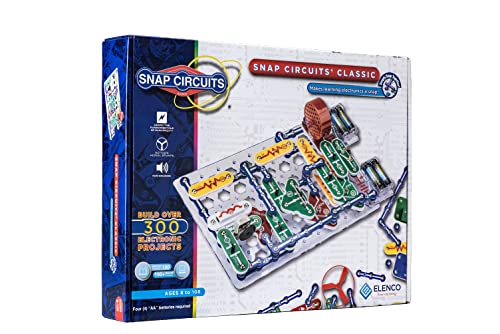
The Classic SC-300 kit is designed for serious junior engineers, offering well over 300 projects and more than 60 pieces. This kit provides a deep dive into electronics, including projects like AM radios and burglar alarms, which help reinforce conceptual understanding through practical application. It also supports social play, as kids can collaborate on challenges and share solutions with friends. The larger assortment of components enables more complex builds, fostering curiosity and persistence as projects scale in difficulty.
Consider this option if your child shows sustained interest in circuits and design. The extensive project library helps avoid repetition and keeps motivation high. As with other Snap Circuits sets, compatibility with additional kits expands possibilities and continued learning over time. The SC-300 balances breadth of projects with clear, engaging instructions to maintain steady progression.
Snap Circuits Beginner

The Snap Circuits Beginner kit is tailored for younger learners, typically ages 5-9. It simplifies the circuitry experience by using childproofed, easy-to-handle pieces that snap together to form functional circuits. In total, the kit includes 21 unique projects, offering a structured pathway from basic concepts to more intricate designs. This approach supports early problem-solving, planning, and troubleshooting, while still delivering the “wow” moment of seeing a circuit come to life.
Ideal for families seeking a gentler start or classrooms introducing younger children to engineering ideas. The Beginner kit can serve as a bridge to more advanced Snap Circuits sets, providing continuity in learning and a smooth transition to higher complexity materials and concepts. Its design prioritizes safety and accessible assembly, which helps build confidence in new learners.
Sntieecr Electric Circuit Motor Kit
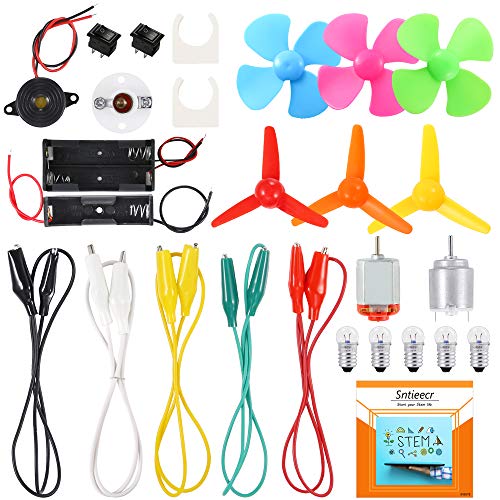
The Sntieecr Electric Circuit Motor Kit is a robust choice for curious minds ready to explore more advanced circuitry. This kit includes multiple components—motors, switches, bulbs, and crocodile clip leads—to build a variety of experiments that demonstrate circuit principles and basic engineering concepts. It is well-suited for homeschool practice, school science projects, and STEM activities that emphasize hands-on problem-solving and creative thinking. The detailed components enable learners to design and test simple circuits with real-world applications.
Consider this option if your child wants to experiment with motion and feedback within circuits. While it introduces a broader range of hardware than entry-level kits, it remains accessible with guided activities. The kit supports collaborative learning and project-based exploration, encouraging learners to iterate and refine ideas as they gain confidence with circuitry concepts.
STEM Toys Science Kits: 7 Bulk Electric Circuit Kit

This bulk set from GadgetGlee offers seven individual fan-kit circuits—packed in separate bags for easy sharing or classroom use. It’s a practical choice for group activities, allowing kids to tackle different circuit challenges independently or collaboratively. While simple in design, the kits provide essential exposure to electrical concepts, including how current flows and how motors and fans respond to different configurations. AA batteries are needed but not included, so consider battery readiness when purchasing.
Use this kit to support classroom-style learning, science fairs, or STEM party activities. It’s especially suitable for introducing basic circuit ideas to larger groups, with the flexibility to assign multiple projects without interference. The kit’s modular nature makes it easy to distribute and manage in a classroom setting or at home with siblings.
Snap Circuits 203 Electronics Exploration Kit

The Snap Circuits 203 kit expands on the classic concept with more than 200 projects and 42 snap modules. It’s designed for ages 8 and up, offering a comprehensive toolbox for building a wide array of devices—from alarms to doorbells and beyond. The project manual remains a central feature, guiding learners through progressively challenging builds. With more components than many entry-level sets, it’s a strong option for sustained engagement and deeper learning in electronics fundamentals.
Choose this kit if your aim is to provide a long-term, scalable learning experience. The diverse project catalog reduces repetition and fosters experimentation, collaboration, and sharing discoveries with friends or classmates. As projects accumulate, learners naturally develop problem-solving strategies and an intuitive understanding of circuit behavior.
National Geographic Circuit Maker Kit

The National Geographic Circuit Maker Kit introduces kids to electrical circuits with over 120 project ideas and kid-friendly video instructions accessible via a QR code. The project variety encourages exploration—from music-making to light shows and flight experiments—providing a broad overview of how circuits work in diverse contexts. The safety-focused design and clear instructions help ensure a smooth learning experience for beginners while offering enough challenge to maintain engagement for older children as their understanding grows.
Opt for this kit when seeking a well-rounded, visually engaging introduction to electronics that can be explored across multiple interests, including sound, light, and motion. The video-supported instruction helps accommodate different learning styles and can be a valuable asset for parents and teachers facilitating hands-on STEM activities.
Buying Guide: Key Purchase Considerations And Comparisons
- Age and skill level: Start with younger, simpler kits to build confidence, then progress to more complex sets. Look for age recommendations and the number of projects as a proxy for learning depth.
- Project variety: A larger project library supports longer engagement and helps prevent repetition. Consider kits that offer 100+ projects for expansive learning or 200+ for deep exploration.
- Component quality and safety: Choose kits with durable, snap-together pieces and clearly labeled components. Safety features and easy cleanup are important for at-home use.
- Expansion potential: Some kits are designed to stack with others or include compatible accessories. If long-term growth matters, pick systems that allow adding more modules later.
- Learning style support: Kits with colorful manuals, QR video instructions, and hands-on activities support varied learning preferences and can improve retention.
- Classroom suitability: For group activities, consider bulk sets or kits with multiple independent projects to minimize wait times and maximize participation.
- Value vs. depth: While entry kits teach fundamentals, more expansive kits offer deeper exploration but come at a higher upfront cost. Balance budget with learning goals.
Across these options, Snap Circuits kits emphasize modular growth, safety, and easy assembly—great for developing foundational electronics literacy in kids. The National Geographic Circuit Maker Kit adds multimedia instruction potential, while the Sntieecr and GadgetGlee offerings provide broader ranges of components for experimentation and class or group use. By aligning a kit with a child’s curiosity and attention span, you can maximize both learning outcomes and sustained interest in STEM topics.