Best Tennis Balls for Kids: Safe, Slow-Flight Options for Young Players
Choosing the right tennis ball for kids means prioritizing low speed, controlled bounce, and visibility. The following selections are designed for beginners and young learners, helping little players build proper technique without getting overwhelmed by pace or bounce. This guide highlights five kid-friendly options, each with features that support early success on the court, whether practicing in a driveway, a gym, or a club court. The table below offers a quick snapshot of the chosen products and their core benefits.
| Product | Brand | Key Benefit |
|---|---|---|
| INSUM Stage-3 Kids Tennis Balls | INSUM | 75% lower compression for controlled bounce and reduced speed |
| GAMMA Quick Kids 36 Training Balls | GAMMA | 75% slower speed with two-toned visibility |
| MRYCZ FYRHD 12 Pack Tennis Balls | MRYCZ FYRHD | 50% low compression, easy transport in mesh bag |
| Franklin Sports Starter + Beginner Balls | Franklin Sports | Pressureless, lower bounce for fundamentals |
| Penn QST 60 Tennis Balls (Youth) | Penn | 50% slower bounce for better control on 60′ courts |
INSUM Stage-3 Kids Tennis Balls

The INSUM Stage-3 line is tailored for beginner players aged 5 to 8. With 75% lower compression, these red balls bounce more slowly, giving young players time to prepare and swing. The two-tone red and yellow felt enhances visibility, making it easier to track spin and trajectory. A larger design adds a forgiving feel on contact, supporting correct stroke mechanics as beginners learn to connect racquet and ball. The Stage-3 standard aligns with USTA/ITF guidelines for entry-level programs, ensuring consistency across youth clinics.
GAMMA Quick Kids 36 Training Balls

GAMMA Quick Kids 36 are designed for young players beginning their tennis journey. The low-compression core reduces speed and bounce by about 75%, enabling longer rallies and improved control for beginners. The two-toned, high-visibility surface (yellow and red) helps kids track flight paths and spin more easily. These balls are well-suited for coaching sessions or home practice, and their predictable performance helps instructors reinforce fundamentals while keeping sessions engaging and productive.
MRYCZ FYRHD 12 Pack Tennis Balls
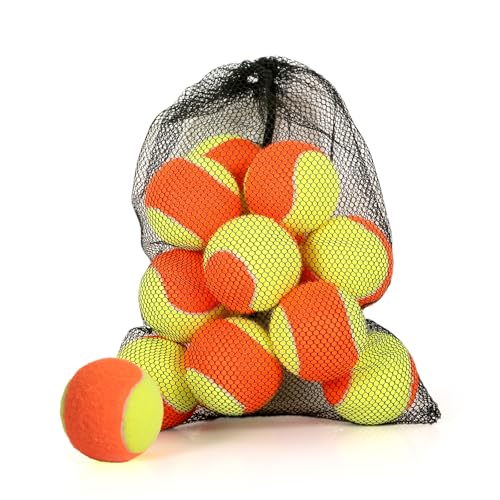
The MRYCZ FYRHD set provides a 12-ball pack designed specifically for beginners. With 50% low compression, bounce height remains manageable, helping kids develop correct stroke timing. The included reusable mesh bag makes transporting balls to lessons or practice sessions convenient. The balls are constructed with natural rubber and durable felt to reduce shock during contact, delivering a comfortable feel that encourages consistent practice and progression for youth players just starting out.
Franklin Sports Starter + Beginner Balls

Franklin Sports offers a starter set designed for younger players (8 and under). The slightly larger ball size makes contact easier, supporting more consistent rallies as beginners learn ball-tracking and swing mechanics. These pressureless, low-bounce balls give new players a forgiving platform to practice fundamentals without the frustration of chasing fast, high-bounce shots. The trio-pack makes it easy to stock a practicing session at home or in a club setting.
Penn QST 60 Tennis Balls

Penn QST 60 tennis balls are crafted for youth players on 60-foot courts, emphasizing slower bounce and reduced speed to improve control during early rallies. Marketed as America’s #1 selling ball, these are designed for consistency and durability, making them a solid option for schools and clubs as well as家庭 practice. The 60′ court-ready design helps players develop proper footwork, timing, and shot selection as they transition to full-size courts.
Buying Guide: Key Purchase Considerations
Choosing the right tennis balls for kids involves balancing speed, bounce, durability, and visibility. Here are essential factors to consider, along with how they apply to young players:
- Compression and bounce: Lower compression balls reduce speed and bounce, giving beginners more time to react and learn. Look for labeled Stage 3 or 50% low compression options for early learners.
- Size and feel: Slightly larger balls and softer felt help with contact, tempo, and hand-eye coordination. For very young players, foam or foam-core balls are a good transitional option before standard felt balls.
- Visibility: Bright, two-tone surfaces improve tracking for new players. High-contrast colors help kids see the ball against different backdrops and lighting conditions.
- Durability and transport: Durable felt and a practical bag or mesh pouch simplify practice logistics, especially for coaches and parents who shuttle balls between sessions.
- Game level alignment: Match balls to age-appropriate court dimensions and competition rules. For example, 60′ court-appropriate balls reduce the challenge of long rallies on smaller surfaces.
Playing Context: Which Ball Fits Your Child?
For absolute beginners, a low-compression ball with forgiving bounce is ideal, allowing confidence-building rallies and steady improvement. For kids transitioning from practice to match play, two-toned, high-visibility balls can aid tracking and shot selection. Coaches may favor a mix of products, using certain balls for warm-ups, others for controlled drills, and still others for match-like scenarios. Consider the child’s age, court size, and practice frequency when selecting a ball type, and rotate through a couple of options to gauge what works best.
Practical Tips for Getting Started
- Start with short, guided practice sessions focusing on stance, grip, and contact point.
- Use a slower ball to build confidence before introducing standard-speed balls.
- Pair balls with age-appropriate equipment, such as smaller racquets or lighter paddles, to support proper technique.
- Incorporate fun drills that reward consistency and accuracy, not just power.
Product Alternatives and Variations
Beyond the five highlighted options, market varieties include foam balls for toddlers or taller youth on mini-courts, as well as traditional pressurized balls for older beginners. If your child shows rapid improvement or begins competing, you may switch to slightly faster or standard-compression balls to accelerate progress. Always monitor wear and bounce to ensure ongoing suitability and safety during practice.