Best Science Kits for Kids: Hands-on Projects That Spark Curiosity
Looking for engaging, educational science kits for kids? This guide highlights five top options that cover chemistry, geology, physics, and Earth science. Each kit offers hands-on experiments, age-appropriate guidance, and real-world learning outcomes. Explore kits that foster critical thinking, problem solving, and creativity while keeping safety in focus. Below you’ll find concise product sections, a quick comparison table, and a practical buying guide to help you choose the right science kit for your child.
Summary Table
| Product | Brand | Key Focus | Age Range |
|---|---|---|---|
| UNGLINGA 150 Experiments Science Kit | UNGLINGA | Earth science, chemistry, physics | 6+ |
| National Geographic Break Open 10 Premium Geodes | Blue Marble | Geology, crystals, geology tools | 6-12 |
| Junior Science Kit for Kids Age 4-14 | PW | Color mixing, basic chemistry, fun experiments | 4-14 |
| National Geographic Science Magic Kit | Blue Marble | Magic tricks with science, physics & chemistry | 6-12 |
| Doctor Jupiter My First Science Kit | Doctor Jupiter | 100+ experiments, STEM exploration | 4-8 |
UNGLINGA 150 Experiments Science Kit

The UNGLINGA 150 Experiments Science Kit provides an extensive set of DIY projects across earth science, chemistry, and physics. It is designed to engage curious minds with hands-on activities and a detailed, step-by-step manual. The kit includes kid-friendly tools and materials, enabling youngsters to wear goggles and function like junior scientists at home or in the classroom.
Key features include a broad selection of experiments, a well-illustrated manual, and accessible tools that make scientific inquiry practical and fun. This kit emphasizes hands-on learning, reinforcing core STEM concepts through repeated experimentation and observation.
National Geographic Break Open Geodes – 10 Premium Geodes

This geode kit invites kids to crack open natural stones to reveal crystals inside, combining geology with the thrill of discovery. Each geode is hand-selected to showcase a variety of crystal formations, encouraging careful observation and identification.
The pack includes protective goggles and display stands, turning the activity into a learning-centered exploration. It offers a clear, tactile way to explore mineralogy, crystal growth, and the science of earth materials, making geology vivid and approachable.
Junior Science Kit for Kids Age 4-14 | 50+ STEM Experiments
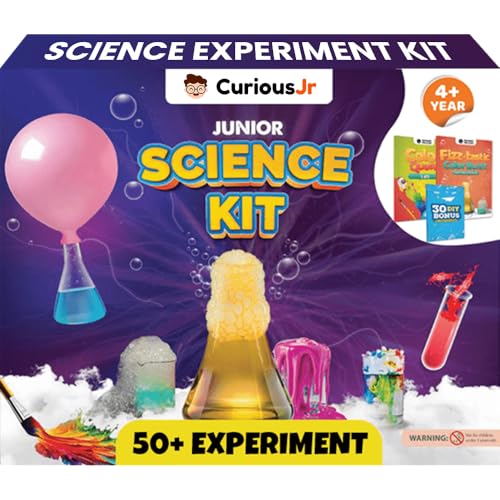
PW’s Junior Science Kit offers more than 50 STEM experiments designed for broad age ranges. It emphasizes color mixing, safe chemical reactions, and visually engaging activities that help kids understand basic scientific principles through interactive exploration. The kit encourages kids to observe, hypothesize, and test ideas in a guided yet open-ended way.
Its colorful experiments and guided prompts support early scientific reasoning, making it a strong option for families seeking diverse, visually appealing activities that still deliver learning outcomes.
National Geographic Science Magic Kit

This kit combines science and magic tricks for entertaining demonstrations that illustrate physics and chemistry concepts. Included materials enable kids to perform 20 magic-inspired experiments that reveal hidden science and spark curiosity about how things work. It is a playful way to introduce scientific thinking and experimental reasoning.
With a focus on visual impact and hands-on participation, the set supports communication skills as children explain their tricks. It also provides a practical bridge between wonder and real-world science, suitable for group activities or individual exploration.
Doctor Jupiter My First Science Kit

This introductory science kit covers more than 100 experiments tailored for younger children. It emphasizes hands-on discovery, critical thinking, and basic STEM concepts through safe, age-appropriate activities. The kit is designed to spark curiosity while guiding parents and teachers in facilitating learning experiences that align with early science standards.
Buying Guide: Key Purchase Considerations
- Age appropriateness: Look for kits labeled for the child’s age to ensure complexity matches development.
- Learning scope: Choose kits that cover multiple STEM areas (chemistry, geology, physics) for a well-rounded experience or focus on a specific interest (volcanoes, minerals, or color science).
- Safety and materials: Prioritize kits with non-toxic materials, clear safety guidelines, and included protective equipment where appropriate.
- Instruction quality: Well-illustrated, step-by-step manuals help independent learning and minimize frustration for younger kids.
- Upgrade potential: Some sets include additional experiments or expansion kits to grow with the child, offering long-term value.
- Engagement factors: Kits that integrate interactive elements, visual results, or magic demonstrations can boost motivation and retention.
- Setting considerations: Consider space, storage, and the possibility of sharing among siblings or classmates.
When evaluating options, consider how a kit aligns with your child’s interests and your learning goals. For families seeking broad STEM exposure, the larger, multi-experiment kits provide variety, while geodes and magic-themed sets can offer focused, captivating experiences. Safety, age guidance, and clear instructions are essential for a positive, educational experience.