Best Reading Toys for 4 Year Olds
Finding the right reading toys for four-year-olds can support early literacy, sounding out CVC words, and letter recognition through engaging, hands-on play. The following five products are chosen for their Montessori-style design, interactive letter activities, and age-appropriate challenges. Each item focuses on foundational reading skills while keeping little learners engaged with colorful visuals and durable materials.
| Product | Brand | Type | Highlights |
|---|---|---|---|
| LITTLE BUD KIDS Spin-and-Read Blocks | LITTLE BUD KIDS | Montessori reading blocks with CVC flashcards | 60+ 3-letter words; self-correction; tactile wooden rods |
| LIWIN LET’S GO! Matching Letter Game | LIWIN LET’S GO! | Educational memory/spelling game | Memory, word recognition, spelling, social play |
| Beestech Alphabet Board + Flash Cards | Beestech | Wooden letters on flash cards | Word building; durable wood; storage bag |
| Tribetots Montessori Alphabet Board | Tribetots | Montessori See & Spell board | Self-directed spelling; movable letters; CVC focus |
| SpringFlower See & Spell Kit | SpringFlower | Letter tiles and cards with CVC word builders | 56 CVC sight words; multi-skill development; collaborative play |
Across these options, the emphasis is on active word construction, phonics awareness, and opportunities for guided or independent practice. Each product is built with kids’ small motor skills in mind, so turning pages, sliding tiles, and rotating blocks remain intuitive for four-year-olds.
LITTLE BUD KIDS Spin-and-Read Blocks
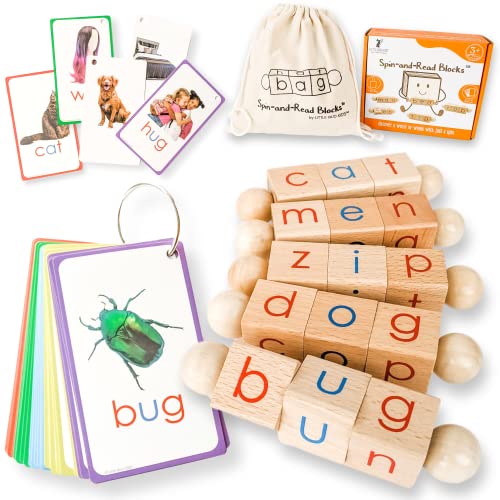
These Montessori-inspired blocks promote phonetic decoding through movable letter rods. The design allows children to rotate vowels and consonants to form 60+ three-letter words, strengthening decoding skills as words link to real-life images on the double-sided flashcards. The kit’s emphasis on CVC word-building helps beginners sound out letters consistently and confidently. The color-coded vowels aid pattern recognition, while the self-correction setup encourages independent learning and accountability for accuracy.
LIWIN LET’S GO! Matching Letter Game
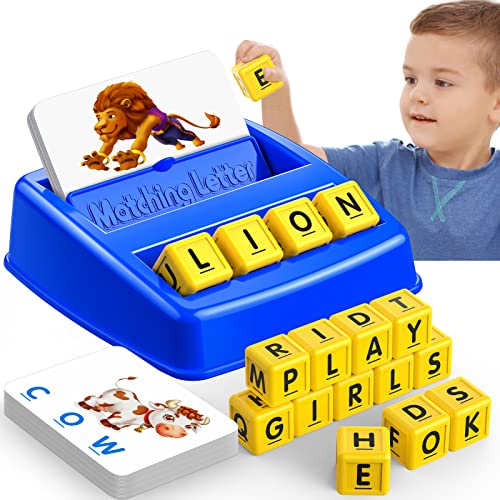
The LIWIN LET’S GO matching letter game is designed to boost memory, letter recognition, and early word-building. Its age-appropriate challenges help children practice quick recall of letters, then connect those letters to potential word formations. The activity also encourages parent-child interaction, turning playtime into a shared literacy session where turns are taken, strategies discussed, and vocabulary explored through engaging, age-appropriate tasks.
Beestech Alphabet Board with Flash Cards

Beestech’s wooden alphabet board pairs with sturdy flash cards to enable word-building practice. Children place wooden letters onto flash cards to form words, reinforcing letter-sound relationships and vocabulary growth. The wooden construction offers durability and a tactile experience that supports fine motor development. The included storage bag makes organization simple, encouraging kids to return pieces to their spot after play, which supports routine and independence.
Tribetots Montessori Alphabet Board

The Tribetots wooden See & Spell board emphasizes self-directed spelling with movable letters that slide along a sturdy board. By building CVC words and gradually longer words, kids gain confidence in letter-sound correspondence and word construction. This Montessori-inspired approach supports independent learning, while the tangible tiles promote dexterity and hand-eye coordination, essential for early literacy habits that persist into later schooling years.
SpringFlower See & Spell Kit

The SpringFlower kit combines double-sided letter flash cards with a generous set of wooden alphabet blocks. It supports sight-word development alongside CVC word-building, and includes a storage bag for easy clean-up and portability. This kit is well-suited for collaborative play, where kids can pair up to spell words, engage in color and letter recognition activities, and practice word-building strategies in a shared setting.
Buying Guide: Key Purchase Considerations
- Learning goals: Choose toys that emphasize phonics, CVC word construction, and letter recognition to build a strong reading foundation before formal reading instruction.
- Age and skill level: Select items that match a four-year-old’s fine motor abilities and attention span, with clear self-correction features for independent practice.
- Durability and materials: Wooden components tend to last longer and withstand daily use; look for smooth finishes and rounded edges for safety.
- Engagement and accessibility: Toys should invite exploration without being overly challenging. Color-coding vowels or visual cues aids pattern recognition and reduces frustration.
- Storage and portability: Kits with pouches or bags promote organization and easy transport for learning on the go or family travel.
- Interactivity: Consider both solitary and collaborative options. Some products encourage parent-child interaction, while others support independent practice.
- Progression: A mix of 1) letter recognition, 2) phonics-based word-building, and 3) simple sight words can provide a well-rounded foundation for early readers.
- Cleaning and maintenance: Look for items that are easy to wipe clean or machine-wafe when applicable, especially for preschool use.
To maximize effectiveness, combine several tools that target different facets of early literacy: tactile letter manipulation, visual flashcards, and playful letter-matching games. Regular, brief practice sessions—5 to 15 minutes a day—can support steady progress in recognizing letters, decoding simple words, and building confidence in reading aloud. Encouraging kids to sound out three-letter words and verify with picture cues strengthens phonemic awareness while keeping the experience enjoyable.