Best Toys for 8 Month Olds: Safe, Stimulating Baby Play
Finding age-appropriate toys for eight-month-old babies involves focusing on safety, sensory exploration, and early motor skill development. The selections below highlight teething relief, grasping and stacking practice, and cause-and-effect play that supports curiosity. Each option is designed for early explorers, with materials that are easy to clean and safe for mouthing. This guide features five top picks with quick references to key features to help caregivers choose wisely.
Summary at a glance: The following products are selected for 8-month-olds. They emphasize tactile variety, simple cause-and-effect mechanics, and portability for on-the-go play. Each item supports fine motor skills, color and shape recognition, and safe teething relief where applicable. Use the buying guide to compare options based on materials, durability, and developmental benefits.
| Product | Brand | Why It’s Great |
|---|---|---|
| Chuya Teether Remote Toy | Chuya | Teething relief with soft silicone and a colorful, baby-friendly remote shape. |
| Sassy Stacks Of Circles | Sassy | Coordinated stacking rings with textured surfaces for mouthing and grasping. |
| Fisher-Price Stacking Blocks | Fisher-Price | Colorful blocks for sorting, stacking, and drop-through play. |
| VTech Busy Learners Cube | VTech | Five sides of discovery with light-up features and pre-K learning basics. |
| Battat Pop-Up Pals | Battat | Cause-and-effect toy with pop-up animals and engaging buttons. |
Chuya Teether Remote Toy

The Chuya teether blends safe materials with a playful, remote-control design that appeals to babies aged 3 to 24 months. The toy is made from food-grade silicone and is suitable for boiling, steaming, or refrigeration, making it a versatile teething solution. Its chew texture addresses discomfort while promoting soft gum relief. Cleaning is straightforward—hand washing, dishwasher, or boiling water are acceptable methods. In addition to soothing teething, the toy can serve as an early education aid by helping infants recognize colors and basic shapes as they explore textures.
Sassy Stacks Of Circles

The Sassy Stacks Of Circles introduces essential early STEM concepts through a simple stacking system. Straight posts accept rings of different sizes, encouraging hand-eye coordination and fine motor development. The chunky rings are easy for little hands to grasp, and each ring offers a distinct texture and weight, which enhances sensory exploration. The design supports independent exploration, making it a reliable toy for flooding early cognitive skills with tactile feedback during playtime.
Fisher-Price Stacking Blocks

The Fisher-Price Stacking Toy offers a set of 10 colorful blocks designed for sorting and stacking. Babies can practice dropping shapes through a lid, and all blocks store neatly inside the included bucket for easy cleanup. The easy-carry handle supports on-the-go play and helps caregivers introduce basic concepts like size, color, and sequence as part of daily routines. This toy aligns well with early problem-solving skills and keeps playtime organized and mess-free.
VTech Busy Learners Cube
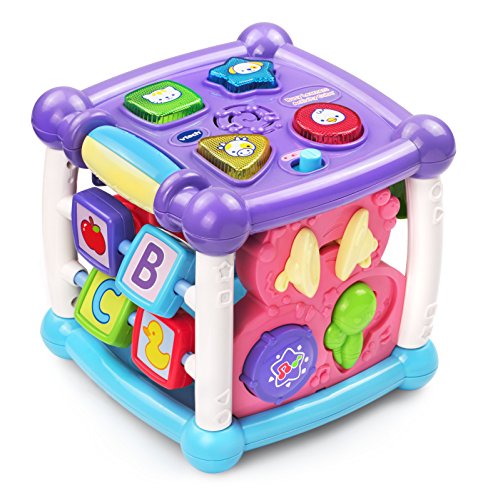
The VTech Busy Learners Activity Cube introduces a five-sided array of activities that encourage discovery and exploration. With 14 interactive features, including light-up buttons and animal-themed sounds, it helps develop fine motor skills, color and shape recognition, and early vocabulary. The motion sensor activates sounds when the cube is moved, attracting a baby’s attention and supporting engagement. This toy fosters independent exploration while also inviting caregivers to participate during playtime for language development.
Battat Pop-Up Pals
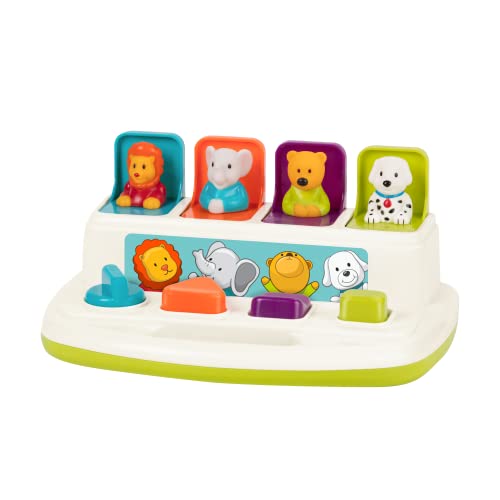
The Battat Pop-Up Pals toy emphasizes cause-and-effect learning. Press a button to trigger a friendly animal pop-up, with multiple buttons offering different actions like turning, pressing, flipping, and sliding. This interactive design helps children understand how actions produce outcomes, while the color and animal variety broadens cognitive awareness and memory. The toy also supports early fine motor skills as little hands learn to operate the mechanisms and observe immediate feedback.
Buying Guide: Key Purchase Considerations
- Safety and age-appropriateness: Look for toys labeled for infants around 6–12 months with non-toxic materials, rounded edges, and small parts that won’t pose choking hazards.
- Materials and cleaning: Opt for silicone, BPA-free plastics, and fabrics that are easy to sanitize. Consider how the toy holds up to teething and frequent washing.
- Motor skill development: Choose a mix of toys that promote reaching, grasping, stacking, and dropping to support fine and gross motor milestones without overwhelming the child.
- Sensory variety: Textures, colors, and sound cues stimulate tactile and auditory senses. A balanced mix helps avoid overstimulation while encouraging exploration.
- Durability and portability: Durable designs withstand chewing and rough handling, while compact shapes and handles enhance portability for travel or car rides.
- Educational value: Prioritize toys that demonstrate simple cause-and-effect, shape and color recognition, and basic problem-solving rather than features requiring screens or batteries.
- Hygiene and maintenance: Consider how easy it is to clean the toy after drooling or accidental spills. Dishwasher-safe or easy hand-wash options are advantages for toys used by babies.
- Noise and batteries: Prefer non-noise or low-volume sounds, and avoid heavy reliance on batteries for prolonged play. Battery-free features tend to be safer for younger infants.
- Multi-use potential: Toys that transform or adapt to different stages (teething, stacking, sorting) extend play value as the child grows.
In summary, the five selected products provide a well-rounded mix of teething relief, motor skill development, and cognitive stimulation suitable for eight-month-olds. They emphasize safety, ease of cleaning, and age-appropriate challenges that promote curiosity without overwhelming the child. Caregivers can rotate several options to maintain engagement and support ongoing development.