Best Solar System Kit for School Projects: Engaging STEM Learning
Discover top solar system kits that make astronomy hands-on and classroom-friendly. This article highlights five reliable options, each designed to help students visualize planetary layouts, learn orbital relationships, and ignite curiosity about space science. All selections are suitable for school projects and home learning alike, offering color, assembly, and display value that aligns with classroom goals.
Below is a quick summary of the chosen products to help teachers and students compare at a glance. Use the table to identify kits that fit your project scope, budget, and display needs.
| Product | Brand | Key Features |
|---|---|---|
| 64 PCS Solar System Project Kit | Wookidel | 7.87″ foam discs, 13 mix shapes, 12 colors, 15 bamboo sticks, 2 brushes, complete set for school projects |
| Pllieay 63PCS Solar System Foam Ball Kit | Pllieay | 12 pigments, 26 foam spheres, 10 toothpick flags, brushes, bamboo sticks; educator-friendly kit |
| 48PCS Solar System Model Kit | Ourtroness | 10 sizes of foam balls, 15 bamboo sticks, 8 pigments, complete painting and assembly materials |
| 4M Solar System Planetarium | 4M | Glow-in-the-dark, includes stencils, glow paint, and movable components for interactive display |
| Innconee 36 Solar System Model Kit | Innconee | 14 foam balls, paints, brushes, 15 claw nails, hanging system for a vibrant 3D model |
64 PCS Solar System Project Kit

The 64 PCS Solar System Project Kit from Wookidel provides a complete set for hands-on solar system construction. It includes 7.87-inch foam discs, a sun, 12 foam balls of different shapes, 4 foam stars, 15 bamboo sticks, 15 toothpick flags, 12 colors, 2 brushes, a palette, and a detailed instruction. Designed for early elementary to upper elementary students, this kit encourages color-coded planet creation and a tangible sense of planetary scale. The included solar system instruction helps teachers introduce key concepts such as orbital order and scale, sparking curiosity about astronomy. The materials are polystyrene foam with a smooth surface that accepts color easily, and the pigments are safe and odorless.
Feature highlights include a versatile set that supports classroom demonstrations and independent projects alike. Students can color and assemble the solar system to match their own designs, promoting creativity while reinforcing factual knowledge about planet names and arrangements. The kit’s durability and kid-friendly materials make it suitable for classroom use, science fairs, or at-home exploration. It’s especially helpful for projects requiring a quick setup with all essential components included.
Pllieay 63PCS Solar System Foam Ball Kit

This Pllieay kit offers a complete set for school science projects, including 12 color pigments, a palette, 26 mixed-sized polystyrene spheres, 10 toothpick flags, two brushes, 12 bamboo sticks, and a concise solar system introduction. The foam balls vary in size to reflect planetary differences, enabling students to build a proportional model and understand spatial relationships within the solar system. The materials emphasize safety and playfulness while maintaining educational value, making it a solid choice for classroom projects, craft-based displays, or space-themed room decor.
Key benefits include its all-in-one design, which reduces shopping time for teachers and students. The varying ball sizes help illustrate planetary scale, while the included pigments and brushes support an engaging color-centered approach to modeling. The kit aligns well with elementary science curricula that cover planets, order from the Sun, and basic space science concepts, and it’s easy to integrate into ongoing classroom activities or science fairs.
48PCS Solar System Model Kit

The 48PCS Solar System Model Kit from Ourtroness provides a comprehensive, easy-to-use setup for school projects. It includes 12 foam balls, 2 foam rings, 15 bamboo sticks, 15 toothpick flags, 8 color pigments, 2 brushes, and a painting palette. The kit emphasizes accurate size variety across 10 planet shapes, ensuring students can model the solar system with reasonable proportions. The foam is lightweight and smooth, making painting straightforward, and the bamboo sticks offer sturdy support for a display-ready model. This kit’s structured approach helps students grasp planetary order and scale while encouraging creativity in color and arrangement.
Ideal for classroom demonstrations and student-led projects, the included painting tools and display-ready materials support a smooth workflow from planning to final presentation. Teachers can guide students through the process of assigning planets, applying color codes, and creating a visual display that can be showcased in hallways or science fairs. The kit’s focus on proportional sizing aids in reinforcing concepts of distance and size in a tangible way.
4M Solar System Planetarium
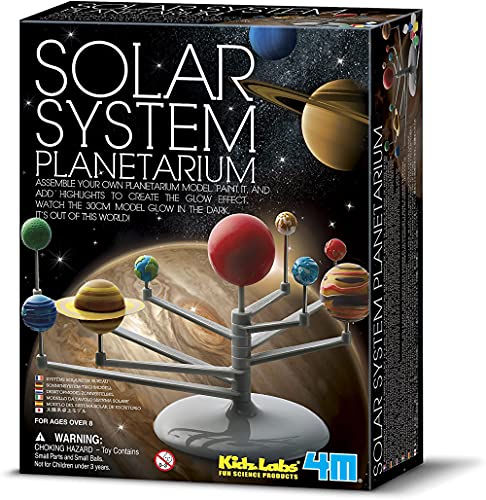
The 4M Solar System Planetarium kit is a glow-in-the-dark classroom favorite. It includes planets, stencils, glow paint, rods, string, a wall chart, and a set of quiz questions. This kit emphasizes an interactive approach to learning by enabling students to assemble a glowing solar system and experiment with animation and display. The glow feature adds an engaging dimension, making it suitable for evening demonstrations or darkened classroom corners to enhance the visual impact of the model. Complete assembly instructions help educators guide students through each step, from painting to hanging the finished display.
With movable components, the kit supports flexible arrangement, allowing teachers to demonstrate orbital order and the relative positions of planets. The inclusion of a wall chart and quiz questions also promotes comprehension checks and review sessions, contributing to a well-rounded learning experience. This kit is ideal for science fairs and STEM nights where a vivid, interactive model can captivate audiences.
Innconee 36 Solar System Model Kit

The Innconee 36 Solar System Model Kit provides a complete craft-and-education package for classroom projects. The kit includes 14 foam balls, 12 paint colors, two brushes, a paint tray, and three rolls of fishing line, plus a sun cardboard, starry sky backdrop, and a colorful light string for hanging. The assortment of ball sizes spans ten distinct scales, mirroring planetary differences for an accurate-looking model. Easy assembly is emphasized through step-by-step guidance and ready-to-display components, making it suitable for students of varying ages and skill levels. The hanging features facilitate an eye-catching classroom display or science fair presentation.
Educators can leverage the kit to demonstrate color-coding, scale, and orbital relationships in a tangible format. The included backdrop and hanging system enable a polished, professional-looking model that can be used repeatedly for different lessons or seasonal displays. It’s a practical option for teachers seeking a complete, visually engaging solar system project kit that doubles as a long-term classroom resource.
Buying Guide: Key Purchase Considerations
- Planetary scale and accuracy: Kits vary in the number of size options and how closely they reflect real planetary dimensions. Decide whether a proportional, simplified, or display-focused model best serves your curriculum.
- Materials and safety: Most kits use polystyrene foam and acrylic paints. Check for non-toxic pigments and smooth surfaces suitable for young learners, and ensure parts are durable for classroom use.
- Inclusivity for different grade levels: Some kits are designed for younger students with straightforward assembly, while others include more complex components for older students or science fairs.
- Display and storage: Consider whether you want a wall-hanging model, a tabletop display, or a freestanding arrangement. Some kits include hanging hardware, backdrops, or decals for easy presentation.
- Curriculum alignment: Look for kits that provide educational guidance, planet names, orbital sequences, and activity ideas to reinforce learning objectives.
- Assessment and activities: Kits with quiz questions, fact sheets, or teacher guides can support quick formative assessments and discussion prompts.
- Reusability and expansion: If future projects are planned, choose kits with extra components (additional foam balls, pigments, or flags) to support more complex models or variations.
Choosing the right solar system kit involves balancing instructional goals with classroom practicality. Consider your students’ age, the time available for project work, and the level of hands-on activity your lesson plan requires. The five options highlighted above provide a range of sizes, materials, and display possibilities to suit most school settings and science-centered curricula.