Best Science Kits for 10-Year-Olds: Fun and Educational Projects for Curious Minds
Finding engaging, age-appropriate science kits for 10-year-olds can boost curiosity, build foundational STEM skills, and offer hands-on learning that’s both entertaining and educational. This guide highlights five standout kits that align with middle-grade curiosity, cover a range of science disciplines, and emphasize safe, hands-on experimentation. Each option provides clear instructions and multiple activities to sustain interest for weeks or months of exploration.
Summary Table of Selected Products
| Product | Brand | Highlights |
|---|---|---|
| The Magic Kit With 100+ Experiments | Blue Marble | Science meets magic; 20+ tricks; beginner-friendly |
| Gross Science Kit | Blue Marble | 15 gross experiments + 30 more; kid-friendly guide |
| Mega Cyborg Hand STEM Kit | Thames & Kosmos | Hydraulic hand; no motors; hands-on pneumatics |
| Magic Chemistry Set | Blue Marble | 10 magic-tinged chemistry tricks; illustrated guide |
| Snap Circuits Jr. Electronics Kit | Snap Circuits | 100+ projects; color manual; beginner-friendly electronics |
Blue Marble National Geographic Science Magic Kit

This kit blends science with magic, turning 100+ experiments into entertaining demonstrations. Children learn core physics and chemistry concepts as they Bend metal with water, create a vanishing test tube, and float a coin. The included wand and gloves help kids perform results as showmanship, making science feel like a performance while remaining educational.
What sets this option apart is its dual focus on content and presentation. The experiments are designed as tricks, encouraging kids to explain the science behind each illusion. The package covers 20 science-magic tricks with accessible materials, so most components are ready to use out of the box. For long-term engagement, the kit invites kids to experiment with physics and chemistry to amaze family and friends.
Blue Marble Gross Science Kit

Gross-out science never felt so educational. This kit offers 15 gross experiments plus a 30-item extension using common household items, providing ample opportunities for kids to explore biology, chemistry, and materials science through playful, memorable activities. The kid-friendly guide includes step-by-step instructions and illustrations, helping young scientists stay engaged and understand the science behind the gross effects.
Several activities focus on observing reactions, changes in texture, and the properties of materials. The bonus booklet expands exploration with additional experiments, encouraging kids to reuse items from around the house. It’s a practical choice for families seeking a mix of curiosity, humor, and science literacy in one package.
Thames & Kosmos Mega Cyborg Hand STEM Kit

This hands-on kit centers on pneumatics rather than electronics. Kids build a wearable hydraulic hand capable of gripping objects, controlled by air pressure. With adjustable finger joints and no motors or batteries, the project emphasizes mechanical engineering principles, force transmission, and problem-solving.
By assembling and adjusting components, learners explore how pressure, leverage, and actuators influence motion. The wearable aspect adds a tangible, action-oriented element that can sustain interest while teaching core STEM concepts like hydraulics and robotics fundamentals.
Blue Marble National Geographic Magic Chemistry Set
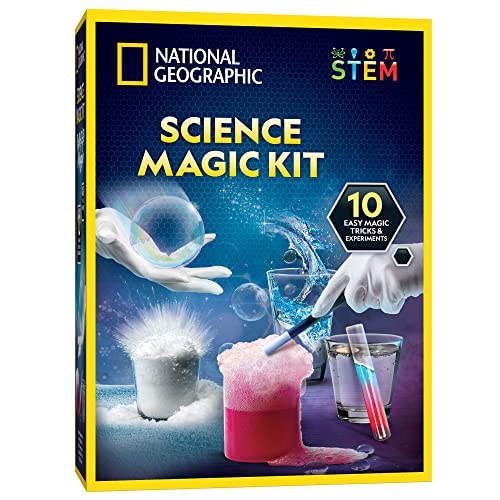
Built around 10 magic-themed chemistry tricks, this kit blends science with wonder. Children can make a coin float, change water color, or create snowy effects while learning the chemistry concepts behind each effect. The included wand and gloves add theatrical flair, turning experiments into memorable demonstrations for family and friends.
The illustrated, kid-friendly guide supports independent exploration while offering insights into the science behind each trick. This approach helps learners connect observable magic with real chemical reactions, reinforcing curiosity and scientific thinking in a playful setting.
Snap Circuits Jr. SC-100 Electronics Kit

Snap Circuits Jr. introduces basic electronics through 100+ projects with a full-color project manual. The kit provides a safe, structured way for 8+ year-olds to learn about circuits, conductivity, and components like switches and LEDs. The modular parts snap together easily, fostering hands-on experimentation, troubleshooting skills, and practical understanding of circuitry.
With a clear progression of projects, kids can start with simple circuits and advance to more complex builds, such as a flying saucer or alarm system. The approachable format supports independent learning while enabling guided exploration for parents or teachers.
National Geographic Mega Science Lab

This kit delivers a broad science experience with 130+ experiments covering earth science, chemistry, and magic STEM projects. Learners can erupt volcanoes, grow crystals, and analyze fossils, while also receiving rock, mineral, and crystal specimens for a tangible collection. The combination of experiments and specimens complement classroom-style learning with real-world observation.
The bonus materials provide a deep dive into science topics, making it suitable for curious students who want to expand beyond the basics. It supports long-term inquiry by mixing hands-on experiments with mineralogy and geology exploration.
STEM 13-in-1 Solar Power Robots Kit

This kit emphasizes renewable energy learning with 13 different solar-powered robot designs. Kids follow a guided manual to assemble models that move on land or water, driven by solar energy rather than electricity. The components are designed to be safe, non-toxic, and easy to disassemble for multiple iterations, reinforcing problem-solving and engineering skills.
Educational value centers on how solar energy is captured and converted into motion, plus how gears and levers influence speed and torque. It’s well-suited for curious 10-year-olds who enjoy hands-on, construction-based challenges.
Doctor Jupiter Ultimate Science Kit

With over 135 experiments, this kit offers a comprehensive science experience across chemistry, physics, and biology. Clear, kid-friendly instructions support independent exploration, while a wide range of activities aims to develop imaginative problem-solving and scientific thinking. Bonus access to 90+ additional experiments expands learning time and depth.
The scope is broad enough to support both casual curiosity and more structured study, making it a versatile option for homes that want a long-term science project collection. It is particularly suitable for students who enjoy coloring outside the lines and testing new ideas in safe, guided settings.
Buying Guide: Key Purchase Considerations And Comparisons
- Age-appropriateness: Check recommended age ranges and complexity to ensure alignment with a 10-year-old’s cognitive and motor skills. Some kits are designed for younger kids but remain engaging for advanced learners.
- Scope and variety: Consider whether the kit focuses on one science area or provides a broad mix. A diverse set can sustain interest longer but may be more challenging for younger learners.
- Hands-on engagement: Prioritize kits with interactive activities that require problem-solving, experimentation, and critical thinking rather than passive demonstrations.
- Material quality and safety: Look for non-toxic components, robust construction, and clear safety guidelines. Kits with reusable components offer better long-term value.
- Educational value: Seek resources with explanations, diagrams, and accessible science concepts. Guides that connect activities to real-world science help deepen understanding.
- Skill progression: Prefer kits that offer a progression of activities—from simple to complex—so a child can grow with the kit over time.
- Supplemental materials: Some kits include extra notebooks, charts, or online resources. These can extend learning and provide reinforcement beyond the physical kit.
- Value and longevity: Consider how many distinct projects a kit provides and whether the parts can be reused for future experiments or combined with other kits for expanded play.
- Storage and organization: Kits with organized compartments or bins help kids manage parts and maintain focus during activities.
- Gifting potential: If selecting as a gift, assess whether the theme matches the child’s interests—chemistry, electronics, or robotics—while offering enough breadth to remain engaging.
In evaluating options, it’s useful to balance curiosity-driven themes (magic tricks, gross science, or mystery) with robust scientific fundamentals (electrical circuits, hydraulics, or chemistry). For families seeking ongoing learning, consider a kit with a mix of core activities and additional experiments to extend the exploration beyond the initial set. Safety, age-appropriateness, and the ability to foster independent inquiry should guide final choices.