Best Preschool Toys for Classroom Learning and Play
The right preschool toys can support early literacy, color and shape recognition, fine motor skills, and social interaction in a classroom setting. Below are five carefully chosen options that blend engaging play with educational outcomes. Each product is suitable for a classroom environment and aligns with core early-learning goals.
| Product | Brand | Key Benefit | Ideal Age | Amazon Link |
|---|---|---|---|---|
| POTATO HEAD Create Your Family Set | Mr. Potato Head | Imaginative family roles and hands-on mixing | 2+ years | https://www.amazon.com/dp/B0CP41C4QN?tag=toysscout-20 |
| Mini ABC Pops | Learning Resources | Letter recognition and phonics through interactive play | 3+ years | https://www.amazon.com/dp/B0BQ8HQ71Z?tag=toysscout-20 |
| Farmer’s Market Color Sorting Set | Learning Resources | Color sorting, vocabulary, and category sense | 2-5 years | https://www.amazon.com/dp/B006RQ8TY0?tag=toysscout-20 |
| Magnetic Letters Numbers Alphabet Fridge Magnets | JoyCat | Alphabet and numbers practice with hands-on magnetic play | 3+ years | https://www.amazon.com/dp/B0C3RFS4WV?tag=toysscout-20 |
| JOYIN Educational Toys Play Food Set | JOYIN | Color sorting and pretend play in kitchen scenarios | 2+ years | https://www.amazon.com/dp/B0C8B9Y2WM?tag=toysscout-20 |
POTATO HEAD Create Your Family Set

The POTATO HEAD Create Your Family Set includes 44 parts and pieces to mix and mash, enabling children to imagine a variety of potato families. With two large and one small potato bodies, it supports family storytelling and role-play, which can be valuable in a classroom for social-emotional learning. The set includes 41 accessories such as headphones, a flower crown, detachable ponytails, and a mustache, offering numerous outfit and character combinations. This Amazon Exclusive encourages creative expression while reinforcing fine motor skills through assembly and disassembly of parts. Suitable for early preschoolers and up, it can be used in literacy-inspired activities, social play centers, or math-inspired family counting scenarios (e.g., counting family members).
Mini ABC Pops — Alphabet Toys

Mini ABC Pops are a colorful, hands-on approach to early literacy. The set features 26 uppercase letter popsicle pieces, with matching lowercase letters and pictures underneath. This design supports letter recognition, phonics, and vocabulary development, while also engaging children in color matching and sorting activities. The pops can be manipulated individually for fine motor development and can be incorporated into small-group or center activities. The set’s multi-learning approach makes it suitable for classroom centers focusing on foundational reading skills and early math concepts like patterning and sequencing.
Farmer’s Market Color Sorting Set
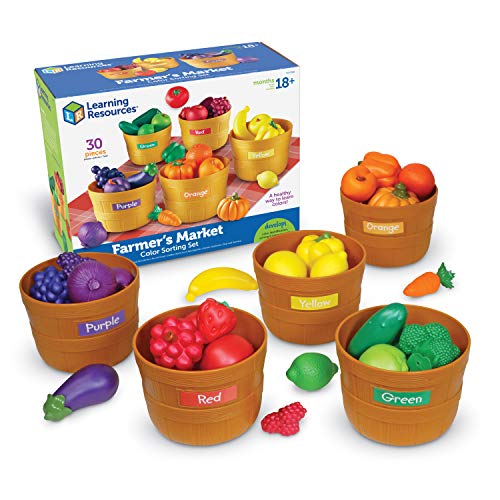
This color sorting set offers realistic play food and bushel baskets to practice color recognition and categorization. Children can sort by color, recall familiar foods, and engage in pretend play that mirrors real-world grocery experiences. The color-coded system supports independent sorting tasks as well as guided teacher-led activities. The materials are designed to be durable for classroom use and help build vocabulary related to foods, colors, and categories, making it a practical addition to early math and science centers.
JoyCat Magnetic Letters Numbers
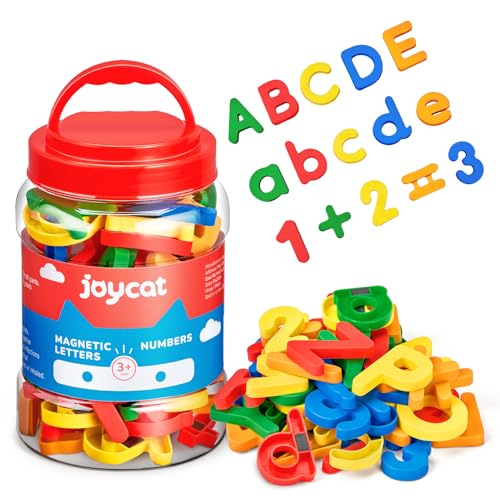
JoyCat provides a 78-piece magnetic set with uppercase letters, lowercase letters, numbers, and math symbols. Packaged in a portable plastic bucket, this set supports literacy and numeracy practice in a flexible, hands-on way. The larger 1.2 to 1.5-inch letter size is ideal for little hands, aiding in grip and manipulation. The magnetized pieces can be used on whiteboards, magnetic boards, or kitchen magnets displays, enabling interactive whole-class activities or small-group work. The materials are designed with child safety in mind and feature smooth edges for safe handling in classroom environments.
JOYIN Educational Toys Play Food Set

This JOYIN play food set offers a comprehensive pretend-food repertoire with assorted fruits, vegetables, and meats arranged in five baskets. The color-sorted design supports color recognition and categorization, while pretend play encourages social interaction and language use during kitchen-centered activities. The set is well-suited for classroom centers that emphasize early math concepts (sorting by color and type) and language development through naming foods and describing attributes. The durable pieces withstand frequent classroom use and encourage collaborative play among students.
Buying Guide: Key Purchase Considerations
When selecting preschool toys for a classroom, consider the following perspectives and factors to ensure strong educational value and durable use in a group setting.
- Age appropriateness and skill scope: Choose toys that align with typical preschool curricula, supporting literacy, numeracy, fine motor development, and social-emotional learning. Ensure activities can be scaled for small groups or whole-class rotations.
- Durability and safety: Classroom toys should be sturdy, non-toxic, and designed with smooth edges. Look for sealed parts or pieces that won’t pose choking hazards for younger students.
- Multi-sensory and cross-curricular potential: Toys that combine color, shape, and language elements (e.g., letters with pictures, color sorting with foods) help reinforce cross-disciplinary skills and keep students engaged.
- Storage and ease of use: Consider sets with clearly labeled pieces and simple storage solutions. This helps teachers manage centers efficiently and minimizes loss or misplacement of parts.
- Teacher-led vs. independent play: Some toys support guided activities (e.g., letter recognition drills) while others facilitate independent or small-group exploration, useful for classroom management and differentiation.
- Scalability and classroom size: For larger classrooms, prioritize sets with many pieces or multiple equivalent sets to prevent bottlenecks or sharing conflicts during activities.
- Cost-per-use and longevity: Durable, reusable items deliver more value over a school year. Consider whether a toy’s benefits justify the investment through ongoing use across multiple groups.
- Alignment with standards: Look for products that match early learning standards (alphabet knowledge, counting, sorting, vocabulary development) to support formal assessment goals.