Best Model Kits for Kids: STEM-Focused Kits That Inspire Young Makers
Explore engaging, hands-on model kits that spark curiosity, teach core STEM concepts, and fuel creativity for kids and teens. The selections below cover radio electronics, engineering, and mechanical design—great for curious minds ages 8 and up. Each option centers on learning by building, playing, and discovering how things work in the real world.
| Product | Brand | Target Age | Key Focus |
|---|---|---|---|
| Science Kits for Kids Age 8-12 12-14, FM Radio Kit | CYOEST | 8-16+ | Electronics, Radio Theory |
| NATIONAL GEOGRAPHIC Da Vinci Model Kit – Catapult | Blue Marble | 8-12 | Engineering, 3D Wood Models |
| LEGO Technic Bugatti Bolide | LEGO | 9+ | Engineering Design, Motorsports |
| Discovery Model Engine Building Kit | Discovery | 8+ | Mechanical Engineering, Pistons |
| SEBUNAS 1:72 F-14 Tomcat Model Kit | SEBUNAS | 8-14 | Aviation, Precision Modeling |
Science Kits for Kids: FM Radio Kit

The CYOEST FM Radio Kit invites kids to discover how radio technology works through a hands-on assembly experience. The kit focuses on building a working FM radio, providing practical exposure to electronics principles, circuits, and signal reception. Assembling the circuit teaches basic circuitry concepts, such as conductivity, resistance, and frequency tuning, while encouraging problem-solving as learners troubleshoot connections to achieve reliable reception. The package emphasizes a stylish, user-friendly design, making it a thoughtful gift for birthdays or holidays and suitable for both beginners and older hobbyists who want a quick, rewarding project. Expect clear assembly steps and a finish that can be used for demonstrations or continued tinkering.
Key features include a 88–108 MHz frequency range with automatic scanning for broadcasts and a retractable antenna for better reception. The kit is positioned as a versatile gift for kids and adults alike, making it a family-friendly entry point into DIY electronics. While it prioritizes accessibility, it remains a substantive project that teaches radio basics and practical electronics assembly rather than a simple toy. Parents should note that some smaller components may require careful handling by younger builders, and adult supervision can help maximize learning outcomes.
STEM Kits: Wood Building Projects Car Set

This 6-pack wooden car building kit from Yutin blends classic craft with STEM learning. Children construct four-wheel drive, tank, wind-powered, off-road vehicles, plus a solar helicopter and a biplane—covering a breadth of mechanical concepts. The set includes a screwdriver and six interactive models that encourage hands-on experimentation with gears, energy conversion, and basic motor theory. The project supports iterative problem solving as kids test how different designs affect movement and efficiency. It’s well-suited for group play, classroom activities, or a focused solo building session. The wooden construction fosters fine motor skills and spatial reasoning while keeping the experience safely contained and durable for repeated builds.
Note that some models require parental guidance for assembling and interpreting the underlying science. Battery power is not included, which invites discussions around energy sources and how different power modes influence performance. The kit also serves as a tangible way to introduce design thinking: prototyping, testing, and refining ideas based on observed outcomes. Overall, it’s a well-rounded choice for curious makers who enjoy tangible, hands-on projects that yield visible results.
NATIONAL GEOGRAPHIC Da Vinci Catapult Kit

This National Geographic Da Vinci model kit provides a multi-machine building experience focused on historical engineering principles. The kit features three functional devices—a ballista, a bombard, and a catapult—offering practical demonstrations of force, trajectory, and leverage. Each model is fully functional, with included projectiles and targets that allow for performance testing and tuning. The wooden components are laser-cut for precise fit, and the set comes with simple, straightforward instructions that facilitate assembly without requiring specialized tools. The project is designed to deliver a satisfying, educational build that can be completed in a few hours, making it an accessible STEM challenge for families or classroom settings. It emphasizes creative problem solving as learners experiment with angles, tension, and timing to achieve desired results.
While the kit is engaging and visually appealing on display, it also encourages critical thinking about historical engineering methods and the physics behind projectile motion. The assortment suits learners who appreciate hands-on, constructivist activities and prefer model-based rather than purely theoretical exploration.
LEGO Technic Bugatti Bolide Racing Car

The LEGO Technic Bugatti Bolide set is a high-fidelity engineering-oriented build that appeals to older kids and teen builders. With its complex construction, this model introduces learners to advanced mechanical concepts, including precision gears, suspension, and aerodynamic detailing. The finished car presents a dynamic display piece that highlights the integration of design and engineering. The kit serves as a bridge between creative play and real-world engineering thinking, making it a compelling option for students who enjoy automotive design, motorsport engineering, and intricate brick-building challenges. The set is also compatible with LEGO enthusiasts who collect Technic models and seek a visually striking, technically rich project to showcase their growing skills.
As with many complex builds, it requires patience and time. Builders should plan sessions to prevent fatigue and maximize learning outcomes. While not a beginner project, it provides a concrete path toward understanding mechanism interactions, gear ratios, and the engineering choices behind performance-oriented models.
Discovery Model Engine Kit
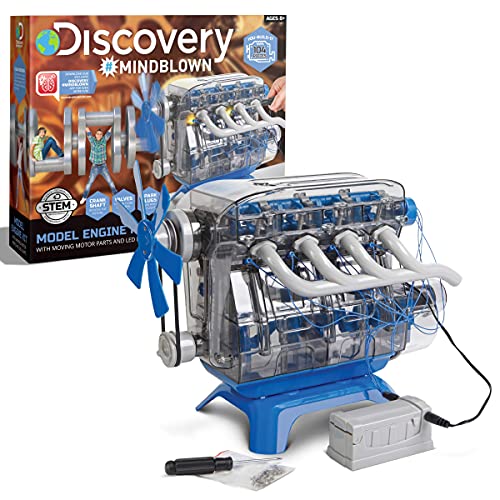
The Discovery Model Engine Kit presents a four-cylinder combustion engine with working pistons, belts, valves, and LED indicators, combining hands-on construction with a clear demonstration of mechanical principles. The kit encourages critical thinking as learners assemble cranks, pulleys, belts, and exhaust valves to power the engine and observe how components interact. A battery pack and distributor help simulate real-world operation, delivering interactive feedback that enhances understanding of energy transfer, torque, and timing. This kit is suitable for both kids and adults who enjoy serious mechanical projects that result in a functioning model rather than a static display.
Educational value is complemented by an approachable assembly process. Step-by-step guidance helps learners progress from basic to more advanced assembly, reinforcing concepts such as combustion, power delivery, and the relationship between engine components. It’s an excellent choice for science fairs, classroom demonstrations, or family STEM nights where participants can compare different engine designs and performance outcomes.
SEBUNAS 1:72 F-14 Tomcat Model Kit

The SEBUNAS 1:72 scale F-14 Tomcat model kit offers a detailed, kid-friendly aviation build with movable parts and a display stand. The kit restores the iconic lines of the Tomcat with attention to accuracy, including rotating swept wings and a functional landing gear system. The assembly process uses plastic parts designed for easy fit without specialized tools, supplemented by a step-by-step diagram that guides beginners through the construction. Assembled models provide a visually impressive display piece that can inspire interest in aerospace engineering, aerodynamics, and the history of military aviation. The kit emphasizes precision and careful handling to maintain the model’s shape and articulation during play and display.
Durability and safety are addressed through quality materials that resist oxidation and provide a safe, engaging building experience. The project supports cognitive skills such as spatial reasoning, pattern recognition, and sequential thinking. It’s well-suited for collectors and young builders who enjoy aviation models or want a challenging, time-bound project with a satisfying finished result.
Buying Guide: Key Purchase Considerations
- Age and skill level: Choose kits labeled for the intended age range and adjust complexity to match the builder’s experience. Some sets offer multiple difficulty modes or stepwise challenges.
- Educational focus: Decide whether the priority is electronics and circuits, mechanical engineering, or modeling and design. Look for kits that clearly explain underlying concepts with hands-on activities.
- Durability and safety: Wooden and high-quality plastic kits generally offer safer, long-lasting builds. Check for smooth edges, non-toxic finishes, and parent-friendly assembly guides.
- Expansion potential: Some kits are part of a wider ecosystem (e.g., LEGO Technic) or can be integrated with additional projects. Consider future learning paths when selecting.
- Time investment: For groups or classrooms, pick projects that fit your time window. Shorter builds are great for quick demonstrations, while multi-hour projects suit deeper exploration.
- Display value: Finished models can serve as ongoing teaching aids or collectibles. Consider the aesthetic appeal of the completed piece as part of the learning experience.
- Safety and supervision: Complex builds benefit from adult guidance to aid with instructions, tool use, and safe handling of small parts.
- Budget considerations: Sets vary in price based on complexity and material. Balance educational depth with the number of projects you want to complete.
Across these options, the common thread is experiential learning. Each kit provides a structured yet flexible path to understanding core STEM concepts, from circuits and radios to engines, gears, and aircraft design. Consider your child’s interests—whether they lean toward electronics, building mechanical systems, or collecting accurate scale models—and use that motivation to guide the best fit for ongoing learning and creativity.