Best Learning Cards for Kids: Top Tools for Early Reading and Language Skills
Learning cards for kids offer engaging ways to build vocabulary, phonics, and cognitive skills. The following selections combine interactive features, durable designs, and age-appropriate content to support early literacy and language development. Explore five carefully chosen options that suit toddlers to early elementary learners, with a quick summary of their strengths to help you choose the right set for your child.
| Product | Brand | Highlights |
|---|---|---|
| Airbition Talking Flash Cards | Airbition | 224 illustrations and sounds; autism-friendly, sensory-friendly |
| THE BAMBINO TREE Phonics Flash Cards | THE BAMBINO TREE | 20 phonics stages; teacher-created framework; blends and digraphs |
| Carson Dellosa Toddler Flash Cards 4 Pack | Carson Dellosa Education | Alphabet, sight words, colors, shapes, numbers |
| School Zone Alphabet Flash Cards | School Zone | 56 colorful cards; uppercase and lowercase; phonics connections |
| QUOKKA ABC Learning Flash Cards | QUOKKA | 60 double-sided cards; includes letters, numbers, colors, animals |
Airbition Talking Flash Cards

Airbition’s 224-card set combines bright illustrations with spoken content, supporting vocabulary growth across categories like animals, vehicles, fruits, and more. The device functions as a Montessori-style learning tool, which can be beneficial for children receiving speech therapy or those on the autism spectrum. The reader delivers content in a standard American accent, with animal sounds, a repeat option, and a five-level volume control. A simple on-off switch and easy card insertion keep usage intuitive for toddlers and preschoolers, promoting independent exploration while building language skills.
THE BAMBINO TREE Phonics Flash Cards

This set emphasizes phonics mastery to support early reading. With 62 flashcards, four sorting rings, and a broad content range (480 words, 120 sentences), it covers 20 phonogram families and multiple difficulty levels. The design supports progressive learning—from Level 1 for kindergarten basics to Level 4 covering more complex phonics. The materials are teacher-created, aiming to blend instructional structure with engaging activities. Parents and educators can use the kit for independent practice, reading readiness exercises, and interactive games that reinforce phonics and word-building skills.
Carson Dellosa Toddler Flash Cards 4 Pack
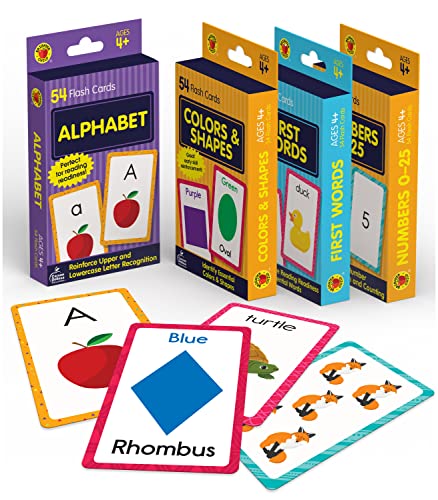
This bundle from Carson Dellosa packages four distinct card sets for preschool learning. Children practice basic sight words, early math concepts (numbers 0-25), and foundational phonics through the alphabet and related activities. The included resource cards offer additional games to extend learning beyond quick card drills, making it suitable for classroom use or homeschooling. The cards are designed for small hands, encouraging repetition and interactive play that supports early literacy and numeracy development.
School Zone Alphabet Flash Cards

School Zone offers a compact alphabet set focusing on letters, phonics, and early word associations. With 52 unique illustrations and bold letter presentation, the cards help children connect sounds to objects and words. The pack includes uppercase and lowercase letters, supporting a broad range of reading readiness tasks. The thick, glossy cardstock enhances durability for daily use in preschool settings and home learning environments, making it a practical staple for foundational literacy work.
QUOKKA ABC Learning Flash Cards

QUOKKA’s flash cards provide a broad set of 60 double-sided cards covering letters, numbers, colors, shapes, animals, and more. The large fonts and clear illustrations support visual development and quick recognition, which aids early communication and vocabulary-building. The deck is designed to be durable for frequent handling by young learners and can be used for individual practice, group activities, or speech therapy exercises. Its inclusive scope makes it suitable for families looking to bolster early literacy across multiple domains.
Buying Guide: Key Purchase Considerations
- Age and skill level: Choose cards aligned with your child’s current reading or language development stage. Some sets emphasize phonics, while others focus on vocabulary or basic sight words.
- Durability and materials: Look for laminated or sturdy card stock to withstand daily use by toddlers and preschoolers. Waterproof options are beneficial for mess-prone learning environments.
- Interactivity: Audio cards or components that support speech therapy can benefit children needing language support. Consider whether a device or simple flashcards better fits your routine.
- Content variety: Sets with a wide range of categories (animals, colors, shapes, numbers, foods) promote broader vocabulary and concept recognition, while focused sets help with targeted skills.
- Ease of use: Simple power controls, intuitive card insertion, and clear visuals reduce barriers to independent learning and encourage consistent practice.
- Educational goals alignment: Some products are designed for classroom or homeschooling contexts, while others suit on-the-go learning or therapy sessions. Match your goals accordingly.
- Multisensory engagement: Audio, imagery, and tactile interaction can enhance retention, particularly for children who benefit from multi-sensory learning approaches.
- Brand and educator backing: Teacher-created or brand-backed sets can indicate structured progression and well-vetted content, which may support longer-term learning trajectories.
Across these selections, the common aim is to support early literacy, phonics, and language development through engaging, durable, and age-appropriate materials. Parents and educators can mix and match sets to cover a broad spectrum of skills—from recognizing letters and sounds to building vocabulary and counting concepts—while considering the child’s responsiveness to interactive versus passive card activities.