Best Flash Cards for Toddlers to Boost Language and Cognitive Skills
Flash cards designed for toddlers can support early language development, memory, recognition, and foundational literacy. This guide highlights five top options, spanning talking cards, double-sided sets, and classroom-grade bundles. Each selection emphasizes durable construction, engaging visuals, and age-appropriate content to help caregivers choose the right fit for home or preschool use. Read on to compare features, learning styles, and practical tips for maximizing learning through play.
| Product | Brand | Key Benefits |
|---|---|---|
| Airbition Talking Flash Cards for Toddlers | Airbition | 224 words with animal sounds, Montessori-friendly, supports speech therapy and autism play |
| Merka Toddler Flash Cards | merka | 58 double-sided cards covering alphabet, numbers, shapes, colors; interactive learning |
| School Zone Alphabet Flash Cards | School Zone | 56 cards; phonics, uppercase/lowercase letters, vibrant illustrations |
| ZazzyKid Flash Cards for Toddlers | ZazzyKid | 54 double-sided cards; letters, numbers, colors, shapes; durable lamination |
| Carson Dellosa Toddler Flash Cards 4 Pack | Carson Dellosa Education | 4 packs; alphabet, sight words, colors & shapes, numbers 0-25; phonics games |
Note: The table above provides quick at-a-glance comparisons for five selected products based on accessibility, content scope, and learning versatility. Each product offers a distinct approach to early literacy and language development, from interactive sound-enabled cards to comprehensive preschool sets. The following sections provide deeper insights into what makes each option effective and how to choose among them.
Airbition Talking Flash Cards For Toddlers

Airbition’s talking flash cards blend 224 vibrant illustrations with authentic animal and object sounds to create a multisensory learning tool. The kit supports vocabulary expansion and cognitive growth in a Montessori-inspired format, making it suitable for autism-focused speech therapy play and general language development. A simple power switch, a reader that activates content from inserted cards, and a repeat button make it straightforward for toddlers to engage independently. Volume control with five levels helps tailor sessions to different environments, from quiet home study to busy classrooms. This option emphasizes authentic sound associations alongside visuals, which can strengthen retention and recall as children encounter familiar categories—animals, vehicles, foods, fruits, and vegetables—across varied contexts.
Merka Toddler Flash Cards

Merka’s set provides a compact, double-sided collection that covers essential early concepts: alphabet, numbers, colors, and shapes. With 58 cards, it offers a balanced mix of foundational literacy and cognitive skills suitable for toddlers ages 1-4. The large, colorful visuals support recognition, while the reverse sides enable interactive activities and quick review. This format is especially convenient for parents and educators seeking an economical bundle that scales from home use to preschool lessons. The emphasis on both uppercase and lowercase letters strengthens early reading readiness and phonemic awareness in a lively, low-stress learning experience.
First Words Flash Cards

Scholastic Teaching Resources presents a concise set labeled as First Words Flash Cards. While compact, these cards focus on essential early vocabulary designed to jumpstart expressive language. The set is well-suited for structured activities, language modeling, and quick daily drills that align with early education objectives. It’s a practical option for caregivers who want a straightforward addition to a broader language-building routine, with cards that encourage naming, categorization, and simple sentence formation. The design prioritizes clarity and easy handling for young children during guided sessions.
School Zone Alphabet Flash Cards

School Zone’s Alphabet Flash Cards combine a broad set of 56 cards with color-rich illustrations and both upper- and lowercase letters. The program emphasizes phonics connections, helping children link sounds to letters with concrete examples—such as K for Kite. The thick, glossy cardstock supports durability through daily use and classroom activities. The layout supports quick, structured lessons, while the visuals foster word families and early reading comprehension. This option is particularly useful in early elementary readiness programs that blend literacy with phonological awareness and memory games.
ZazzyKid Flash Cards For Toddlers Learning

ZazzyKid offers a 54-card, double-sided set focusing on alphabets, numbers, colors, and shapes. With bold visuals and printed words, the cards are designed to stimulate recognition and early math concepts. Laminated construction enhances durability for everyday toddler use, travel, and classroom activities. The variety supports multiple learning contexts—guided play at home, independent practice, and small-group instruction. This option appeals to caregivers seeking a resilient, visually engaging package that covers core literacy and early numeracy in a compact format.
Carson Dellosa Toddler Flash Cards 4 Pack
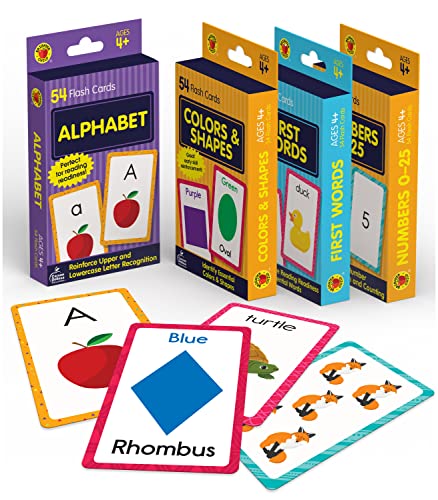
This four-pack bundle from Carson Dellosa Education combines focused sets for alphabet recognition, sight words, colors & shapes, and numbers 0-25. It supports a well-rounded early literacy and numeracy program, including phonics-based activities and games. The included resource cards provide extra ideas for interactive learning beyond the cards themselves. The line-up is particularly useful for structured preschool routines, homeschooling, or after-school enrichment, enabling teachers and parents to rotate topics while maintaining consistency across sessions.
Buying Guide: Key Purchase Considerations
- Learning goals: Choose sets that align with language development, phonics, vocabulary build, and basic math concepts.
- Card format: Single- or double-sided cards affect content density and durability. Double-sided cards offer more content per card but may be bulkier for tiny hands.
- Durability and finish: Laminated or thick cardstock cards withstand toddler handling, spills, and frequent use in playrooms and classrooms.
- Audio features: Talking flash cards provide auditory reinforcement, which can aid non-readers and children with language delays, but require batteries and maintenance.
- Age range and progression: Look for sets that scale from toddlers to preschoolers, with a clear progression from letters to words and basic concepts.
- Inclusivity and accessibility: Cards with universal icons, simple language, and sensory-friendly designs support a wider range of learners, including children on the autism spectrum.
- Support materials: Additional activity suggestions, game ideas, and printable worksheets can extend learning beyond the cards themselves.
- Portability: Smaller card sets are ideal for travel or on-the-go practice, while larger bundles support longer classroom sessions.
In practice, selecting a mix of products—such as a sound-enabled option for auditory learners and a larger, non-sounding set for visual and tactile learners—offers a balanced approach. For caregivers and educators, combining these resources with daily, short practice sessions can help establish consistent language-building routines while keeping toddlers engaged and motivated.