Best Emotion Chart for Toddlers: Top Classroom Mood Posters for Young Learners
Discover effective emotion charts designed for toddlers and young children to support emotional literacy in classrooms and homes. This guide highlights five engaging, developmentally appropriate posters and tools that help kids name feelings, regulate behavior, and communicate needs. Each product is chosen for its clear visuals, durable design, and relevance to social-emotional learning in early education settings. Browse the selections below to find options that fit your calming corner, counseling office, or home learning space.
Summary Table of Chosen Products
| Product | Brand | Key Benefit | Format |
|---|---|---|---|
| Hadley Designs Feelings Chart For Kids | Hadley Designs | Laminated 11×17 posters for self-regulation | 4 posters |
| Feelings Chart, Emotions Learning Posters for Toddler | DOI-LANEE | Two-piece set with framed look for decor and dialogue | 2 posters, 12×16 each |
| FLYAB Feelings Chart for Kids | FLYAB | Bright, welcoming emotions with classroom appeal | 11.2×16.5 inches |
| Feelings Chart for Kids — Coping Skills | HAMIEW | Double-sided laminated posters for versatility | 2 posters, 11×17″ |
| Thought-Spot I Know What to Do Flipbook | Thought-Spot | Autism-friendly, visual emotions guide | Flipbook |
Hadley Designs Feelings Chart For Kids
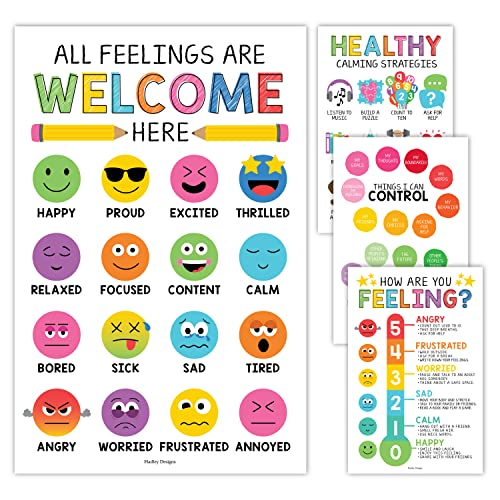
These four laminated 11×17″ self-regulation posters are designed to help children express how they’re feeling and decode emotional states in real time. The posters emphasize coping skills and zones of regulation, aiding classroom management and individual calming strategies. The design is USA-inspired, aiming to make children feel understood even when adults aren’t present. Ideal for a calming corner or classroom wall, these posters support lifelong coping skills and reduce meltdowns by providing a clear, colorful emotional map.
Feelings Chart, Emotions Learning Posters for Toddler

This two-piece set features a framed appearance with durable 12×16″ posters, designed to foster dialogue about emotions in homes, schools, and counseling spaces. The posters serve as versatile decorations that reinforce mental health awareness while supporting conversations about feelings. They are well-suited for classroom counseling offices and other settings that encourage safe, constructive discussions about emotions. While colors may vary slightly from the image due to monitor differences, the design remains engaging and child-friendly.
FLYAB Feelings Chart for Kids

FLYAB offers a bright, kid-friendly emotions poster highlighting 16 feelings with a welcoming message. The design encourages young learners to identify emotions in themselves and others, supporting social-emotional literacy and self-awareness. The poster is sized to stand out on classroom walls and bulletin boards, making it an effective tool for back-to-school decor and ongoing emotional education. It arrives with glue points for easy mounting and is suitable for both classroom and home learning environments.
Feelings Chart for Kids — Coping Skills

HAMIEW presents two 11×17″ laminated posters focused on coping skills and emotional self-awareness. The set emphasizes understanding and expressing emotions, building resilience, and improving communication in a supportive learning environment. The posters are designed to be durable for frequent classroom use, with thick, sturdy paper that withstands daily handling. They work well in classrooms, counseling rooms, and therapy spaces, helping children recognize emotions and empathize with others.
Thought-Spot I Know What to Do Flipbook

The flipbook format from Thought-Spot provides a compact, autism-friendly tool that visually communicates emotions and positive choices. It’s designed to support children who benefit from concrete steps for recognizing feelings and selecting appropriate responses. The durable pages support frequent use at home, school, or in calm-down corners, and the layout assists nonverbal or minimally verbal learners by offering a clear sequence for emotional regulation and social interaction.
Buying Guide
Choosing the right emotion chart or poster for toddlers involves balancing clarity, durability, and classroom fit. Consider these aspects to compare options effectively:
- Age-appropriateness: Look for visuals that reflect preschool and early elementary expressions and scenarios. Simple icons, high-contrast colors, and expressive faces enhance recognition.
- Durability: Laminated posters or thick card stock withstand daily handling, especially in busy classrooms and high-traffic areas like calming corners.
- Format and display: Decide between wall posters, framed-style boards, or tactile flipbooks. A modular set can cover a broader range of emotions and coping strategies.
- Educational alignment: Ensure the materials support social-emotional learning goals, including self-regulation, empathy, and communication. Check for age-appropriate language and culturally inclusive imagery.
- Integration with routines: Choose tools that can be integrated into daily routines—circle time, calm-down corners, or individual counseling sessions—to maximize impact.
- Ease of mounting: Poster sets with mounting points or glue dots simplify setup and repositioning as classrooms evolve during the year.
Two-Poster vs. Multi-Poster systems: For mixed-age classrooms, a combination approach often works best. Use larger, laminated posters for shared spaces and smaller, portable tools for individual or small-group activities. Consider a flipbook or frame-style option for caregivers who prefer compact, portable guidance during transitions.
Color and layout considerations: Bright, friendly colors attract attention but avoid overly complex scenes that may distract. Clear labels and consistent emotion icons help children generalize emotions across settings. If possible, choose a set that allows customization to reflect your student population and language needs.
Measurement and maintenance: Keep track of which emotions are most frequently discussed or needed during a given period. Rotate posters or themes seasonally to maintain engagement. Regularly check lamination and mounting hardware for wear and safety.
Accessibility and inclusivity: Look for formats that support diverse learners, including nonverbal or minimally verbal children. Visual supports, predictable structure, and opportunities for guided practice can enhance comprehension for all students.