Best Emotion Cards for Kids: Simple Tools to Understand Feelings
Emotion cards offer a practical, engaging way for children to recognize, name, and express how they feel. This article reviews five highly relevant options that support emotional development, social skills, and communication for kids, including those on the autism spectrum or with speech delays. Each product features colorful imagery, kid-friendly wording, and often coping strategies to help children manage emotions in real life settings. Use the buying guide below to compare design, durability, and ease of use to choose the best fit for home, therapy, or classroom use.
Summary table of chosen products:
| Product | Brand |
|---|---|
| Emotions Flashcards, 50 Different Feelings with Coping Skills | SpriteGru |
| Lachilly Emotions Learning Flashcards, 15 Cards, 28 Words | Lachilly |
| MEROCO Feelings Emotions Cards for Kids Therapy | MEROCO |
| Teacher Created Resources Emotions Flash Cards | Teacher Created Resources |
| 40PCS Autism Emotions Feelings Communication Cards | ZOIIWA |
Emotions Flashcards With Coping Skills

The SpriteGru Emotions Flashcards present 50 distinct moods through cartoon faces, paired with practical coping skills. This dual-sided format helps children identify feelings on one side and apply strategies on the other, supporting emotional literacy and self-regulation. The set is designed to engage young learners, including those with autism or ADHD, by combining bright visuals with concrete tools to manage emotions. Durable printing and kid-friendly icons make it suitable for therapy sessions, classrooms, and home activities. A versatile tool for broad emotional education goals.
Key features
- 50 emotion cards with cartoon expressions
- Double-sided: emotion labeling and coping skills
- Supports empathy, communication, and self-awareness
- Helpful in therapy and home practice
Lachilly Emotions Learning Flashcards

The Lachilly Emotions Learning Flashcards are designed to support early readers through high-frequency words and engaging pictures. This set includes 28 emotion words across 15 double-sided cards, with each word paired with a cute cartoon image to reinforce memory. The design emphasizes classroom-ready efficiency, reducing weight and cost via double-sided printing while helping kindergarten to first grade students build vocabulary, reading confidence, and social communication skills. A practical choice for teachers and homeschoolers focusing on language development.
Key features
- 28 emotion words with 15 double-sided cards
- Cute cartoon images to reinforce word recall
- Cost-efficient, classroom-friendly design
- Supports vocabulary, reading, and expressive language
Realistic Feelings Cards With Mirror

MEROCO offers realistic facial expressions across a broad range of emotions, with a mirror included to help children observe and imitate their own expressions. This reflective feature enhances self-awareness and expressive practice, making it a strong option for speech therapy, ABA therapy, or social-emotional learning. The cards cover core emotions and are designed for durability, ensuring repeated use in clinical or home settings. The set is especially suitable for children with autism or developmental differences who benefit from concrete, visual emotional cues.
Key features
- Realistic child facial expressions
- Includes a mirror for self-observation
- Diverse range of emotions
- Durable materials for long-term use
Emotions Flash Cards For Classrooms
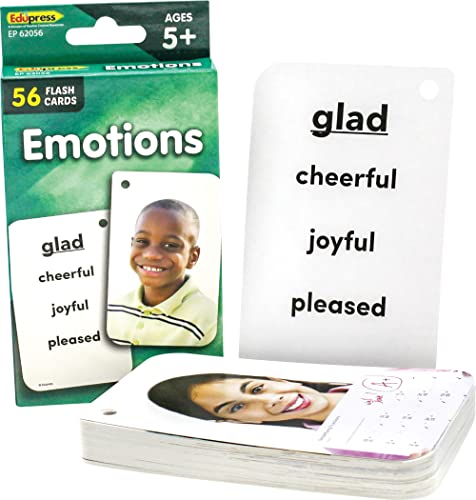
Teacher Created Resources Emotions Flash Cards provide a durable bundle of 56 double-sided cards designed for classroom use. These cards come with teaching tips and hole punching for easy organization. The larger set helps educators build a structured emotional literacy program, supporting classroom activities ranging from daily check-ins to targeted social-emotional learning lessons. The straightforward design makes it a reliable option for teachers seeking a versatile set that scales across age groups and learning styles.
Key features
- 56 double-sided cards
- Includes teaching tips
- Hole-punched for storage and organization
- Suitable for classroom and therapy settings
Autism Emotions Communication Cards

The 40-piece ZOIIWA set targets autism communication needs with explicit emotional words and vivid illustrations. Each card is designed to be portable and easy to use in various settings, from home to school to therapy. A ring keeps the cards together, and a retractable rope adds accessibility for on-the-go use. The cards’ compact size makes them kid-friendly, while the visual cues support quick recognition of feelings and appropriate social responses.
Key features
- 40 emotion cards with vivid visuals
- Includes ring binder and retractable rope for portability
- Designed for autism-focused communication support
- Compact, child-friendly format
Buying Guide
When choosing emotion cards for kids, consider the following factors to align with learning goals and settings:
- Age and needs: Pick sets with age-appropriate language and images. For preschoolers or nonverbal children, boards with more visuals and coping strategies can be more effective than bulky text.
- Durability and format: Double-sided cards, sturdy cardboard or plastic, and protective coatings extend life in busy environments like classrooms or clinics.
- Number of emotions: A broader range (50+ emotions) supports nuanced understanding, while smaller sets (15–28 emotions) work for focused lessons or younger kids.
- Accompanying coping strategies: Sets with practical tips help children translate recognition into action, promoting self-regulation.
- Therapy compatibility: For speech, ABA, or special education programs, look for proven alignment with common therapy goals and ease of integration into activities.
- Portability and storage: Rings, cords, or compact packaging aid transportation and organization for ongoing practice at home or school.
- Visual design: Bright colors, clear facial expressions, and legible wording improve recall and engagement for mixed-ability groups.
In practice, educators and caregivers may combine two or more sets to cover both everyday language and therapy-specific goals. Evaluate whether a mirror or interactive coping prompts are appropriate for your child’s comfort level and therapy plan. The best choice balances durability, clarity, and the ability to use the cards across multiple settings.