Best Educational Toys for 3 Year Olds to Boost Learning at Home
For parents and caregivers, selecting engaging, developmentally appropriate toys can support early literacy, numeracy, fine motor skills, and social learning. This article highlights five top educational toys for 3-year-olds, each designed to spark curiosity and build confidence through hands-on activities. Read on to learn how these picks align with common preschool learning goals and what to look for when choosing similar toys.
Quick Reference: Chosen Products
| Product | Brand | Key Focus | Amazon Link (Click) |
|---|---|---|---|
| LeapFrog Prep for Preschool Activity Book | LeapFrog | Early literacy, shapes, colors, counting | View Product |
| LeapFrog 2-in-1 LeapTop Touch, Green | LeapFrog | Alphabet, letters, numbers, role play | View Product |
| Airbition Talking Flash Cards | Airbition | Vocabulary, language concepts, autism-friendly learning | View Product |
| Montessori Busy Book Color Sorting | MUONE | Color recognition, fine motor, vocabulary | View Product |
| Magnetic Wooden Fishing Game | NASHRIO | Letters, numbers, hand-eye coordination | View Product |
LeapFrog Prep For Preschool Activity Book

This interactive book is designed to help preschoolers build confidence before entering school. It features six touch-sensitive pages with activities that cover counting, colors, shapes, the alphabet, and words. A companion erasable pen supports letter writing practice, number matching, shape tracing, and line drawing on marker pages. The dress-for-the-weather activity adds a playful scenario for practical life skills and decision making, encouraging thoughtful choices and fine motor planning.
Learning outcomes include early literacy readiness, number sense, and interactive engagement that sustains attention. Parents can guide sessions or let children explore independently, thanks to replayable activities that adapt to a child’s pace. Durability and kid-friendly design support frequent use, which helps reinforce cognitive connections through repetition. This option aligns well with teaching households prioritizing literacy-rich play and structured practice within a familiar environment.
LeapFrog 2-in-1 LeapTop Touch, Green

This 2-in-1 learning toy can switch between a traditional keyboard-style laptop and a touch tablet, offering flexible play modes to suit different activities. The keyboard includes letters A-Z and numbers 1-10, supporting early literacy and numeracy. The transformable design encourages role play—children can pretend to email or communicate as a caregiver or student, adding a social-emotional dimension to playtime. Parents can customize experiences to help a child spell their own name or practice basic words, reinforcing phonics and recognition in a familiar, home-friendly setup.
Educational benefits include letter and number recognition, fine motor engagement through tapping and typing, and pretend-play routines that build executive function. The device’s portability fosters on-the-go learning and quick, focused sessions, which can be beneficial for short attention spans common in preschoolers. The product also supports a gradual transfer of skills from screen-based interaction to hands-on tasks, a balance many educators recommend for early childhood development.
Airbition Talking Flash Cards For Toddlers

This Montessori-inspired device includes 224 words across a range of themes and vibrant illustrations. The talking cards provide audio cues to reinforce vocabulary, with animal sounds and clear pronunciation to support language development. Designed as an accessible tool for autism-friendly learning and speech therapy contexts, the device uses a simple switch to activate content, a standard American accent, and adjustable volume. A repeat button helps reinforce challenging words, while a five-level volume control accommodates different environments.
Strengths center on vocabulary expansion, receptive and expressive language skills, and multisensory engagement. The setup is straightforward, which is helpful for caregivers seeking a low-frustration learning experience. When used consistently, it can complement other literacy activities and support children who benefit from auditory reinforcement and visual associations. This makes it a practical addition to households prioritizing language development and inclusive learning approaches.
Montessori Busy Book Color Sorting Toys

This busy book blends color recognition with fine motor practice. Children sort 12 colors using a hook-and-loop fastener, matching 48 cartoon stickers that pair with simple words. The design supports vocabulary growth and pre-reading skills while offering a tactile, hands-on experience. The Montessori-inspired approach emphasizes independent exploration and building concentration, patience, and problem-solving as kids pair color names with visual cues.
Educators and caregivers can use the book for guided activities or as a quiet, independent task. It fosters collaborative play when shared, making it a versatile tool for small-group settings or family time. The compact, durable format makes it easy to store and transport, which is ideal for travel or classroom centers. Overall, it strengthens cognitive development through structured, self-directed color sorting and language learning.
Magnetic Wooden Fishing Game
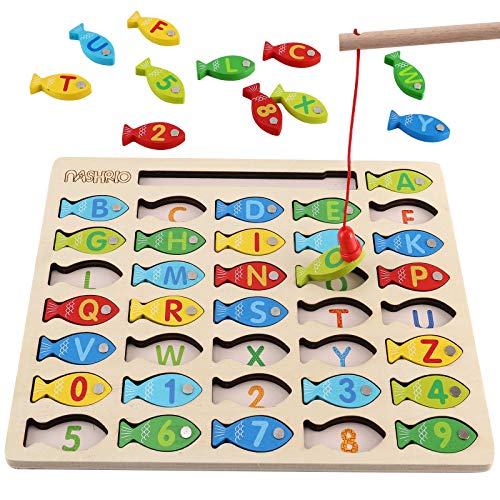
This wooden fishing game combines letters and numbers in a playful aquarium setting. Children use a magnetic pole to catch fish pieces, which supports hand-eye coordination, letter and number recognition, and color differentiation. The natural wood construction with a non-toxic finish prioritizes safety and durability for repeated use. The game’s simple mechanics allow siblings or peers to take turns, promoting social interaction and cooperative play.
Educational value includes early math and literacy foundations, along with fine motor development. The open-ended design invites experimentation, as kids can create their own challenges by sorting fish by color or by the letter or number on each piece. Its tactile nature also makes it appealing for kinesthetic learners who benefit from movement and manipulation during learning activities.
Buying Guide: Key Purchase Considerations And Comparisons
When choosing educational toys for a 3-year-old, consider the following factors to ensure meaningful learning and age-appropriate play:
- Learning goals: Match toys to foundational skills like letter and number recognition, vocabulary, fine motor skills, and counting.
- Engagement and pace: Look for replayable activities and multi-mode play to sustain interest without overwhelming the child.
- Safety and durability: Prioritize sturdy construction, rounded edges, and non-toxic finishes for frequent handling.
- Social play potential: Some toys support cooperative play or guided parent-child interactions, which can reinforce language and social skills.
- Accessibility and inclusivity: Consider tools that accommodate varied learning needs, including language support and sensory-friendly features.
- Mobility and space: For homes with limited space, compact options or multi-functional toys are practical choices.
- Progression: Select toys that offer scalable challenges or different play modes to grow with the child’s skills over time.
Comparing the five highlighted options reveals different strengths: LeapFrog’s activity book and LeapTop Touch emphasize literacy and role play with structured activities, while Airbition’s flash cards and MUONE’s busy book focus on vocabulary, color recognition, and fine motor skills. The magnetic fishing game from NASHRIO provides a tactile, multi-skill approach that blends math and literacy in a single play experience. Families can mix these toys to create a well-rounded play routine that balances cognitive development with imaginative play.