Best Building Kits for Teens: Engaging STEM Projects and Fun Engineering Challenges
Teens exploring science, technology, engineering, and mathematics can benefit from hands-on building kits that blend learning with play. The following five kits offer a variety of engineering concepts—from catapults and engines to solar-powered bots and programmable robots—designed to spark curiosity and develop critical thinking. Each product includes clear instructions, practical components, and real-world applications to keep teen learners motivated. The table below provides quick reference details for easy comparison.
| Product | Brand | Key Idea | Includes |
|---|---|---|---|
| NATIONAL GEOGRAPHIC Da Vinci Model Kit – Catapult Kit for Kids | Blue Marble | Functional medieval siege machines and projectiles | Ballista, Bombard, Catapult; 15 projectiles; simple laser-cut wood parts |
| Discovery Model Engine Building Kit | Discovery | Working four-cylinder engine with pistons and valves | Pulleys, belts, cranks, exhaust valves; LED lights; battery pack |
| Sillbird 12-in-1 Solar Robot Building Kit | Sillbird | Solar-powered robotics and renewable energy concepts | 12 models; solar power; 190 pieces; outdoor/indoor use |
| ELEGOO UNO R3 Smart Robot Car Kit V4 | ELEGOO | Intro to programming, electronics, and robotics | 24 modules; obstacle avoidance; line tracking; remote control |
| INSOON Mechanical Shark Building Set | INSOON | Movable mechanical shark with LED lighting | 687 pieces; gear system; display stand; LED light |
NATIONAL GEOGRAPHIC Da Vinci Model Kit – Catapult Kit

Overview: This kit assembles three functional machines—a Ballista, a Bombard, and a Catapult—to demonstrate early artillery concepts. It includes 15 projectiles and six targets to test aim and trajectory. The parts are laser-cut from wood, and the package provides clear, simple instructions that avoid the need for extra tools. The project duration for each model typically stays within a few hours, making it suitable for a focused weekend project or a series of build sessions.
What it teaches: Students explore simple machines, levers, geometry, timing, and mechanical advantage. The kit’s hands-on nature supports kinesthetic learners while illustrating historical engineering developments. The included targets and projectiles help learners quantify accuracy and adjust designs, reinforcing iterative thinking and measurement skills.
Why teens will benefit: The multi-model format encourages planning and experimentation. Learners can assess which machine design delivers the best range or stability and then compare differences in arm length, base support, and tension from rubber bands. This kit pairs well with lessons in physics and history-driven engineering narratives.
Discovery Model Engine Building Kit
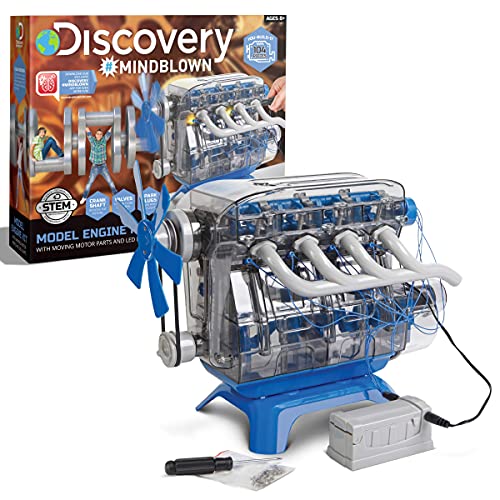
What’s inside and what it teaches
Designed to resemble a classic car engine, this kit features a four-cylinder setup with interactive cranks, pulleys, belts, and exhaust valves. Teens can observe the pistons moving, connect cables to a battery pack, and watch the engine fan respond. LED lights add a visual layer to the demonstration, making the learning experience engaging as the model “comes to life.”
Skills developed include mechanical reasoning, spatial thinking, and sequencing. The kit emphasizes how engines convert fuel or electrical energy into motion, a foundational concept in robotics and automotive technology. It also offers a hands-on pathway to discuss thermal dynamics and machine efficiency in a tangible way.
Why it benefits teens: This kit appeals to those curious about how machines work and those seeking a tactile way to translate theory into observable outcomes. It supports project-based learning goals and can be paired with basic electronics and control concepts to extend the activity beyond assembly.
Yutin 5 in 1 STEM Kits (Not Included in This Pick) — 5 in 1 Variant
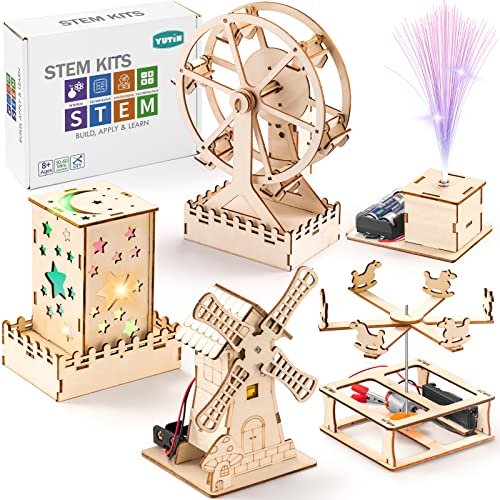
Note: This product line offers multiple themes and is included here for context. The five-in-one approach helps learners explore diverse mechanisms within a single project family, reinforcing consistency in engineering practice while expanding exposure to different devices and systems.
Sillbird 12-in-1 Solar Robot Building Kit

Overview: This solar-powered set includes a rotating Ferris wheel, a merry-go-round, a windmill, and other models that teach renewable energy concepts. With 190 pieces, it encourages kids to explore how solar energy can drive mechanical motion, and it supports outdoor use alongside indoor activities with adequate lighting.
Key learning points: Solar power basics, energy conversion, gear systems, and simple circuits. The kit also introduces design iterations as users experiment with sun exposure, angle, and shading to optimize performance. It’s a versatile option for science fairs or independent projects.
Why teens like it: The open-ended play encourages experimentation with real-world energy sources. It suits families seeking screen-free STEM activities and can be a stepping-stone toward more advanced robotics and environmental engineering topics.
ELEGOO UNO R3 Smart Robot Car Kit V4

Overview: This Arduino-compatible kit combines programming with electronics and robotics concepts. It includes 24 module parts such as obstacle avoidance sensors and line tracing modules, with compatibility for Android and iOS control via phones or tablets. It’s a practical entry point for novices to learn coding and circuit assembly in a cohesive package.
Learning outcomes: Teens practice programming logic, sensor integration, motor control, and remote operation. The kit supports experimenting with autonomous navigation, control algorithms, and hardware-software interaction, bridging hardware tinkering with software development.
Why it’s a good fit: The blend of hardware and software aligns with typical high-school STEM curricula, offering a hands-on path from basic electronics to more advanced robotics projects. It also scales with learners as they add more complex features and behaviors to the car.
INSOON Mechanical Shark Building Set

Overview: This semi-mechanical shark features a built-in gear system that drives head, body, and tail movements. The model lights up with a neon LED and includes a display stand, making it suitable as a decorative exhibit or a high-interest display piece for a science fair. It’s designed for older teens and adults who enjoy intricate mechanisms and mechanical symbolism.
Educational value: The gear mechanism demonstrates linkage, rotational motion, and the coordination of multiple moving parts. Lighting adds a visual dimension that helps learners observe the relationship between energy input and observed motion, reinforcing concepts of kinematics and systems thinking.
Why it appeals to teens: Beyond engineering fascination, the shark design offers a thematic, visually striking project that can serve as a conversation piece in classrooms or living spaces. It encourages patience and precision as learners align joints and gears for smooth movement.
Buying Guide: What to Consider When Choosing a Teen STEM Kit
- Learning goals: Identify whether the teen is more interested in mechanical engineering, robotics, electronics, or renewable energy, and select a kit that emphasizes those skills.
- Complexity level: For beginners, start with kits that emphasize clear instructions and gradual challenge. More advanced learners can handle multi-model kits or programmable systems.
- Hands-on vs. screen time: Solar-powered and mechanical kits provide tangible experiences, while programmable kits introduce coding and software concepts when ready.
- Materials and durability: Wood and sturdy plastics offer durability for repeated assembly and disassembly, which supports iterative learning.
- Scalability: Consider whether a kit can be extended with additional modules or projects to maintain engagement over time.
- Safety: Check for age recommendations and small parts where relevant, especially for younger teens or those with sensitivities to certain materials.
- Educational value: Look for kits that explicitly teach STEM concepts, include clear explanations, and provide opportunities for experimentation and measurement.
- Project duration: Some kits are quick-build activities, while others span multiple sessions. Align with available time and interest.
- Support and community: Availability of tutorials, forums, or creator support can help troubleshoot and inspire deeper exploration.
These considerations help ensure a kit’s value remains high as teens develop new skills and pursue more challenging projects. The selected five demonstrate a diverse mix of hands-on mechanics, renewable energy, robotics, and programmable electronics, offering multiple angles on modern STEM education.