Best Robot Building Kits for Kids: Hands-on STEM Fun
Families looking to inspire young engineers can explore a range of robot-building kits designed for creativity, problem-solving, and screen-free play. This guide highlights five well-rounded options that teach fundamentals of STEM, from solar power to programmable controls. Each kit supports hands-on learning, collaboration, and long-term interest in robotics for kids ages 8 and up.
| Product | Brand | Why It Stands Out |
|---|---|---|
| BeAndge STEM Kits – 6 Set | BeAndge | Multiple builds including solar and wind cars, obstacle-avoidance robot, and more for diverse learning experiences. |
| Sillbird Robot Building Kit with Remote Control – 5-in-1 | Sillbird | App and remote control options with basic programming and precise movement for interactive play. |
| Sillbird 12-in-1 Solar Robot Building Kit | Sillbird | Solar-powered construction with water/land mobility and a broad set of parts for experimentation. |
| Bottleboom 13-in-1 Solar Power Robots | Bottleboom | Expanded solar robot lineup with easy disassembly and hands-on exploration of solar energy. |
| Henoda Robot Toys – APP/Remote Control | Henoda | 468+ pieces, multiple control modes, and engaging transformations to boost fine motor skills and imagination. |
BeAndge STEM Kits – 6 Set STEM Toys

Includes five distinct kits designed to build a solar powered car, wind-powered car, obstacle avoidance robot, a transmission tank, and a glider. This set supports family STEM activities and classroom projects, with a gift-box presentation that makes it ideal for birthdays and holidays. Batteries are required but not included, and the set encourages kids aged 8-12 to explore mechanical and electrical concepts through hands-on assembly.
Sillbird Robot Building Kit with Remote Control

This 5-in-1 programmable robot set blends hands-on building with digital control. It features dual control modes—Bluetooth app and remote—plus basic programming, pathing, and precise movement. It’s suitable for kids aged 8 and up, fostering creativity, problem-solving, and STEM curiosity without requiring screens as the sole focus.
Sillbird 12-in-1 Solar Robot

This solar-powered kit offers a 12-in-1 building experience with 190 pieces, letting kids construct robots that operate on solar energy. It emphasizes renewable energy concepts and hands-on engineering, with an emphasis on outdoor or well-lit indoor play. The kit supports safe play with non-toxic materials and a focus on durability for growing builders aged 8-13.
Bottleboom 13-in-1 Solar Robots

The 13-in-1 kit includes gears, plates, tires, and shafts to build multiple solar-powered robots that can move on land or water. Clear instructions guide children through step-by-step builds, with easy disassembly for exploring new configurations. Emphasizes safe, non-toxic materials and encourages learning through play for ages 8-12 in a family or classroom setting.
Henoda Robot Toys with APP or Remote
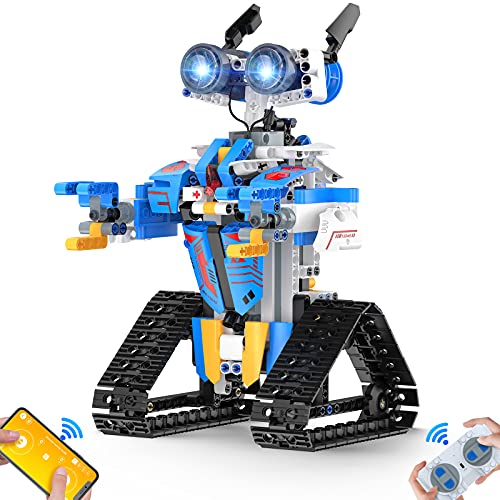
Henoda offers a 468+ piece build with app Bluetooth control, plus a 2.4GHz remote. Features include multiple modes (path, voice, gravity sensor, STEM programming), 360-degree rotating joints, glowing eyes, and transforming robot bodies. This kit supports extensive hands-on learning, fine motor development, and imaginative play for ages 8-16 and up, with a strong emphasis on coding fundamentals and modular design.
Educational Insights Design & Drill Robot

Although slightly different in focus, this robot kit doubles as a tool-based construction set for toddlers and younger kids to practice fine motor skills and basic STEM concepts. The design-and-build approach helps kids decorate and assemble a snap-and-screw robot, fostering early STEM education, problem-solving, and imaginative play for ages 3 and up.
Buying Guide
- Age and skill alignment: Choose kits labeled for appropriate age ranges to ensure the projects are challenging but not frustrating. For newer builders, start with simpler 5- or 6-piece kits before advancing to 12-in-1 or USB/app-driven systems.
- Power source and environment: Solar-powered kits promote environmental awareness and outdoor play, while battery- or electricity-powered options work well indoors. Consider lighting conditions and space when selecting a kit.
- Control and programming: Remote control and app-based kits offer immediate hands-on interaction, while programmable kits introduce coding concepts and sequencing logic, building foundational computational thinking.
- Materials and safety: Look for non-toxic materials, durable plastics, and smooth edges. Disassembly should be straightforward for ongoing experimentation and safe storage.
- Educational value: Favor kits that encourage problem-solving, design iteration, and understanding of basic physics (motion, gears, energy sources) in addition to basic robotics concepts.
- Future growth: Some brands offer expansion sets or additional models that complement the core kit, helping extend learning over months or years as skills develop.
- Gift suitability: If purchasing as a gift, consider packaging, presentation, and the potential for family STEM activities or classroom projects to maximize long-term engagement.